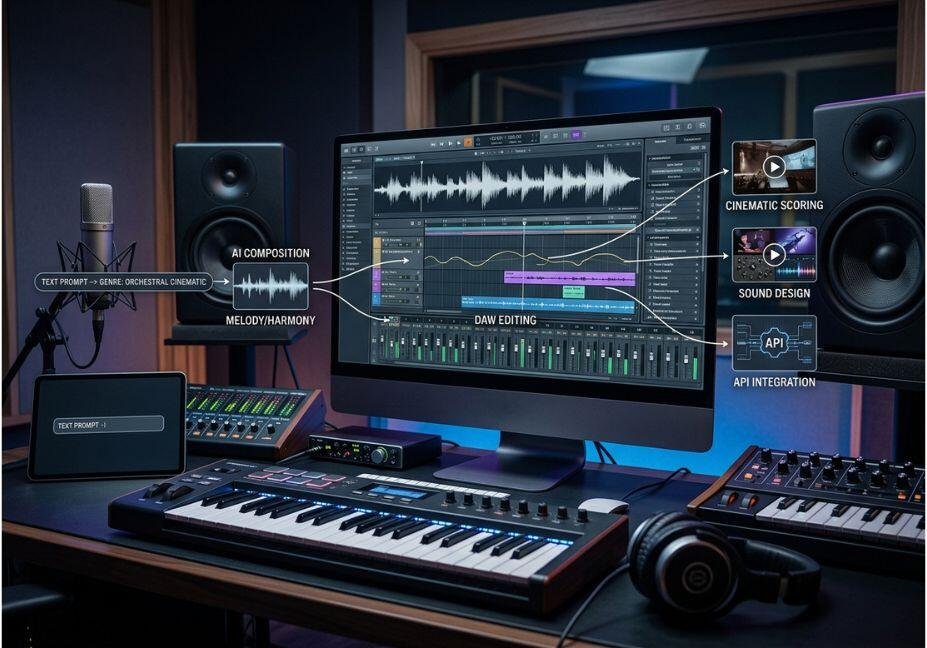
The process of generating music with AI is more than simply writing “create a cinematic piece of music” into a chatbot and accepting the first result it gives.
The most advanced tools for music creation using AI in 2026 are far more different because of something other than just the quality of the produced sound: the level of control you are having over the music even after its creation.
Suno and Udio are the two most successful programs when it comes to music generation while AIVA is still one of the best for MIDI compositions. Other platforms are focused on background music, sound design, APIs, and production. Recent research from Meta and Google shows what had triggered such rapid progress of the technology as modern systems can create the music based on text, melody, and other signs and do not treat it as some kind of unified audio source.
For musicians, producers, developers, and AI creators, the question is not only about what program is the best.
What Is an AI Music Composition Tool?
An artificial intelligence tool for creating music takes advantage of different machine learning algorithms for creating or supporting various musical features such as tone, structure, rhythm, diversity of sounds, singing, and mixing music.
There are several main methods.
1. The text-to-music approach allows converting the desired text description into its own sound.
2. In other approaches, more structure is required; therefore, there may be specific limitations like melody, reference notes, sections, and MIDI.
This differentiation is important because the terms “AI music generator” can be used in different contexts.
Music technologies have demonstrated that the research of systems such as MusicGen is possible because they are able to generate music based on user’s instructions and melody characteristics, whereas, the MusicLM experiment opened the doors to the hierarchical technique of music generation.
How Does AI Music Generation Actually Work?
Modern AI music systems can represent music as sequences of learned tokens or other compressed representations.
For example, MusicGen uses a language-model-style approach over compressed discrete music representations. Instead of predicting raw audio sample-by-sample, the model works with a more manageable representation of musical information.
Older research such as OpenAI’s Jukebox used hierarchical VQ-VAE representations and autoregressive Transformers to generate raw-audio music, including singing.
At a simplified level:
- Prompt conditioning describes the desired music.
- The model maps the request into learned representations.
- The generation model predicts musical/audio tokens.
- A decoder converts those representations into audible sound.
- Post-processing produces the final track.
Modern commercial systems hide most of this pipeline behind a prompt interface.
The result is convenient, but it can also hide important limitations: long-range structure, repetition, artifacts, weak transitions, vocal inconsistencies, and limited deterministic control.
Why quality of the prompt is very important
An unclear prompt like:
“Create a reflective rock song.”
generates much confusion.
However, a more detailed prompt can clarify
. Genre
. Pace
. Instruments used
. Vocal type
. Intensity
. Tonality
. Arrangement of the song
. Style of the song
Tip: Consider the music challenge as a brief for production instead of a line about emotion in lyrics.

The 7 Best AI Music Composition Tools in 2026
The right tool depends heavily on what you’re composing. Current comparison testing consistently separates full-song generation, production control, background music, cinematic scoring, and commercial/API workflows rather than treating them as one category.
| Tool | Best use | Composition control | Strongest advantage | Main limitation |
| Suno | Full songs + vocals | High | Fast complete-song generation | Less deterministic than a traditional DAW |
| Udio | Iterative composition | High | Section-level experimentation | Current platform/download constraints require checking |
| AIVA | Cinematic/orchestral | High | Composition + MIDI workflow | Less suited to some modern genres |
| ElevenLabs Music | Commercial/API workflows | High | Structured composition plans | Better suited to programmatic workflows |
| Soundraw | Creator background music | Medium | Fast customizable soundtrack generation | Less compositional freedom |
| Stable Audio | Sound design/instrumentals | Medium-High | Audio-focused generation | Not the strongest full-song workflow |
| Mubert | Adaptive/API music | Medium | Programmatic and continuous music | Limited traditional composition control |
1. Suno — Best Overall for Complete AI Songs
Suno represents the best default option if you want to turn your textbook concept into a recognizable song fast.
Its main benefit is its extensive capabilities: the vocals, instruments, lyrics, arrangement, and production are all performed in the same generative process.
Recent 2026 comparisons highlight Suno as being constantly among the leaders in fully represented vocal music creation technologies.
Best suited for:
. Songwriters working on demos
. Songs with complete vocal lines
. Quick idea generation
. Creation of social media content
. Experimentation over different music genres
Be aware of:
Lower determinism in terms of arrangement control compared to DAW
Variability of generated product
Commercial rights determined by the specific terms of your plan
Suno’s given terms specify some significant differences between paid and free/basis outcomes and state that it cannot guarantee that copyright will be established for every generated product.
In conclusion, if speed is your major point of interest, choose Suno.
2. Udio – Ideal for Progressive Music Control
Udio stands out particularly for its usefulness in getting creative with musical ideas instead of merely accepting one-off compositions.
Historically, Udio’s workflow has focused on the use of extensions, remixing, influences, song lyrics changes, and more to evolve the music project. It also allows uploading your own audio files to work with – be it through extending, remixing, stylizing, or inpainting, assuming you have the legal rights to do so.
This makes the workflow resemble:
create → evaluate → modify → extend → recreate
instead of:
input → completed song
Recently, the licensing conditions and its platform situation have been changing for Udio due to its move towards licensed music solutions, so fellow users will have to check the latest information on the terms of use.
Suitable for:
. Producers
. Experimenting with various styles
. Works developed iteratively
. Audio-to-audio projects
. Section-wise development
In short, Udio is an interesting choice for those who want to be in charge of the process even if it’s not as straightforward.
3. AIVA – The Best Cinematic and Orchestral Composition Tool
AIVA targets a unique segment of the market. And instead of being a direct rival to those software tools that create vocal melodies, it specializes in composing music for instrumentation, film scoring, orchestration, and similar areas.
Therefore, the main target groups are:
1. Film composers
2. Game developers
3. Companies that create trailers
4. Cinematic YouTube channels
5. Musicians interested in creating music compositions
The most important difference is in how the generated music is related to the DAW. Indeed, sometimes a creative workflow that provides you with MIDI data or structured music files can be more beneficial for a composer than a perfect audio file that is difficult to modify
4 . ElevenLabs Music — Ideal for Structured and Programmatic Generation
In 2026, ElevenLabs made a major overhaul in its music features by launching Music v2 with structured composition methods.
Rather than using a single prompt, Music v2 utilizes the GenerationChunk and AudioRefChunk methods that empower one with much more specific control over composition structure and tone.
This is particularly appealing for application developers.
Imagine a needs to create:
A 15-second introduction
A 45-second main part
A transitional element
A 30-second conclusion
Structured representation of compositions makes it much easier to facilitate its integration into software than a single opaque generation request.
Best for:
. Developers
. Content creation platforms
. Automated content production pipelines
. Structured music compositions
. API-supported generation
Architect’s perspective: This is where AI music can turn into something potentially more than just a consumer-oriented generator.
Soundraw: The Ideal Software for Music Creation
Soundraw becomes relevant for you if you’re not planning to create a music album with artificial intelligence.
However, it can be useful for such tasks as movie or video making:
– Youtube
– Podcaster
– Advertiser
– Creator of company video
– Social media content creator
When using Soundraw, your focus should be laid on how appropriate your background music is for the video, rather than on its artistic uniqueness.
Specifically, you need to consider:
– Duration
– Impact
– Vibe
– Genre
– Music instruments
– Edits
6. Stable Audio — Ideal for Sound Creation and Instrument Generation
Stable Audio falls more towards the audio-creation and sound-design area of the spectrum.
Making it suitable for:
. Instrumental sounds
. Electronic sounds
. Sound effects
. Experimental sounds
. Loops
. Production experimentation
The important distinction is that the “music generator” may not necessarily generate a complete song in the form of a verse and chorus.
Generating a convincing sound texture can be more important for the AI app, game, or multimedia project than a whole song.
Pro Tip: make sure to separate evaluating the generation of composition and audio asset generation because they are different problems.
7. Mubert – Most Suitable for A.I Specific Music Development-Driven Sector
Mubert is particularly useful when music has become a part of software.
a developer may require music that will perfectly adapt to:
– The atmosphere of an application
– The stage of a game
– The features of a live broadcast
– The type or direction of a workout
– The content of a video
– The content of an online feed
In such cases, API features and adaptive characteristics are much more necessary than traditional writing processes.
Best for: 5ware developers, apps, streaming channels, and systems requiring continuous background music.
In conclusion: Mubert is best perceived as musical infrastructure rather than an alternative to a conventional music composer.
Which AI Music Tool Should You Choose?
Instead of asking which model is “best,” map the tool to the production problem.
| Your goal | Best starting point | Why |
| Complete song with vocals | Suno | Fastest route from idea to finished track |
| Detailed iteration | Udio | Stronger emphasis on developing generated material |
| Film/game score | AIVA | Orchestral and structured composition workflow |
| API-based generation | ElevenLabs Music | Structured composition plans |
| YouTube background music | Soundraw | Creator-oriented workflow |
| Experimental audio | Stable Audio | Stronger sound-generation orientation |
| Adaptive application music | Mubert | Programmatic use cases |
The key insight is that output quality is only one variable.
How to Get Better Results From AI Music Composition Tools
Use an iterative composition loop instead.
Step 1: Identify musical requirements
Note down:
. Style
. Beat speed
. Instruments
. Vocal features
. Emotional state
. Plan of the piece
. Duration of the track
Step 2: Separate composition from production
First, check if your melody, harmony, rhythmic structure, and structure work.
Then check:
. Mixing
. Mastering
. Equalization
. Compression
. Spatial effects
Step 3: Create music variability
Do not think that the first generation is successful.
Generate more options and compare:
. The strength of the hook
. Memorability of the chorus
. Arrangement
. Vocals
. Variability of the dynamics
. Artifacts
Step 4: Leave the best musical idea
You don’t have to use the entire best-sounding track.
You may have:
. Track A with the best-sounding chorus
. Track B with the best drums
. Track C with the best sounding intro
Use the production process to synchronize all the ideas whenever it is possible.
Step 5. Use the DAW when you need to work with accuracy.
AI generation is fantastic in terms of creativity.
However, DAW is the best when you need to be precise regarding:
. Timing
. MIDI
. Automation
. Mixing
. Arrangement
. Instrument replacement
. Mastering
Common AI Music Composition Failure Modes
The most advanced AI systems for music composition still have their pitfalls.
1. Repetition
Systems are able to create high-quality sections but typically lack in developing music from an overall perspective.
2. Arrangement drift
Musical compositions may begin with the structure that was originally meant, only to deviate from it later.
3. Vocal artifacts
It is not uncommon for the created voice to have issues of pronunciation, unnatural intonation, and changing timbre from one fragment of music to another.
4. Instrumental artifacts
Synthetic music can sometimes produce artifacts that would not be noticeable during a casual listening.
5. Lack of specificity
The program may manage to be within the parameters of a broad genre, but forget about the specifics of the composition.
6. Legal issues
Just because the track works, it does not mean that it is similar to a traditionally produced track in terms of the legality of its usage.
Comment by the creator:
There are three questions to ask yourself separately:
. Can it be produced?
. Can I access it?
. Do I have the rights for my purposes?
They are not the same questions.

FAQ — People Also Ask
What is the best AI music generator for 2026 going to be?
While Suno might be the top preferred option for general purpose original song creation with vocals, Udio presents a viable alternative if most important thing for you is the level of control you enjoy. AIVA thrives in projects that need cinematic and orchestral styles but it lacks expertise compared to other solutions, APIs, and structured production flows.
How does AI music generation work?
AI generators of music are programmed to figure out connections between musical or sonic representations and information related to any conditions such as written text, melody or other sounds. For example, MusicGen is based on compressing discrete representations of music while MusicLM implies using sequence to sequence hierarchical technology for text-based generation.
Can AI music generation tools make full songs featuring vocal parts?
Yes! With the help of today’s systems it’s very easy to create songs with all necessary components vocals, instruments, arrangements and even lyrics.
Which AI music tool allows for the greatest amount of creative control over music developments?
Udio and systems similar to it would be better for hosting experiments and iterations. On the contrary, AIVA would be better for use in systems that are concentrating more on music composition. New AI music tools that give more freedom of manipulation rather than generating the output immediately are the ones that employ audio references.
Can one make any use of AI music commercially?
Some AI-generated music can be commercially used; however, it all depends on a platform. Commercial prices, ownership, copyright laws, rules of usage of the uploaded materials, and rules of distribution vary. It is always necessary to check current conditions before selling a track.
Is AI music replacing the traditional music production?
Not really. AI is becoming better and more efficient in creating compositions and making music in general, but traditional DAWs are still providing much better management over arrangement, MIDI technologies, mixing, and performance.
Conclusion
“The finest AI music composing technologies in 2026 aren’t determined by which can make the best demo anymore. What sets them
apart is how much control one can exert over the process.
Suno is best suited for whole songs or vocals production, Udio balances out the process of creation, AIVA is useful for composing structured pieces of music and programs like ElevenLabs Music, Soundraw, Stable Audio, and Mubert have their niches when it comes to using them for APIs, background music, sound design, or adaptive media.
From the point of view of professional creators, the right architecture in this case is the following, in most cases:
AI Generation → selection by a human operator → structural editing by a human → final mix by means of a DAW → licensing verification.
The next stage would be the creation of AI systems not just capable of generating music but planning, evaluating, improving, and composing it.
Remember to visit agentiveaiagents.com for more intensive studies of the influence of AI or LLM on workflow.