AI music production has moved beyond novelty prompts that generate a short melody. In 2026, producers can generate full arrangements, separate stems, transform audio, create cinematic scores, automate mastering, and even run open-weight models locally.
But there is a catch: the best AI music production tools are not necessarily the best AI music generators.
A full-song generator can be excellent for ideation while being frustrating for detailed mixing. A stem separator may be far more valuable to a producer working inside Ableton or Logic than another text-to-music platform. Likewise, an AI mastering service solves a completely different bottleneck.
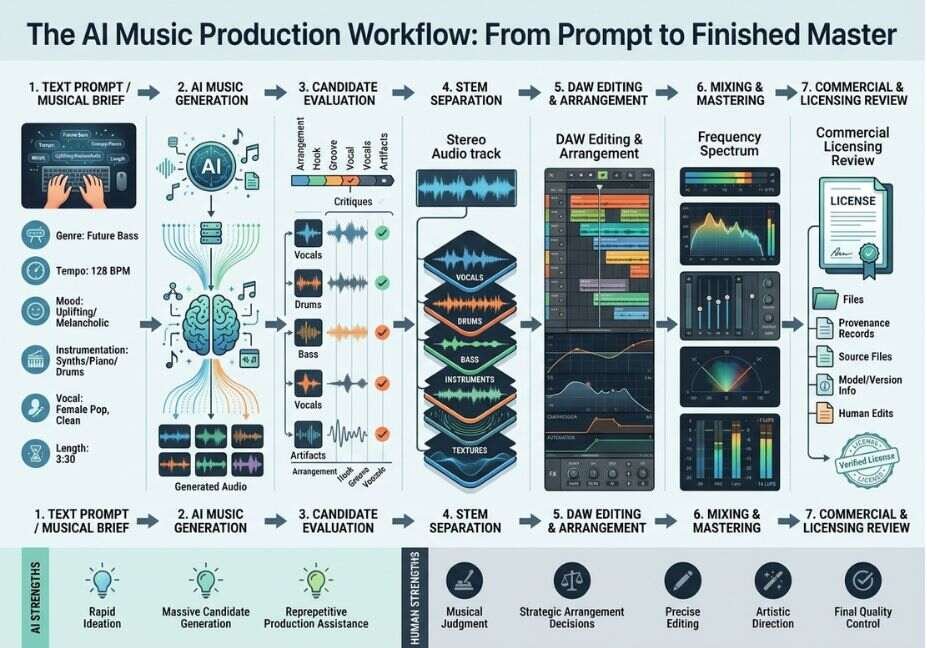
The strongest workflow therefore looks less like “type a prompt and release the result” and more like a production pipeline: generate → inspect → separate → edit → mix → master.
That distinction matters because modern music models such as MusicGen demonstrate how language-model-style architectures can operate over compressed musical representations rather than ordinary text tokens.
What Is AI Music Production?
AI music production uses machine-learning models to assist or automate parts of the musical creation process, including composition, arrangement, sound generation, stem extraction, vocal processing, mixing, and mastering.
Modern text-to-music systems convert natural-language descriptions into musical audio. Research such as MusicLM showed that hierarchical models could generate high-fidelity music conditioned on text and melody, while MusicGen demonstrated a more streamlined Transformer-based architecture.
For producers, the important distinction is between:
- Generative tools create new songs, loops, or sound effects.
- Transformation tools modify existing audio.
- Production assistants help with mixing, mastering, arrangement, or cleanup.
- Open models allow greater control, customization, and potentially local inference.
- DAW-integrated tools fit directly into an existing production workflow.
The practical question is therefore not “Which AI makes the best music?” but “Which production bottleneck am I trying to remove?”
Technical Note: Music generation models commonly work with compressed representations of audio. The model does not necessarily “think” in terms of raw WAV samples; it predicts or transforms learned representations that are subsequently decoded into audio.
Best AI Music Production Tools in 2026
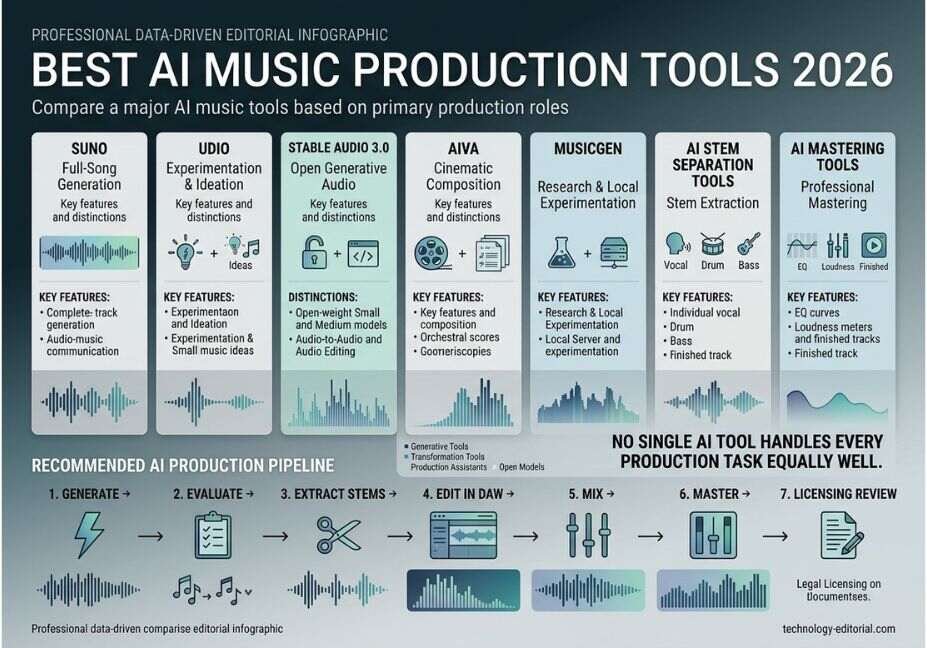
The current landscape is easier to understand when tools are grouped by production task rather than ranked as one universal list.
| Tool / Model | Best Use | Strength | Main Limitation |
|---|---|---|---|
| Suno | Full songs and rapid ideation | Complete vocal + instrumental generation | Less granular than a traditional DAW |
| Udio | Iterative song experimentation | Strong musical detail and control | Current export workflow has important limitations |
| Stable Audio 3.0 | Open generative audio | Open weights, audio-to-audio, longer generation | More technical setup for advanced use |
| AIVA | Cinematic composition | Structured instrumental scoring | Less suited to modern vocal production |
| Eleven Music | High-quality generative compositions | Strong music-generation workflow | Product capabilities continue evolving |
| MusicGen | Research/local experimentation | Open research ecosystem | Less turnkey than commercial platforms |
| Stem separation tools | Remixing and production | Extract vocals, drums, bass, etc. | Artifacts can remain in difficult mixes |
| AI mastering tools | Finalization | Fast loudness and tonal starting points | Human mastering still provides deeper judgment |
The important shift in 2026 is that AI music is becoming a multi-tool workflow rather than a single-product category.
Suno: Best for Full-Song Ideation
Suno remains one of the strongest choices when the objective is to move from an idea to a complete musical sketch quickly.
Its major advantage is breadth: vocals, instrumentation, lyrics, arrangement, and production can be generated together. Suno has also been expanding toward a more complete production environment through Studio and stem-oriented features.
Its v5.5 release introduced capabilities including Voices, Custom Models, and My Taste, while the company has announced a new generation of music models being developed with the music industry.
Best workflow: generate several concepts → choose the strongest arrangement → export usable elements → finish the production manually.
Pro Tip: Don’t repeatedly regenerate the same prompt. Change one variable at a time—tempo, instrumentation, vocal character, structure, or genre—to understand which conditioning factor is affecting the output.
Udio: Best for Experimentation and Iteration
Udio is particularly interesting for producers who value experimentation and iterative generation.
However, workflow constraints matter. Udio’s own February 2026 help documentation states that audio, video, and stem downloads were disabled following changes associated with its Universal Music Group partnership.
That makes Udio potentially useful as a creative exploration environment, but producers should verify current export and licensing conditions before building a production pipeline around it.
Architect’s Note: A technically impressive generator is not automatically a good production tool. Exportability, stems, file formats, revision control, and licensing can matter more than marginal differences in audio quality.
Which AI Tool Is Best for Professional Music Production?
For professional work, choose according to the production stage.
1. Best for songwriting and demos: Suno
Use it when you need:
- Fast song concepts
- Vocal demos
- Arrangement references
- Genre experiments
- Topline inspiration
2. Best for open generative audio: Stable Audio 3.0
Stable Audio 3.0 is particularly notable because Stability AI released small and medium models with open weights. The system supports variable-length generation, audio editing, and audio-to-audio workflows. Stability AI also states that the models were trained using licensed and Creative Commons data.
That makes it particularly interesting for developers and technical producers who want to experiment beyond a closed web application.
3. Best for cinematic composition: AIVA
AIVA fits workflows where orchestral structure, atmosphere, and cinematic scoring are more important than realistic pop vocals.
It is particularly relevant for:
- Film scoring
- Game music
- Ambient compositions
- Classical-inspired arrangements
- Background scoring
4. Best for production assistance: AI stem and mastering tools
If you already have strong musical ideas, another song generator may not be what you need.
Stem separation and AI mastering can have a much higher practical ROI because they accelerate tasks that traditionally consume significant editing time.
Did You Know? Stable Audio 3.0 supports generations exceeding six minutes on its medium and large variants, while its small model targets full music composition on consumer devices.
How AI Music Generation Actually Works
Modern AI music systems borrow several ideas from generative AI for language and images, but audio introduces additional complexity.
A simplified pipeline looks like this:
Text prompt
    ↓
Text / semantic representation
    ↓
Music generation model
    ↓
Compressed audio / latent representation
    ↓
Decoder / vocoder
    ↓
Stereo audio
    ↓
DAW editing
    ↓
Mix + mastering
MusicGen is a useful research example. Rather than requiring multiple cascading models, its architecture uses a single Transformer language model operating over several streams of compressed discrete music representations.
MusicLM took another approach, framing music generation as a hierarchical sequence-to-sequence problem and conditioning generation on text and melody.
These approaches explain why prompt quality alone does not determine output quality.
The model’s representation, conditioning method, training data, context handling, sampling process, and decoding pipeline all influence the result.
Technical Note: Think of a text prompt as a high-level conditioning signal not a complete musical score. “Dark cinematic techno, 128 BPM” specifies intent, but it does not guarantee exact bar structure, chord voicings, transient placement, or mix decisions.
How to Build an AI-Assisted Music Production Workflow
A practical workflow should preserve human control at the stages where musical judgment matters most.
Step 1: Define the musical objective
Before generating anything, specify:
- Genre
- Tempo
- Mood
- Instrumentation
- Vocal requirements
- Track length
- Intended platform
- Commercial-use requirements
Step 2: Generate multiple candidates
Do not treat the first generation as the final composition.
Generate several variations and evaluate them for:
- Arrangement
- Hook strength
- Groove
- Vocal phrasing
- Instrument separation
- Repetition
- Artifacts
Step 3: Extract usable material
Take only the elements that actually improve your track.
That could mean:
- Vocal ideas
- Drum patterns
- Chord progressions
- Bass concepts
- Textures
- Melodic phrases
Step 4: Move into your DAW
This is where the workflow becomes production rather than generation.
Use your DAW to control:
- Timing
- Gain
- EQ
- Compression
- Automation
- Arrangement
- Stereo imaging
- Effects
Step 5: Mix and master
AI mastering can provide a useful starting point, but listen critically for excessive loudness, harsh high frequencies, pumping compression, or loss of dynamics.
# Conceptual AI-assisted production pipeline

prompt =
    "genre": "melodic techno",
    "tempo": 124,
    "mood": "dark, atmospheric",
    "elements": ["analog synth", "deep bass", "female vocal"]


drafts = music_model.generate(prompt, variations=8)

best = select_by_human_review
    drafts,
    criteria=["arrangement", "hook", "vocal_quality", "artifact_level"]


stems = stem_separator.extract(best)

mix = daw.process
    stems,
    eq=True,
    compression=True,
    automation=True


master = mastering_engine.process(mix)

export(master, format="WAV")
The code illustrates the workflow architecture, not a vendor-specific API.
Pro Tip: Use AI to increase the number of creative candidates you can evaluate, not to eliminate evaluation itself. Selection is often where the producer’s taste creates the biggest quality difference.
Common Failure Modes in AI Music Production
AI-generated audio still has predictable weaknesses.
1. Repetitive structure
Models may produce convincing sections but struggle with long-range musical development.
Fix: Use generated material as a structural reference and rebuild transitions manually.
2. Vocal artifacts
Synthetic vocals can contain unnatural consonants, unstable phrasing, or excessive processing.
Fix: Separate the vocal, edit problematic phrases, or replace the section with a human performance.
3. Muddy mixes
Full-song generators may combine many elements into a dense stereo result.
Fix: Work from stems whenever possible instead of treating the generated stereo master as finished.
4. Weak instrumental separation
Stem extraction is not perfect. Bleed and spectral artifacts can remain.
Fix: Use high-quality source material and inspect isolated stems before committing them to a commercial mix.
5. Licensing uncertainty
Commercial usage rights and copyright ownership are different questions.
A platform may grant you contractual permission to use an output while copyright law may treat purely machine-generated material differently.
Technical Disclaimer: AI music product features, model versions, export policies, pricing, and commercial-use terms change rapidly. Verify the current license and plan terms immediately before releasing or monetizing AI-generated music.
Can AI Music Be Used Commercially?
Yes, AI-generated music can be used commercially in some circumstances, but the answer depends on both the platform’s license and the copyright rules applicable to your jurisdiction.
Do not assume that “commercial use allowed” means you automatically possess exclusive copyright in every element.
Check:
- Whether your subscription grants commercial rights.
- Whether the output was generated under a qualifying paid plan.
- Whether uploaded material was legally yours to use.
- Whether voice or likeness rights are involved.
- Whether your jurisdiction recognizes copyright in the resulting material.
- Whether platform terms changed after generation.
This distinction is becoming increasingly important as AI music companies move toward licensed training arrangements.
For developers, provenance tracking should become part of the workflow: retain prompts, source files, model/version information, subscription status, and human edits for commercially important projects.
Open Models vs Closed AI Music Platforms
The choice between open and closed systems mirrors the broader AI ecosystem.
| Factor | Closed Platform | Open / Self-Hosted Model |
| Setup | Very easy | More technical |
| Hardware | Usually unnecessary | Often important |
| Customization | Limited | Much higher |
| Model access | Provider-controlled | Potentially direct |
| API integration | Often available | Highly flexible |
| Reproducibility | Can change with updates | More controllable |
| Maintenance | Provider handles it | You handle infrastructure |
| Research potential | Limited | High |
Stable Audio 3.0 is particularly relevant here because Stability AI released open-weight models and documentation for customization, including LoRA-based training workflows.
For AI developers, this changes the question from “Which website makes the best song?” to “Which model can I integrate into my production system?”
What Developers and Producers Are Saying
Developer communities increasingly discuss AI music as a workflow problem rather than simply a generation problem.
Recent community discussions around local music models mention systems such as Stable Audio and ACE-Step, while users also highlight persistent challenges involving repetition, model control, and editing.
That feedback aligns with the broader engineering reality: generation quality is improving quickly, but controllability remains a major differentiator.
A producer may prefer a slightly less impressive model if it provides:
- Better stems
- Better editing
- Repeatable generation
- Local inference
- API access
- MIDI support
- Better provenance
- More predictable licensing
Architect’s Note: For production systems, optimize for controllability and repeatability—not demo quality. A spectacular generation that cannot be edited, exported, reproduced, or licensed may have less practical value than a slightly weaker but controllable model.
FAQ: Best AI Music Production Tools 2026
What is the best AI music production tool in 2026?
Suno is one of the strongest choices for complete song generation and rapid ideation, while Stable Audio 3.0 is especially compelling for open generative audio and technical experimentation. Producers who already work heavily in a DAW may get more value from AI stem separation, MIDI generation, or mastering than from another full-song generator.
Is Suno better than Udio for music production?
Neither is universally better because they optimize different parts of the creative workflow. Suno is particularly strong for quickly generating complete songs and ideas, while Udio has been valued for iterative experimentation and musical detail. Current export and subscription conditions should be checked before selecting either for a production pipeline.
Can AI-generated music replace a DAW?
No, not for most professional workflows. Generative platforms can accelerate composition and arrangement, but a DAW still provides detailed control over timing, MIDI, audio editing, automation, effects, mixing, and mastering. The strongest approach is usually AI generation followed by deliberate DAW-based editing.
Is Stable Audio 3.0 open source?
Stable Audio 3.0 includes open-weight Small and Medium models rather than being simply a traditional closed music-generation service. Stability AI says these models support local experimentation and were trained on licensed data, while the Large model is positioned for API and enterprise use.
Can AI music be copyrighted?
AI-generated music and copyright ownership are not the same thing. Platform licensing determines what you are contractually permitted to do with an output, while copyright protection depends on applicable law and the degree of human creative authorship. Treat commercial rights and copyright registration as separate checks.
What is the best AI workflow for professional producers?
Use AI for ideation and repetitive production tasks, then return control to the DAW. A practical pipeline is generation → candidate selection → stem separation → arrangement/editing → mixing → mastering → licensing/provenance review. This preserves human musical judgment while reducing repetitive work.
Conclusion
The best AI music production tools 2026 are not necessarily the platforms producing the most impressive one-click songs.The better approach is to build a workflow around production bottlenecks.
First, use full-song generators such as Suno when you need rapid ideation, demos, arrangements, or vocal concepts.
Second, use specialized systems such as Stable Audio 3.0 when open models, audio transformation, local experimentation, or developer integration matter.
Third, keep the DAW at the center of serious production. AI can generate possibilities, but arrangement decisions, editing, mixing, artistic direction, and final quality control still benefit enormously from human judgment.
AI music is becoming a production layer rather than a standalone application. The producers who get the most value will be the ones who treat generation, retrieval of useful musical elements, editing, and mastering as a connected pipeline not as a competition to find one magic button.Bookmark this guide and use the workflow above as a framework for evaluating new AI music models as they arrive.