
You can rank #1 for a keyword and still be invisible. That’s the uncomfortable reality of Google’s AI Overviews. A generated answer sits above the ten blue links, and unless your page is one of the sources it cites, your ranking barely matters. In fact, Google Search Console still doesn’t isolate this traffic cleanly. As of mid-2026, it folds AI Overview impressions into the standard “Web” search type, so there’s almost no native way to separate a real ranking win from an AI citation. That’s exactly the gap a proper google ai overviews tracking tool is built to close.
For teams already building agentic workflows, this problem should feel familiar. After all, tracking AI Overviews is really a small retrieval-and-monitoring loop query, check, log, alert not unlike the tool-use loops covered elsewhere on this site. So instead of just listing paid trackers, this guide also shows how to build a lightweight one yourself.
What Is a Google AI Overviews Tracking Tool?
A google ai overviews tracking tool is software that repeatedly checks Google search results, detects whether an AI Overview appears, and records whether your domain is cited as a source. Unlike a traditional rank tracker, which only reports blue-link position, this kind of tool measures citation presence whether the model actually used your content to ground its answer. That distinction matters because, as Search Console’s generative-AI reporting documentation confirms, AI feature impressions are folded into the standard Performance report by default, with no simple way to isolate them.
How Does an AI Overview Tracker Actually Work?
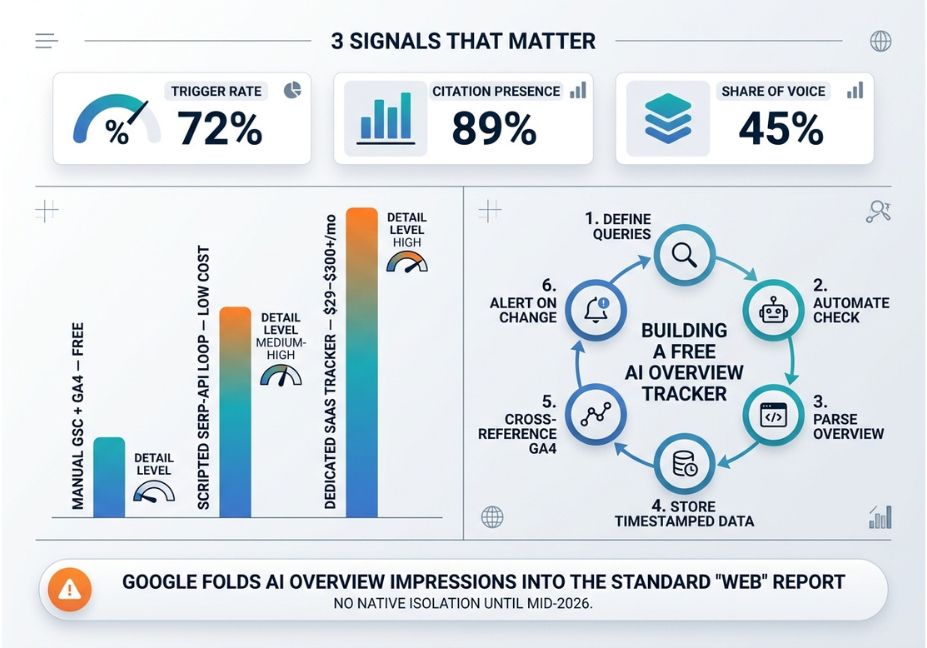
Three signals matter most, and most tools only report one or two of them:
- Trigger rate how often a keyword produces an AI Overview at all
- Citation presence whether your domain is one of the cited sources
- Share of voice how your citation frequency compares to competitors on the same query set
Pro Tip: Don’t treat a single day’s citation drop as a failure. Because AI Overviews are volatile by nature, it’s better to use a 7-day rolling average before concluding you’ve actually lost a citation.
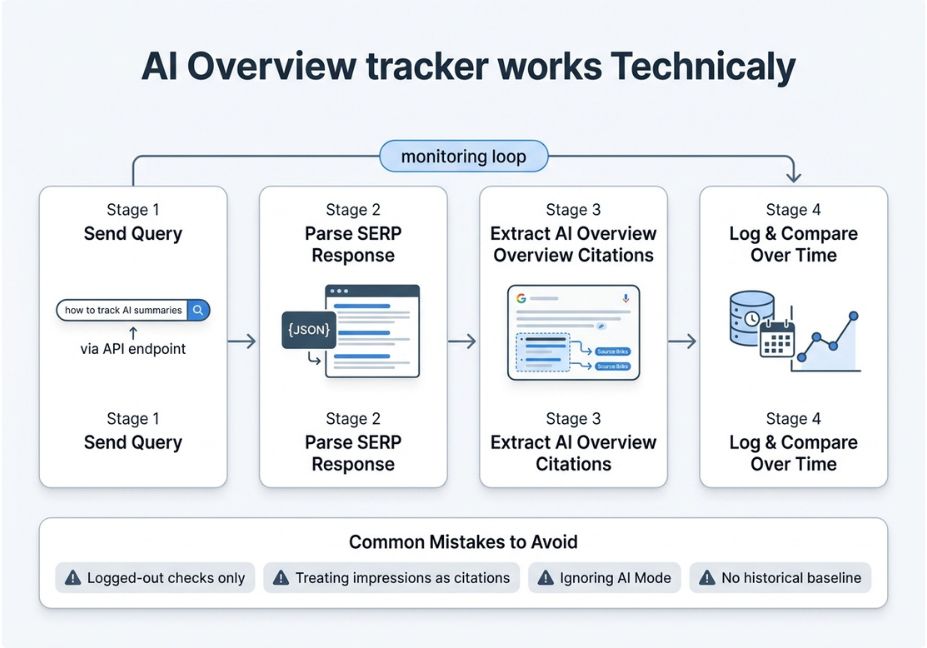
Under the hood, most dedicated trackers run a scheduled check-and-compare loop. First, a query is sent, often through an open-source SERP scraping client or a paid API. Then the response is parsed for an AI Overview block, cited URLs are extracted, and the result is diffed against yesterday’s snapshot. In other words, it’s the same request → parse → compare pattern used in most monitoring agents, just aimed at a SERP instead of an API endpoint.
Technical Note: Because AI Overviews sometimes only render for logged-in users, automated checks and manual logged-out searches won’t always agree. Treat single-session mismatches as expected noise rather than a bug in your tracker.
Real-World Use Cases for AI Overview Tracking
- E-commerce brand monitoring catch it when a competitor replaces you as the cited source for a high-intent product query.
- Publisher content audits see which articles are losing organic clicks because an AI Overview now fully answers the query on its own.
- Agency reporting pull weekly citation-rate deltas into a client dashboard alongside traditional rank data.
- Content-gap discovery find queries where an AI Overview triggers but cites none of your pages, which usually signals a content gap worth filling.
Best Tools and Approaches, Compared
| Approach | Cost | Citation-level detail | Best for |
|---|---|---|---|
| Manual GSC + GA4 checks | Free | Low (impressions only) | Small sites, occasional spot-checks |
| Scripted SERP-API loop | Low (API usage cost) | Medium–high | Dev teams wanting a custom pipeline |
| Dedicated SaaS tracker (SE Ranking, OtterlyAI) | $29–$300+/mo | High (dashboards, alerts, history) | Agencies, larger brands |
Did You Know? As of mid-2026, Google added a dedicated Search Console report for generative-AI surfaces but it still lumps AI Overviews and AI Mode impressions together rather than splitting them out. That’s a limitation worth flagging before promising stakeholders granular numbers.
How Do You Build a Free AI Overview Tracker?
This is one of the most common long-tail questions teams search for, so here’s a direct step-by-step answer:
- Define your query set. Pull your top 100–200 GSC queries by impressions. Long-tail, question-form queries trigger AI Overviews far more often than short head terms.
- Automate the check. Use a SERP API or headless browser to fetch results for each query on a schedule, typically daily.
- Parse for the AI Overview block and extract cited domains from the response.
- Store results with a timestamp, since trigger rate and share of voice only mean something when measured over time.
- Cross-reference with GA4. Filter for the
#:~:text=text-fragment parameter in landing-page URLs — its presence strongly suggests traffic arrived from an AI Overview, featured snippet, or People Also Ask citation. - Alert on change, not just totals. A disappearing citation matters more than the raw count on any single day.
python
# Minimal structure for a scheduled AI Overview check
import requests

def check_ai_overview(query, api_key):
    params = {"engine": "google", "q": query, "api_key": api_key}
    r = requests.get("https://serpapi.com/search", params=params)
    data = r.json()
    ai_overview = data.get("ai_overview", {})
    cited = [src.get("link") for src in ai_overview.get("sources", [])]
    return {"query": query, "triggered": bool(ai_overview), "citations": cited}
Common Mistakes to Avoid
- Relying on logged-out checks alone. Since AI Overviews often need a logged-in session to render, incognito testing tends to under-report trigger rate.
- Treating GSC impressions as proof of citation. An impression in the “Web” search type only confirms your URL appeared somewhere in the grounding set not that it was actually cited in the visible answer.
- Ignoring AI Mode. Tracking Overviews alone misses a second, fast-growing generative surface with its own separate citation behavior.
- Skipping a historical baseline. Without weekly snapshots, it’s nearly impossible to tell normal fluctuation from a genuine visibility loss.
What Developers Are Saying
Developer discussions on custom SERP monitoring including scraping-versus-API tradeoffs and rate-limit handling echo a broader shift toward retrieval-augmented generation pipeline thinking. In this framing, the SERP itself becomes a retrieval source you monitor, similar to how Stanford CRFM and other AI research groups treat search grounding as a measurable pipeline rather than a black box.
Technical Disclaimer: SERP structures and Google’s AI feature APIs change frequently. The code and field names above reflect publicly documented behavior as of July 2026 — always verify against current provider docs before deploying to production.
Frequently Asked Questions
What is an AI Overview tracker?
An AI Overview tracker is a tool that monitors which search queries trigger Google’s AI-generated summaries and whether your domain is cited as a source. Unlike rank trackers, it measures citation-level visibility, not just position.
Can Google Search Console show AI Overview clicks?
Not cleanly. GSC folds AI Overview impressions into the standard “Web” report. According to Google’s June 2026 announcement on generative Search controls, dedicated generative-AI reporting is still rolling out gradually, not yet showing full click-level data for every site.
How do I know if my site is cited in an AI Overview?
Search the target query while logged in, or use a SERP API that captures AI Overview data, then check whether your domain appears in the sources list attached to the generated answer.
Is there a free way to track AI Overviews?
Yes. Manually logging trigger and citation status in a spreadsheet works, and so does filtering GA4 for the #:~:text= text-fragment parameter on landing pages. Both are free, though they scale poorly beyond a small keyword set.
How often should I check my AI Overview citations?
Daily checks are ideal for volatile, high-value queries, while weekly checks are usually enough for a broader keyword set, since AI Overviews tend to shift more slowly than standard rankings.
Conclusion
A reliable google ai overviews tracking tool setup comes down to three things: knowing your trigger rate, confirming actual citation presence instead of assuming it from GSC impressions, and tracking share of voice against competitors over time. Whether you build a scripted SERP-check loop or adopt a dedicated SaaS tracker, the goal stays the same stop guessing at your AI search visibility and start measuring it. Bookmark this guide, and explore more hands-on agentic workflow tutorials at agentiveaiagents.com.