
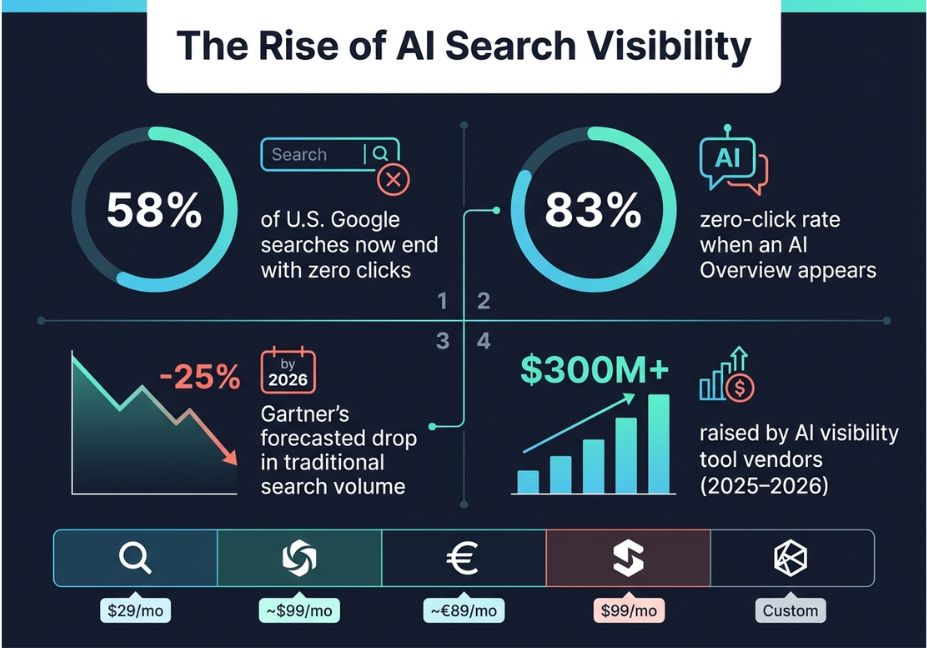
Most teams still measure search performance with rank trackers built for a web of blue links. That model is breaking. Roughly 58% of U.S. Google searches now end without a click, and when an AI Overview appears, that number climbs toward 83%. As a result, if your brand isn’t the source an LLM cites, you’re invisible in a growing share of buyer research no matter where you rank on page one.
That’s the gap AI search visibility tools are built to close. Instead of tracking blue-link positions, they monitor whether ChatGPT, Perplexity, Gemini, Copilot, and Google’s AI Overviews mention, cite, or recommend your brand and how often competitors get the citation instead. In this guide, you’ll learn how the top AI search visibility tools 2025 has produced actually work under the hood, which one fits your budget, and how to avoid the mistakes that waste a GEO budget in the first ninety days.
WHAT IS AI SEARCH VISIBILITY?
AI search visibility is a measure of how often, and how favorably, a brand appears inside AI-generated answers rather than in a traditional organic results list. It’s the practical output of two related disciplines: answer engine optimization (AEO) and generative engine optimization (GEO) largely interchangeable terms for optimizing content so LLMs select it as a source.
Under the hood, most AI answer engines rely on a pipeline close to retrieval-augmented generation (en.wikipedia.org/wiki/Retrieval-augmented_generation): a query triggers retrieval over indexed or live-crawled web content, and the model grounds its answer in whatever passages that retrieval step surfaces. Consequently, visibility tools reverse-engineer this loop by running large panels of real user prompts against each AI engine and logging which domains get cited.
This same retrieval logic increasingly powers Google’s Search Generative Experience (SGE) successor features and Bing Copilot, and it overlaps conceptually with how the Knowledge Graph and Schema.org structured data have long helped Google understand entities on a page. In other words, the tools that measure AI visibility are really measuring how well your content maps onto an entity the model already trusts.
HOW DOES AI SEARCH VISIBILITY TRACKING WORK?
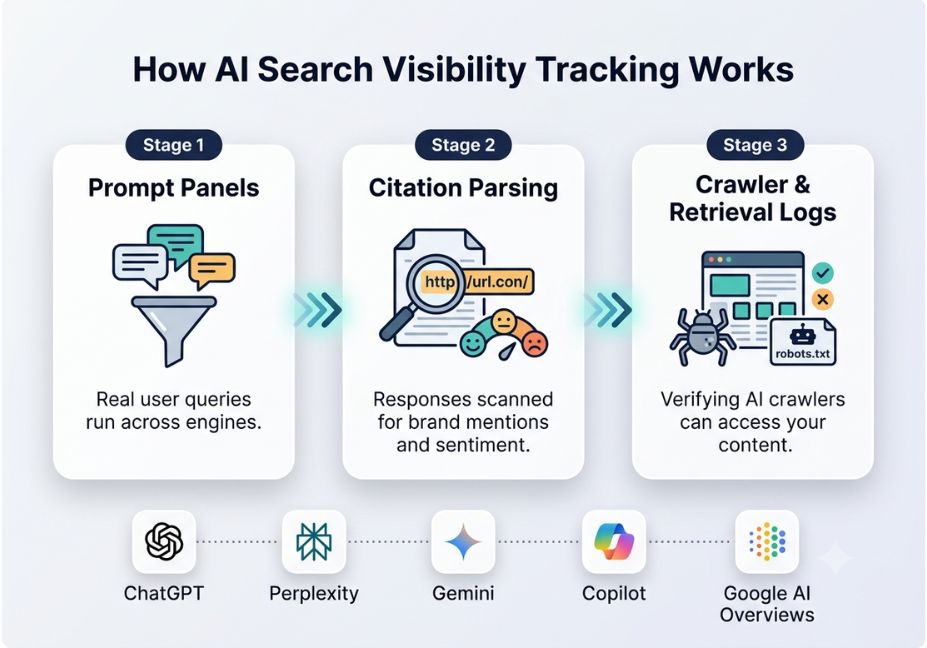
Under the surface, a visibility platform runs three layers most competitor articles never explain. Understanding them helps you evaluate any tool, not just the ones listed below.
- Prompt panels a curated, high-volume set of realistic queries (not just branded keywords) run repeatedly across engines to simulate real usage, including voice-style queries such as “what’s the best tool to track my brand in AI search.”
- Citation parsing each AI response is parsed for cited URLs, brand mentions, and sentiment, then attributed back to a domain and page.
- Crawler and retrieval logs some platforms also monitor which AI crawlers (GPTBot, PerplexityBot, ClaudeBot) actually fetch your pages, cross-referenced against robots.txt and the llms.txt specification (github.com/AnswerDotAI/llms-txt), an emerging convention for signaling which content is safe for LLMs to ingest.
Pro Tip: Before evaluating any tool, check your own server logs for AI crawler user-agents. If GPTBot or PerplexityBot isn’t hitting your site, no visibility platform can report citations you were never eligible for in the first place.
Code snippet — quick DIY check: which AI crawlers hit your site last week?
import re
from collections import Counter

AI_AGENTS = ["GPTBot", "PerplexityBot", "ClaudeBot", "Google-Extended", "Amazonbot"]

def count_ai_crawlers(log_path):
    hits = Counter()
    with open(log_path) as f:
        for line in f:
            for agent in AI_AGENTS:
                if agent in line:
                    hits[agent] += 1
    return hits

print(count_ai_crawlers("access.log"))
Technical Disclaimer: Schema markup specifically FAQPage and Article JSON-LD doesn’t guarantee an AI citation, but it gives crawlers a clean, structured signal that’s easier to retrieve than dense prose. Add it alongside whichever visibility tool you choose.
TOP AI SEARCH VISIBILITY TOOLS 2025 COMPARED
The market raised over $300M in funding between mid-2025 and early 2026. As a result, the top AI search visibility tools 2025 buyers actually adopted split into three tiers: enterprise platforms, mid-market analytics tools, and affordable self-serve monitors.
- Profound Best for: Enterprise / Fortune 500. Entry price: ~$99/mo (scales to enterprise). Standout feature: Prompt Volumes demand data plus hallucination detection.
- Otterly.ai Best for: SMBs and agencies wanting affordable monitoring. Entry price: $29/mo. Standout feature: GEO Audit across 25+ on-page factors a strong pick if you’re searching for “cheap AI visibility tracking tools.”
- Peec AI Best for: Mid-market, multi-country brands. Entry price: ~€89/mo. Standout feature: 8-engine coverage with fast onboarding.
- Semrush AI Toolkit Best for: Teams already inside Semrush. Entry price: $99/mo add-on. Standout feature: the deepest existing SEO-to-AEO data bridge, useful if you’re also optimizing for Google Search Console impressions alongside AI citations.
- Scrunch AI Best for: Content teams optimizing for agent retrieval. Entry price: Custom. Standout feature: structured content delivery built specifically for AI crawlers.
Technical Note: Pricing tiers above are volatile several vendors (Profound, Otterly, Semrush) restructured plans twice between late 2025 and mid-2026 as the category matured. Therefore, confirm current pricing on the vendor’s site before budgeting.
Coverage of comparative feature sets is tracked closely by outlets like VentureBeat’s coverage of the AI-visibility funding boom (venturebeat.com/ai/), which is a useful pulse-check on which vendors are consolidating versus which are still raising.
REAL-WORLD USE CASES
- E-commerce: Tracking whether product pages get cited when AI Overviews answer “best [category] for [use case]” queries. Retail keywords triggering AI Overviews grew sharply through 2025.
- B2B SaaS: Monitoring share of voice against named competitors across recurring buyer-research prompts, since a large share of B2B buyers now form a shortlist before ever running a manual search.
- Publishers and media: Detecting citation drop-off as AI Mode sessions increasingly resolve entirely inside the AI interface, with no click to the source article.
- Agencies: Using white-label or multi-client dashboards to report AI visibility alongside traditional rank tracking for dozens of accounts at once.
- Voice assistant readiness: Because voice assistants like Siri and Alexa increasingly pull from the same underlying answer engines, structuring content for AI citation also improves eligibility for spoken results not just typed ones.
STEP-BY-STEP: HOW TO EVALUATE AND IMPLEMENT AN AI VISIBILITY TOOL
- Map your top 30–50 real customer questions — not keywords, actual questions — across the buyer journey.
- Run a free or trial scan on 2–3 shortlisted tools using that prompt set, not the vendor’s demo prompts.
- Check engine coverage against where your buyers actually search: ChatGPT and AI Overviews first, then Perplexity and Claude if your audience is B2B or technical.
- Audit crawler access — confirm GPTBot, PerplexityBot, and ClaudeBot aren’t blocked in robots.txt.
- Set a citation baseline, then track share-of-voice change over 60–90 days before judging ROI.
- Feed the gaps back into content — pages with no citations usually lack the structured, direct-answer formatting these engines retrieve well.
COMMON MISTAKES AND HOW TO AVOID THEM
- Buying enterprise before proving the use case. Instead, start with a $29–99/mo self-serve tool before a five-figure enterprise contract.
- Ignoring crawler blocking. No amount of content quality overcomes a robots.txt disallow rule against GPTBot.
- Treating citation count as the only metric. Sentiment matters — a hallucinated or negative citation isn’t a win.
- Skipping structured data. AI engines retrieve and quote structured, well-labeled passages far more reliably than dense prose.
- Assuming AEO is a one-time fix. Because engines re-crawl and re-rank constantly, visibility tracking is ongoing, not a launch checklist item.
WHAT PRACTITIONERS ARE SAYING
Sentiment among technical marketers and developers tracking this shift, including developers comparing GEO tools on r/SEO (reddit.com/r/SEO/), generally converges on the same point: prompt-panel size and citation-parsing accuracy matter more than raw engine count. In other words, a tool that tracks 10 engines shallowly is less useful than one that tracks 3 engines with verified, screenshot-backed citation logs.
FAQ — VOICE SEARCH & PEOPLE ALSO ASK
Hey, what is an AI search visibility tool?
An AI search visibility tool monitors how often and how favorably a brand is mentioned or cited inside AI-generated answers from engines like ChatGPT, Perplexity, and Google AI Overviews, using repeated prompt panels rather than keyword rank positions.
How is AI search visibility different from regular SEO?
Traditional SEO tracks ranking positions in a list of links; AI search visibility, on the other hand, tracks citation and mention frequency inside a single generated answer, where there’s often no ranked list at all.
How much does an AI visibility tool cost?
Entry-level monitoring starts around $29–49 a month for a handful of prompts, mid-market platforms run $99–500 a month, and enterprise suites with citation logs and hallucination detection can exceed $1,000 a month.
Can I check my AI search visibility for free?
Yes some vendors offer limited free tiers or graders, and manually running your top questions through ChatGPT or Perplexity and logging the results in a spreadsheet works as a free starting point.
Will an AI visibility tool actually get me cited in ChatGPT?
Not by itself. The tool only measures visibility; improvement comes from acting on what it surfaces, typically by restructuring content for direct-answer retrieval and fixing crawler access.
What’s the best free way to see how AI search engines describe my brand?
Ask ChatGPT, Perplexity, and Google AI Overviews your top five customer questions directly, then note whether your brand is mentioned, cited, or absent — a manual, no-cost first step before buying a tool.
CONCLUSION
The shift from ranked links to generated answers isn’t a passing SERP feature it’s a structural change in how people find information. Gartner’s own forecast of a 25% drop in traditional search volume by 2026 reflects that trajectory, and Google Discover, voice assistants, and AI Overviews are all converging on the same entity-driven retrieval model. Therefore, picking from the top AI search visibility tools 2025 offers means matching engine coverage and citation depth to your actual buyer behavior, not chasing the platform with the biggest funding round. Start with a prompt panel built from real customer questions, verify your crawler access, add FAQPage schema, and track citation share the way you’d track any other growth metric continuously, not once.
Bookmark this guide and explore more hands-on AI agent tutorials at agentiveaiagents.com.