
Most marketing automation still runs on brittle if-then rules: if a user opens an email, send a follow-up. AI agents for digital marketing, however, break that pattern by observing signals, reasoning about intent, and choosing the next action themselves no rule tree required. According to Lilian Weng’s widely cited formulation, an agent is best understood as LLM + Memory + Planning + Tool Use. Ultimately, that framing matters more for marketers than any feature list, because it explains why agents behave differently from the automation tools they’re replacing.
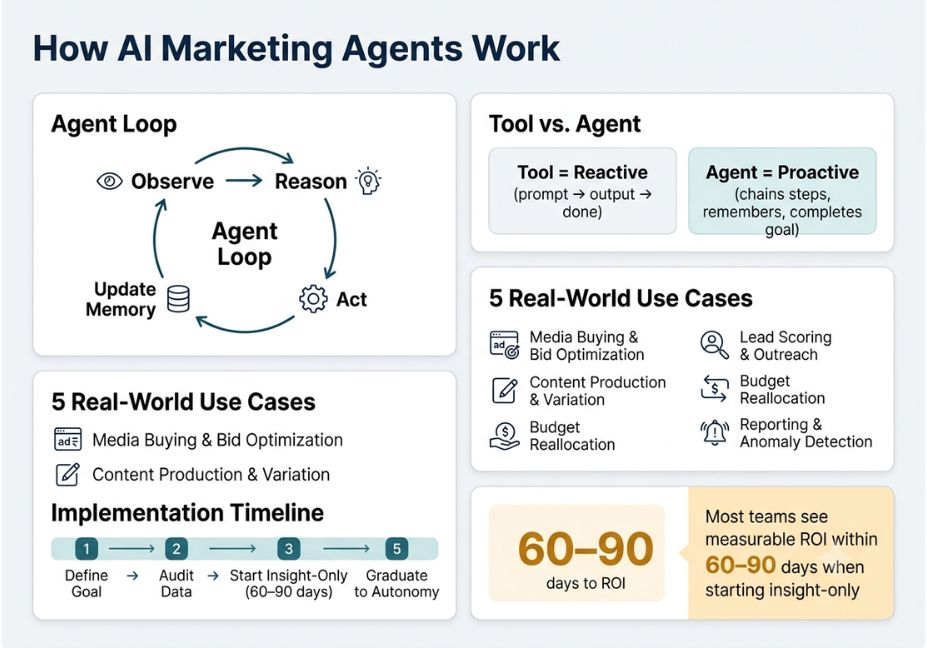
In short, a tool is reactive: you prompt it, it returns an output, and the loop ends. An agent, by contrast, is proactive it chains steps together, remembers what worked, and runs a workflow to completion inside a defined scope. That distinction is the actual dividing line between “AI-powered” marketing software and a true autonomous marketing agent, and it’s the one most buyer’s guides skip entirely.
Quick Answer: An AI agent for digital marketing is an autonomous system built on an LLM plus memory, planning, and tool-use that pursues a marketing goal (like lowering cost-per-lead) by deciding its own next actions, rather than following a fixed automation rule. This differs from marketing automation, which only executes pre-set if-then triggers.
What Is an AI Marketing Agent?
An AI marketing agent is an autonomous system that executes multi-step marketing work without constant human prompting. Specifically, you give it a goal “plan and draft this month’s content for client X, optimized for search” and it determines the steps: what data to pull, which tools to call, what to draft, and when to surface a decision for human review. This is why teams increasingly search for the best AI agents for digital marketing automation rather than another point-solution app: the value is in the reasoning layer, not a single feature.
This goal-orientation, rather than instruction-orientation, is what separates an agent from traditional marketing automation. In other words, the behavior maps closely onto the broader definition of AI agents as autonomous software entities that perceive their environment, make decisions, and take action toward a goal without constant human input a definition that traces back to the formal computer-science literature on intelligent agents (en.wikipedia.org/wiki/Intelligent_agent). As a result, if you’re comparing AI marketing agents vs. marketing automation tools, the deciding factor isn’t feature count it’s whether the system can reason about a goal on its own.
How Does the Agent Loop Work?
So, how do AI marketing agents actually decide what to do next? Every marketing agent runs on some version of the same architecture: observe, reason, act, update memory, repeat. This is the agent loop, and its canonical implementation is the ReAct pattern that interleaves reasoning with action, first formalized in a 2022 paper from Princeton and Google Research. Rather than the model simply picking a tool, it reasons about why that tool is appropriate, executes the call, processes the result, and then reasons again before the next step.
Architect’s Note: Production agent loops need explicit exit conditions max iterations, timeout thresholds, and backoff strategies. Without them, a misfiring loop can burn API budget or, worse, take repeated bad actions (like reallocating ad spend) based on the same flawed signal.
For more complex marketing workflows say, a full-funnel campaign build a plan-and-execute pattern often outperforms a pure ReAct loop. First, a planner generates the full task breakdown upfront; then, an executor works through each subtask; finally, a re-planner adjusts when execution drifts from plan. This is essentially how LangChain’s agent orchestration framework implements its more advanced multi-step marketing agents, and it’s a useful mental model even if you’re not writing code yourself.
# Simplified marketing agent loop (pseudocode)
while not goal_achieved and iterations < MAX_ITER:
    observation = get_campaign_state()
    thought, action = llm.reason(observation, memory)
    result = execute_tool(action)       # e.g. adjust_bid(), draft_copy()
    memory.update(action, result)
    iterations += 1
Did You Know? Anthropic’s Model Context Protocol for connecting agents to external tools has been adopted across OpenAI, Google, and Microsoft’s ecosystems, making it the closest thing marketing-agent tooling has to a common standard for tool discovery and connection.
AI Agents for Digital Marketing Real-World Use Cases
Naturally, the next question is: where do these agents actually create value? Agentic marketing tools have moved past chatbots, and here’s where autonomous agents are earning their keep in 2026 a useful reference if you’re specifically researching AI agent use cases for small business marketing or enterprise-scale campaigns alike:
- Media buying and optimization agents monitor bid, budget, and targeting performance continuously and adjust without fatigue, a workload that’s hard for any human team to match at scale.
- Content production and variation agents draft, test, and iterate on ad copy, email subject lines, and landing-page variants based on live performance data, not a static content calendar.
- Lead scoring and outreach agents analyze website behavior, social engagement, and email interaction together to infer intent and trigger the next best touchpoint automatically.
- Budget reallocation when pacing data shows a campaign overspending, an agent can pause it or shift budget to a better performer, all within a human-set scope.
- Reporting and anomaly detection agents continuously watch engagement metrics and flag (or act on) sudden spikes or drops without waiting for a scheduled report.
Pro Tip: Start with insight-only agents recommendations with no autonomous action before granting write access to ad accounts or CRM records. Teams that skip this step tend to discover data-quality problems only after an agent has already acted on them.
Best Tools and Frameworks for Marketing Agents
Admittedly, there’s no single winner the right choice depends on whether you need a packaged product or a framework to build on.
| Tool / Framework | Best For | Autonomy Level |
|---|---|---|
| HubSpot Breeze | End-to-end suite (content, CRM, support) inside an existing HubSpot stack | Semi-autonomous |
| Drift | Conversational lead qualification and meeting booking | Semi-autonomous |
| Lavender | Email copy scoring and improvement (copilot, not autonomous sender) | Human-in-the-loop |
| LangChain (custom build) | Teams building bespoke multi-agent marketing workflows | Fully configurable |
| Google Analytics 4 (AI insights) | Analytics-driven recommendations layered onto existing data | Insight-only |
| Salesforce Agentforce / Einstein | CRM-native agents for enterprise sales-and-marketing alignment | Semi-autonomous |
| Adobe Sensei GenAI | Creative and content personalization inside the Adobe Experience stack | Semi-autonomous |
For context, this landscape sits alongside broader enterprise AI agent platforms from vendors like Salesforce, Adobe, and Microsoft, all of which are converging on the same observe-reason-act architecture described above which is exactly why understanding the underlying agent loop matters more than memorizing any single vendor’s feature list.
Technical Disclaimer: Framework versions evolve rapidly. If you’re building custom agents, verify current APIs against LangChain’s agent orchestration framework docs directly version-specific behavior changes often enough that blog-post code samples go stale within a few months.
Step-by-Step: How to Implement an AI Marketing Agent
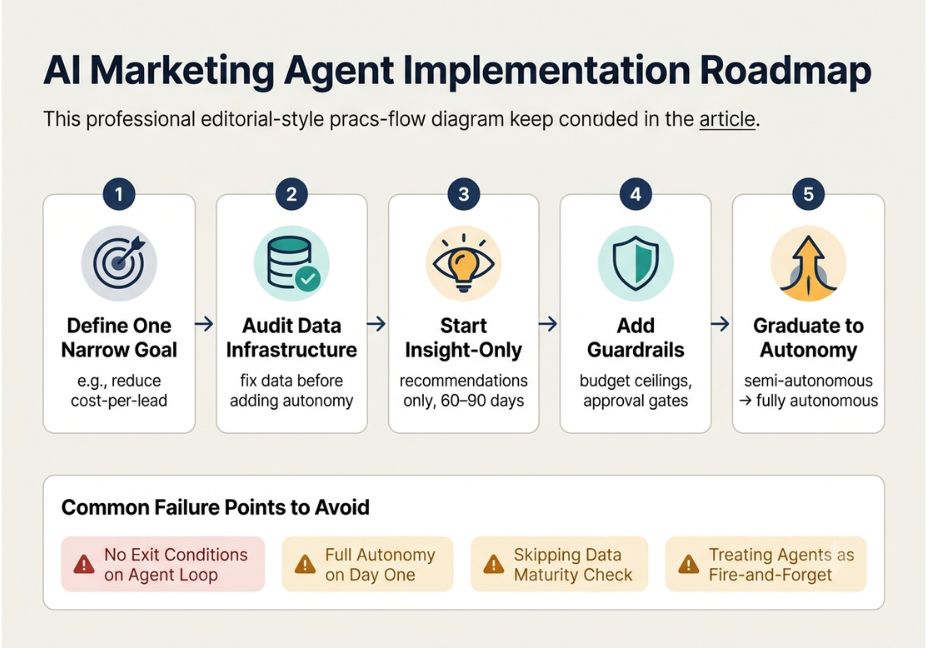
- First, define one narrow goal. “Reduce cost-per-lead on paid search by X%” beats “improve marketing,” because a vague objective gives the planning module nothing concrete to decompose.
- Next, audit your data infrastructure. Agents trained on incomplete or fragmented data produce confident but wrong recommendations, so it’s worth fixing the data pipeline before adding autonomy on top of it.
- Then, start insight-only. Let the agent recommend actions for 60–90 days before it’s allowed to execute them.
- Meanwhile, add guardrails before autonomy. Budget ceilings, approval gates, and clear scope limits should exist before an agent touches live spend.
- Finally, graduate to semi-autonomous, then fully autonomous but only after validated performance, and only for the specific workflow you tested, not your whole stack at once.
Common Mistakes and How to Avoid Them
- Treating agents as fire-and-forget. In particular, feedback loops compound errors: if an agent misattributes a conversion to the wrong channel, it keeps optimizing toward that false signal until someone catches it.
- Skipping the data maturity check. Below a certain data-volume and cleanliness threshold, an agent’s “insights” are closer to guesses. Therefore, it’s safer to use a dashboard until the data justifies autonomy.
- No exit conditions on the agent loop. Indeed, missing iteration limits or backpressure controls is the most common cause of runaway API costs and repeated bad actions in production agents.
- Full autonomy on day one. Reallocating budget without human approval sounds efficient, but in practice an agent can optimize toward the wrong objective at scale, faster than anyone can catch it.
What Practitioners Are Saying
Developer discussion around agent reliability tends to be more candid than vendor marketing. Communities like r/LocalLLaMA frequently surface the same theme found in production case studies: agents amplify whatever data and business logic they’re given, for better or worse. That’s consistent with the emerging conventional wisdom that agents accelerate what already works rather than fixing what’s broken.
FAQ People Also Ask
What is the difference between an AI agent and marketing automation?
Marketing automation follows fixed if-then rules (if X happens, do Y). An AI agent instead pursues a goal: it reasons over multiple signals, decides its own next action, and adapts as conditions change, rather than executing a static script.
How do AI marketing agents decide what action to take?
Most agents run an observe-reason-act loop commonly the ReAct pattern where the model reasons about the current state, selects a tool or action, evaluates the result, and repeats until the goal is met or an exit condition is hit.
Can AI agents run ad campaigns without human approval?
Technically yes, but it’s not recommended out of the gate. Best practice is to start with insight-only agents, add guardrails like budget ceilings and approval gates, and only grant full autonomy after validating performance on a narrow workflow.
What is the biggest risk of using AI agents in marketing?
Compounding feedback-loop errors an agent that misreads a signal (like conversion attribution) will keep optimizing toward that wrong signal at machine speed, faster than a human would typically catch and correct it.
Do I need a data team before deploying AI marketing agents?
You need clean, sufficiently mature data more than you need a large team. Agents built on fragmented or sparse data produce confident but wrong recommendations, so fixing data infrastructure should come before adding autonomy.
How long does it take to see ROI from an AI marketing agent?
Most teams see measurable results within 60–90 days if they start insight-only and validate performance before granting autonomy. That said, timelines shrink or stretch depending on data maturity, since agents built on messy data need longer to prove reliable.
Is ChatGPT considered an AI marketing agent?
Not on its own. ChatGPT is a conversational tool that responds to prompts, whereas an AI marketing agent chains reasoning, tool calls, and memory together to pursue a goal autonomously the same underlying model can power either, but the agent wrapper is what makes it act rather than just answer.
Conclusion
In summary, AI agents for digital marketing aren’t just faster content generators they’re systems that plan, act, and adapt inside a goal you define, built on the same observe-reason-act loop that powers agentic AI everywhere else. Ultimately, the teams getting real value in 2026 aren’t chasing the most autonomous tool available; instead, they’re starting with insight-only agents, fixing their data foundations, and adding autonomy incrementally with real guardrails. Bookmark this guide and explore more hands-on agentic AI tutorials at agentiveaiagents.com.