
Most teams still measure search performance with rank-tracking tools built for a world where results were ten blue links. However, that world is gone. An AI Overviews mentions tool solves a different problem: knowing whether your brand gets named inside Google’s AI-generated summary at all, even when no link is clicked and no impression is logged in Search Console. Because Google’s AI Overviews run on a customized Gemini model wired to a retrieval-augmented generation (RAG) pipeline, visibility is now a function of retrieval quality, not just keyword rank. As a result, if your content never gets pulled into the candidate set, you don’t just rank lower you disappear from the answer entirely.
Quick Answer: An AI Overviews mentions tool is software that monitors Google’s AI-generated search summaries to detect when your brand, product, or domain is named or cited whether or not that mention includes a clickable link. It’s used to track brand mention tracking, citation tracking, and “share of AI voice” across AI search engines like Google AI Overviews, ChatGPT, and Perplexity.
What Is an AI Overviews Mentions Tool?
An AI Overviews mentions tool is software that queries Google at scale and records whether your brand, product, or domain is named or cited inside an AI Overview — whether or not that mention includes a clickable link.
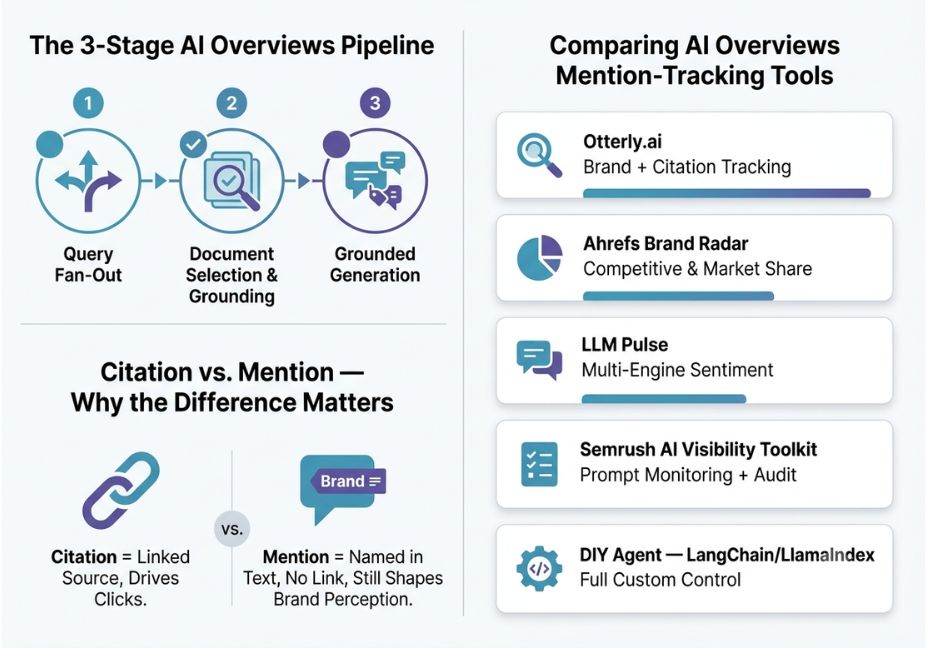
This distinguishes brand mention tracking (your name appears in the generated text) from citation tracking (your URL is listed as a source). Most vendors report these separately because unlinked mentions still shape zero-click brand perception, even without driving traffic. If you’ve been searching for how to track brand mentions in Google AI Overviews without a dedicated platform, this is also the exact gap a DIY monitoring agent fills.
The category exists mainly because Google Search Console has no field for it. Instead, it bundles AI Overview impressions into generic “Web” search data with no per-mention or per-citation breakdown.
How Does an AI Overviews Mentions Tool Work?
Understanding the tool first requires understanding what it’s watching. Google’s AI Overviews don’t answer from the model’s parametric memory. Instead, they run a grounded retrieval-augmented generation pipeline against the live Search index, so the summary is only as good as the documents the retriever pulls in.
Specifically, the pipeline runs through three stages a monitoring agent has to mirror:
- Query fan-out. A single search question gets decomposed into a batch of related sub-queries covering different angles of intent, and Google retrieves documents against all of them, not just the literal query typed.
- Document selection and grounding. Google favors diverse, trustworthy, and freshly-crawled documents over a strict re-ranking of top organic positions, which is why AI Overviews frequently cite pages that don’t rank #1 in traditional results.
- Grounded generation. Gemini writes the summary using only the retrieved candidate set, then attaches citations back to the source pages.
Technical Note: Because query fan-out generates sub-queries you never typed, a mentions tool that only checks your exact target keyword will systematically under-count your real AI Overview visibility. Robust tools sample the fan-out neighborhood, not just the head query.
Pro Tip: If you’re building this yourself, log the full rendered AI Overview HTML per run, not just a boolean “present/absent” flag Google changes phrasing and citation order between runs for the same query, and you’ll want the raw text for sentiment analysis later.
AI Overviews Mentions Tool Real-World Use Cases
- SaaS marketing teams tracking whether their product gets named alongside competitors when users ask “best [category] tool” style questions.
- E-commerce brands monitoring unlinked mentions in comparison-style AI Overviews where no outbound click is possible but brand recall still shifts.
- Agencies running competitive benchmarking across a client’s domain versus 3–5 named competitors, reporting “share of AI voice” alongside classic rank data.
- Publishers auditing which specific pages get pulled into the retrieval candidate set so editorial teams know which formats (FAQ blocks, definition paragraphs, comparison tables) earn citations most often.
Best Tools and Frameworks for Tracking AI Overview Mentions
| Tool | Focus | Platforms Covered | Notable For |
|---|---|---|---|
| Otterly.ai | Brand + citation tracking | Google AI Overviews, ChatGPT, Perplexity, AI Mode | Prompt-library workflow mirroring real user questions |
| Ahrefs Brand Radar | Citation + competitive share | Google AI Overviews (part of Ahrefs suite) | “Competitive Share” and “Market Share” metrics, upstart-competitor alerts |
| LLM Pulse | Multi-engine citation + sentiment | Google, ChatGPT, Perplexity, Gemini, AI Mode | Broad cross-engine coverage at a lower entry price |
| Semrush AI Visibility Toolkit | Prompt monitoring + technical audit | Multiple AI engines | AI Search Site Audit for crawler-blocking issues |
| DIY agent (LangChain/LlamaIndex + SERP API) | Custom brand/citation tracking | Whatever you wire up | Full control over query fan-out sampling and reporting |
Did You Know? Ahrefs’ Brand Radar reports both a domain’s “Competitive Share” and “Market Share” of AI mentions, and can flag when a smaller, non-obvious site starts getting cited frequently often surfacing an AI-era competitor that never showed up in traditional keyword-rank tracking.
Step-by-Step: Build Your Own AI Overviews Mentions Agent
You don’t need an enterprise contract to get a working prototype. A minimal monitoring agent needs three components: a query set, a fetch/parse step, and a mention-detection step.
python
import requests
from bs4 import BeautifulSoup

BRAND_TERMS = ["YourBrand", "yourbrand.com"]
QUERIES = ["best project management tool", "top RAG frameworks 2026"]

def fetch_serp(query: str) -> str:
    # Swap in a SERP API of your choice — direct scraping violates Google's ToS
    resp = requests.get("https://api.example-serp-provider.com/search",
                         params={"q": query})
    return resp.json().get("ai_overview_html", "")

def detect_mentions(html: str) -> dict:
    text = BeautifulSoup(html, "html.parser").get_text().lower()
    return {term: term.lower() in text for term in BRAND_TERMS}

for q in QUERIES:
    html = fetch_serp(q)
    if html:
        print(q, detect_mentions(html))
Wrap this loop in an orchestration layer LangChain’s agent orchestration docs cover scheduling tool calls on a cadence, and LlamaIndex’s GitHub repository is a solid starting point if you’d rather index your own historical results for retrieval-based trend queries later. Persist every run to a database keyed by query + date so you can chart mention frequency over time instead of just spot-checking.
Technical Disclaimer: Framework versions evolve rapidly. Code examples in this article use standard
requests+BeautifulSoupas of mid-2026. Always check the official docs for the latest API before shipping.
Common Mistakes and How to Avoid Them
- Scraping Google directly instead of using a compliant SERP API. This breaks Google’s terms of service and produces unstable results as anti-bot measures shift.
- Tracking only exact-match keywords. Because of query fan-out, your brand may be mentioned in AI Overviews triggered by sub-queries you never explicitly track.
- Conflating citations with mentions. A brand can be discussed by name in an AI Overview with zero linked citation treating the two as the same metric hides real visibility loss.
- Ignoring unlinked mentions in reporting. Most teams report only citation counts because they’re easier to scrape; brand mention tracking is harder but matters more for zero-click brand perception.
- Running one-off checks instead of scheduled monitoring. AI Overview content changes between runs for the same query, so a single snapshot is not representative.
Schema Markup: Making This Page Readable to AI Search Engines
Because AI search engines and AI Overviews themselves parse structured data more reliably than prose, adding FAQPage and Article schema (per Google Search Central guidelines) increases the odds this exact page gets pulled into a retrieval candidate set. This is the “hidden” layer of relevance invisible to readers, but machine-readable to crawlers.
json
  "@context": "https://schema.org",
  "@type": "FAQPage",
  "mainEntity":
    "@type": "Question",
    "name": "What is an AI Overviews mentions tool?",
    "acceptedAnswer":
      "@type": "Answer",
      "text": "Software that queries Google at scale and records whether your brand is named or cited inside an AI Overview, whether or not the mention includes a link."
Pro Tip: Pair this with Organization schema and a sameAs array linking your brand’s verified profiles (LinkedIn, Crunchbase, GitHub) that entity graph is part of how Gemini and other models resolve “which brand is this text actually about” during grounding.

What Developers Are Saying
Builders working on retrieval and agent tooling regularly compare notes on the reliability of AI Overview scraping, retrieval quality, and how citation behavior shifts between Gemini model updates. If you want to see current threads on retrieval pipeline design and grounding behavior from practitioners, r/LocalLLaMA and r/MachineLearning are active communities where this gets discussed alongside broader RAG and agent-tooling questions.
FAQ People Also Ask
What is an AI Overviews mentions tool?
It’s software that queries Google at scale to detect when your brand’s name or URL is surfaced inside an AI Overview, tracking both linked citations and unlinked text mentions over time.
How do AI Overviews decide which brands to mention?
Google’s retrieval-augmented generation pipeline retrieves a candidate set of trustworthy, diverse, and fresh documents through query fan-out, then Gemini grounds its summary in that set and cites the sources it drew from.
Can I track AI Overviews mentions for free?
Yes, at small scale a DIY agent using a SERP API’s free tier and simple keyword matching can monitor a handful of queries; paid tools become worthwhile once you need multi-engine coverage, sentiment, or dozens of tracked prompts.
Is Google Search Console enough to track AI Overview visibility?
No. Search Console bundles AI Overview impressions into generic Web search metrics and provides no per-mention or per-citation breakdown, which is the core reason dedicated tracking tools exist.
What’s the difference between a citation and a mention in AI Overviews?
A citation is a linked source reference attached to the AI-generated answer; a mention is your brand name appearing in the generated text itself, with or without a link both affect visibility, but only citations drive direct clicks.
How do I know if my brand is mentioned in Google’s AI Overviews?
Run your brand name and key product terms through a mentions tool or a manual search on a recurring schedule, since AI Overview content changes between runs. This is the fastest way to check without waiting on a quarterly SEO audit.
Conclusion
An AI Overviews mentions tool isn’t just another SEO dashboard it’s the only lens into a retrieval-augmented generation pipeline that decides whether your brand exists in an answer at all. Whether you adopt a platform like Otterly.ai or Ahrefs Brand Radar, or wire up your own agent on top of a SERP API and a simple tool-use loop, the fundamentals are the same: sample beyond your exact-match keywords to catch query fan-out, separate citations from unlinked mentions in your reporting, and monitor on a schedule rather than a single snapshot. Bookmark this guide and explore more hands-on agentic AI tutorials at agentiveaiagents.com.