
Most brand dashboards still measure a world that’s disappearing. They track web mentions and social sentiment. Meanwhile, they ignore the fastest-growing discovery surface: generative engines like ChatGPT, Perplexity, and Google AI Overviews. As a result, a brand can look healthy on Talkwalker and still be invisible or misrepresented inside an LLM’s answer.
That gap is why brand performance analysis tools generative ai has become its own category, alongside a growing set of related searches how to track brand mentions in ChatGPT, the best AI tools for brand sentiment analysis, and how to measure AI share of voice against competitors. These systems don’t just scrape mentions. Instead, they run structured queries against multiple models, retrieve the sources those models cite, and score sentiment inside AI-generated text itself.
Under the hood, most of them are built the way developers build any production LLM app: as an agentic RAG systems pipeline with a retrieval layer, an orchestration layer, and a scoring agent on top. This same architecture also powers generative engine optimization (GEO) and what Google calls its Search Generative Experience (SGE) the broader shift toward AI-mediated discovery.
Below, this guide breaks down exactly how that pipeline works. It also compares leading platforms against a build-it-yourself approach, and it gives you a working architecture you can implement with LangChain or LlamaIndex today.
What Is Brand Performance Analysis in Generative AI?
Brand performance analysis in generative AI is the practice of measuring how large language models describe, rank, and cite a brand when users ask category-related questions. In short, it combines two signals: AI visibility (whether and how often a brand appears) and sentiment classification (whether the mention is favorable, neutral, or negative).
Unlike classic social listening, this discipline relies on retrieval-augmented generation to trace why a model cited a given source. Therefore, it connects an LLM’s output back to the exact web page, review, or forum thread that shaped it the same underlying mechanism that powers Google’s AI Overviews and Perplexity’s cited answers.
How Do You Track Brand Mentions in ChatGPT and Other AI Tools?
To track brand mentions in ChatGPT, Perplexity, or Gemini, you send the model a set of realistic buyer questions, then scan each answer for your brand name and your named competitors. For example, a query like “best project management software for remote teams” reveals whether a brand shows up at all, and if so, how favorably. Most teams automate this with a scheduled script rather than checking manually.
How Does an AI-Driven Brand Performance Pipeline Work?
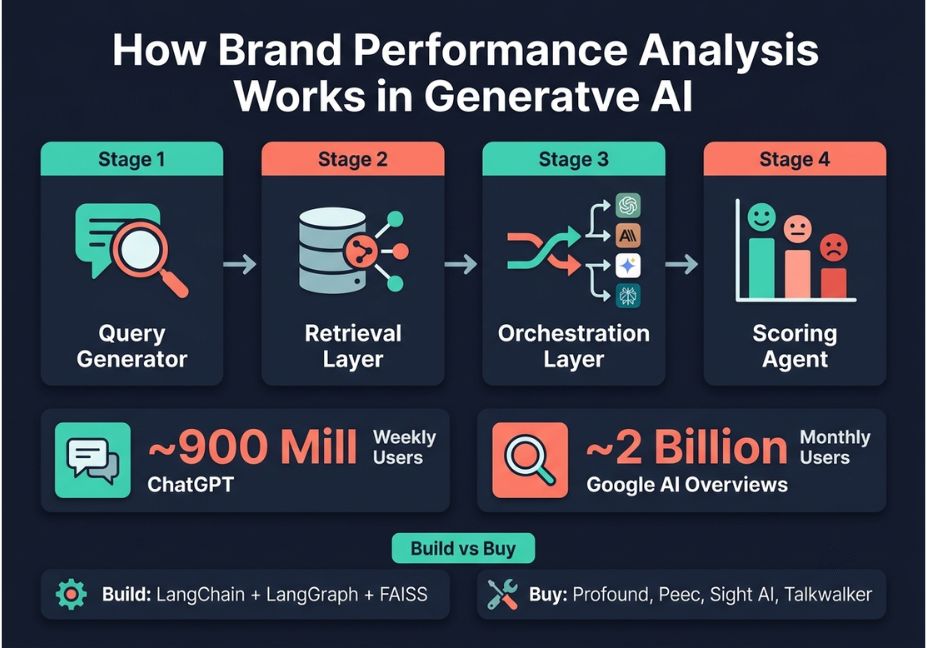
A production-grade brand performance system is an agentic RAG application with four moving parts:
- Query generator produces natural-language prompts real customers would type (“best CRM for a 10-person sales team”), not just keywords.
- Retrieval layer embeds those prompts, matches them against a vector store of indexed pages, reviews, and prior model outputs.
- Orchestration layer routes each query to the right model (GPT, Claude, Gemini, Perplexity) and manages retries and rate limits.
- Scoring agent classifies sentiment, extracts cited sources, and computes share-of-voice against named competitors.
In other words, this is functionally a routing-and-planning agent stack. Query planning agents that decompose complex requests handle multi-part brand queries for instance, “compare X and Y on pricing and support.” Meanwhile, a separate agent handles citation extraction, so the scoring step never touches raw model text without provenance.
Technical Note: Analyst firms such as Gartner have started referencing this category as “AI answer monitoring,” while industry data trackers like Statista publish adoption figures for the underlying models. Consequently, expect terminology to keep shifting even as the architecture stays consistent.
Did You Know? Industry benchmarks put ChatGPT at roughly 900 million weekly active users and Google AI Overviews at around 2 billion monthly users in early 2026. As a result, brand mentions inside AI answers may already reach more people than a brand’s own website.
What Are the Real-World Use Cases for AI Brand Visibility Tracking?
- Enterprise reporting: Marketing teams generate presentation-ready dashboards showing AI share-of-voice against named rivals, for leadership review.
- Content strategy: Teams identify which specific competitor pages get cited most often, then build content to compete for that citation slot a core generative engine optimization tactic.
- Crisis detection: A scoring agent flags a sudden negative-sentiment spike in AI-generated answers before it shows up in traditional social monitoring.
- Multi-market tracking: Agencies run the same pipeline across regions and languages to catch localized perception gaps, similar to how they’d use Google Search Console to catch regional ranking drops.
For example, a SaaS company might discover that Perplexity consistently cites a three-year-old comparison article instead of its current pricing page. In that case, the fix isn’t paid media — it’s publishing fresher, more citable content.
Pro Tip: Don’t monitor every model your budget allows. Instead, prioritize the two or three generative engines your actual ICP uses for research, since monitoring all of them dilutes signal and inflates cost without improving decisions.
What Are the Best Tools and Frameworks for Brand Performance Analysis?
Choosing between platforms mostly comes down to one question: build it, or buy it? The table below compares the main approaches side by side.
| Approach | Examples | Best For | Tradeoff |
|---|---|---|---|
| Build it yourself | LangChain + LangGraph + FAISS | Teams with engineering resources, custom scoring logic | Requires ongoing maintenance and prompt-eval work |
| AI-visibility SaaS | Profound, Peec, Sight AI | Marketing teams needing fast, presentation-ready reporting | Less control over query design and scoring methodology |
| Hybrid brand intelligence | Talkwalker, PSB’s Breakthrough Brand Intelligence | Consumer brands needing visual + text listening in one place | AI-search coverage is often an add-on, not the core product |
| Primary-research layer | Interview-based platforms (e.g., Listen Labs) | Explaining why sentiment shifted, not just detecting it | Doesn’t replace ongoing automated monitoring |
In short, engineering-heavy teams tend to build; lean marketing teams tend to buy. Either way, the underlying agentic RAG architecture is the same.
How Do You Build a Brand Visibility Tracker With LangChain?
A minimal version of this pipeline can run in an afternoon using LangChain’s orchestration framework with any model provider. Below is a simplified starting point.
python
from langchain_openai import ChatOpenAI
from langchain.prompts import ChatPromptTemplate

llm = ChatOpenAI(model="gpt-4o")

query_prompt = ChatPromptTemplate.from_template
    "Generate 5 natural-language questions a buyer would ask "
    "about {category}, without naming any brand."


def run_visibility_check(category: str, brand: str, competitors: list[str]):
    queries = llm.invoke(query_prompt.format(category=category))
    results =     for q in queries.content.split("\n"):
        answer = llm.invoke(f"Answer as a helpful assistant: {q}")
        mentioned = brand.lower() in answer.content.lower()
        comp_hits = [c for c in competitors if c.lower() in answer.content.lower()]
        results.append({"query": q, "brand_mentioned": mentioned, "competitors_cited": comp_hits})
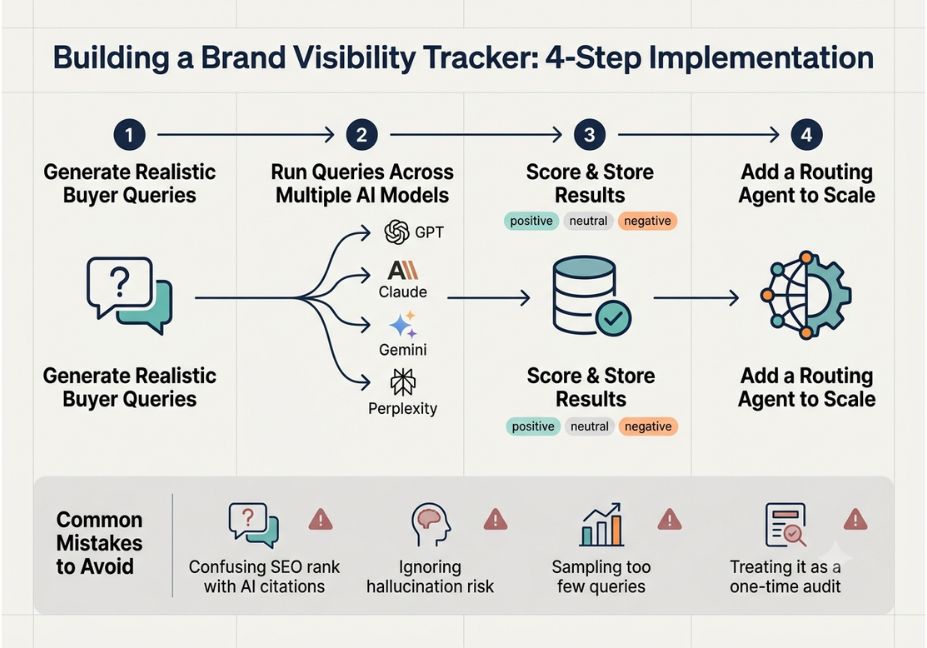
return results- Generate realistic queries rather than keywords this is what separates AI visibility from traditional SEO.
- Run the same query set across multiple models to compare citation behavior.
- Score and store results in a lightweight database, tagged by date, model, and query category.
- Add a routing agent once you’re tracking more than one model or market, so the pipeline scales without a rewrite.
Technical Disclaimer: Framework versions evolve rapidly. Code above uses LangChain v0.3.x as of mid-2026. Always check the official docs for the current API before deploying.
Common Mistakes and How to Avoid Them
- Conflating keyword rankings with AI citations. A page ranking #1 on Google may never be retrieved by an LLM’s own search step these are separate ranking systems.
- Ignoring hallucination risk in scoring. If your scoring agent trusts a model’s claim about “leading” a category without checking the cited source, you’ll report false positives.
- Sampling too few queries. Five prompts per week isn’t enough signal to detect a real sentiment shift; most reliable pipelines run daily, higher-volume query sets.
- Treating this as a one-time audit. Model behavior drifts with every provider update, so brand performance tracking needs to run continuously, not quarterly.
What Developers Are Saying
Threads on r/LocalLLaMA and similar developer communities increasingly discuss building lightweight “AI visibility” scrapers in-house rather than paying for enterprise SaaS mainly because the underlying architecture (query generation, retrieval, sentiment scoring) is well within reach of a small RAG pipeline, provided the team is willing to maintain prompt sets and handle rate limits across multiple model providers.
FAQ People Also Ask
What is brand performance analysis in generative AI?
It’s the measurement of how LLMs describe, cite, and rank a brand in response to category-relevant questions. It combines AI visibility tracking with sentiment classification of the generated text.
How do AI agents track brand sentiment?
An agent runs structured queries through one or more models. It then retrieves the answer text and its cited sources, and classifies sentiment and share-of-voice automatically.
What’s the difference between AI visibility tools and traditional brand monitoring?
Traditional monitoring tracks web and social mentions. AI-visibility tools instead query generative engines directly to see how those models cite and frame a brand.
Can you build your own brand performance analysis pipeline?
Yes. A basic version needs only a query generator, a retrieval layer, and a scoring agent, and it can be built with open frameworks like LangChain or LlamaIndex.
How often should brand performance be tracked in AI search?
Daily or weekly, depending on category volatility. Fast-moving or competitive categories benefit from daily tracking to catch citation shifts quickly.
What are the best AI tools for brand sentiment analysis in 2026?
Profound, Peec, and Sight AI lead the AI-visibility category, while Talkwalker remains a strong choice for teams that also need traditional social listening in the same dashboard.
Conclusion
Brand performance analysis has expanded beyond social listening into a discipline built on agentic RAG pipelines: query generation, retrieval, orchestration, and sentiment scoring working together to reveal how generative engines actually represent a brand. Whether you adopt a platform like Profound or Sight AI, or build your own pipeline with LangChain and a vector store, the underlying architecture is the same and understanding it is what lets you evaluate any brand performance analysis tools generative ai vendor claims to offer. Bookmark this guide and explore more hands-on agentic AI tutorials at agentiveaiagents.com.
3 Responses