
Most teams find out they’ve lost a Perplexity citation the same way they find out a server went down by accident, weeks later, while looking for something else. A Perplexity AI brand mention monitoring tool exists to close that gap, but almost every vendor page describing one skips the part that actually matters to an engineer: how the detection loop works under the hood. The original generative engine optimization research from Princeton and the Allen Institute for AI formalized this problem back in 2023, framing generative engines as black boxes where creators have “little to no control over when and how their content is displayed.” Nothing about that has gotten easier Perplexity now answers with citations pulled from a live retrieval index, re-ranked per query, which means your brand’s presence in its answers is a moving target, not a fixed ranking.
This guide covers what these tools actually measure, how the underlying pipeline is built, and unlike most competing articles when it makes more sense to build your own lightweight monitoring agent instead of buying one.
What Is a Perplexity AI Brand Mention Monitoring Tool?
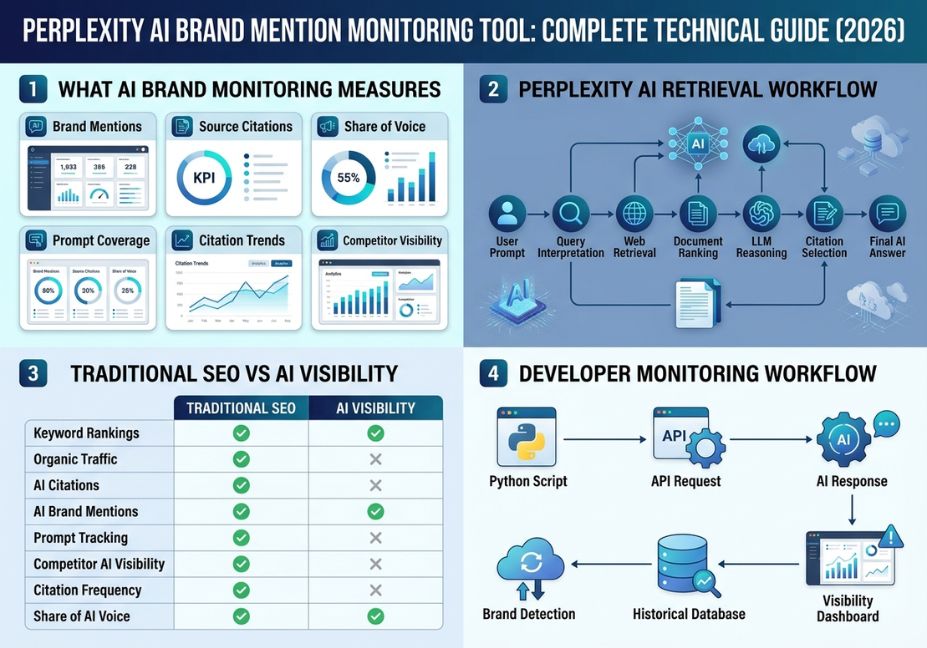
A Perplexity AI brand mention monitoring tool is software that repeatedly queries Perplexity with a fixed set of prompts, then parses the returned answer text and citation list to detect whether, where, and how favorably your brand appears. Perplexity operates as an AI-native answer engine that uses large language models to generate responses by searching and summarizing web-based content, rather than returning a ranked list of blue links. That distinction is why traditional rank trackers can’t do this job there’s no static SERP to scrape, only a synthesized paragraph that changes with each query.
At minimum, a real monitoring tool needs three data points per run: mention frequency (did your brand appear at all), citation status (was your page actually linked as a source), and sentiment/framing (was the mention neutral, positive, or wrong).
How Does Perplexity Mention Tracking Actually Work?
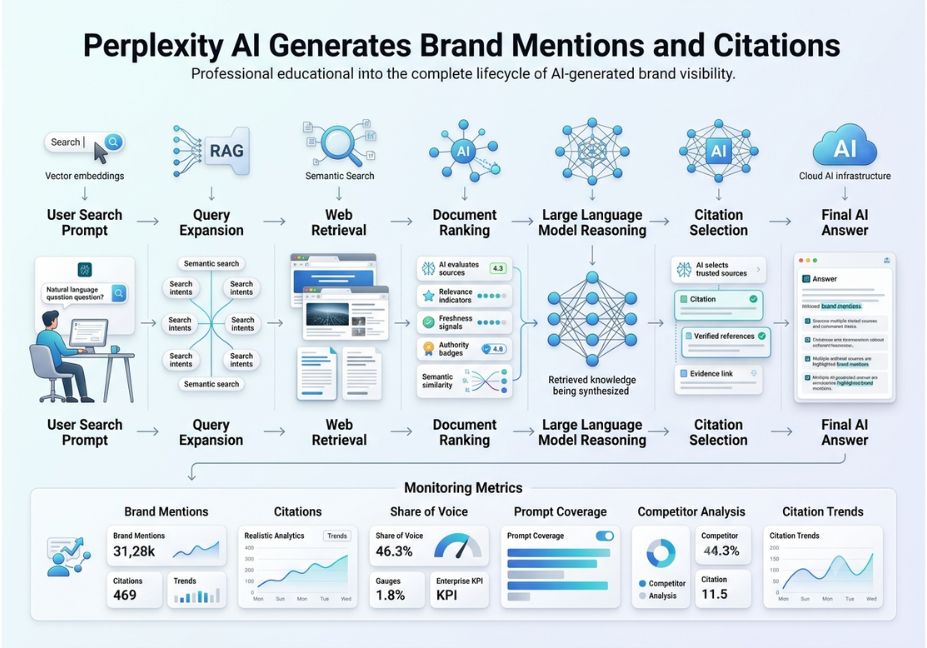
Under the hood, this is a small agentic pipeline, not magic. Four stages, in order:
- Prompt scheduler a cron-style job fires a library of realistic user prompts (“best [category] tools,” “[competitor] vs [your brand]”) on a recurring cadence.
- Query execution each prompt hits an LLM-backed search layer. Most DIY builds and several commercial tools call Perplexity’s Sonar API documentation directly, since Sonar returns both the generated answer and its supporting citation list in one response.
- Entity matching the returned text is checked for brand mentions. Naive tools do a string match; better ones use embedding similarity so “Acme Corp,” “Acme,” and “acme.com” all resolve to the same entity even without an exact match.
- Sentiment and citation scoring an LLM judge (or a simpler classifier) tags each mention as cited-and-linked, mentioned-without-link, or absent, plus a rough sentiment label.
Technical Note: This is a textbook retrieval-augmented generation consumption problem, not a generation problem you’re not asking a model to write; you’re auditing what an existing retrieval-and-summarization system already produced.
5 Real-World Use Cases for Perplexity Brand Monitoring
- Pre-purchase research defense B2B buyers increasingly ask Perplexity “best [category] tools” before ever visiting a vendor site; missing that mention means missing the shortlist entirely.
- Competitor share-of-voice tracking running the same prompt against your brand and three competitors weekly reveals who’s gaining ground before it shows up in traffic numbers.
- Misattribution catching Perplexity occasionally cites outdated pricing, deprecated features, or a competitor’s claim as if it were yours; monitoring catches this before a prospect does.
- Content-gap discovery when a prompt returns your competitor’s blog post as the cited source instead of yours, that page is your next content brief.
- PR crisis early warning a sudden negative-sentiment shift across monitored prompts often precedes a wider news cycle by days.
Build vs. Buy: Comparing DIY Agents to SaaS Tools
There’s a real engineering tradeoff here, and it’s worth being honest about it instead of just recommending a purchase.
| Approach | Setup effort | Ongoing cost | Best for |
|---|---|---|---|
| DIY Sonar API agent | Medium (a few hours) | API usage only | Small teams, single-brand tracking, engineers comfortable with cron + a script |
| SE Ranking / Keyword.com style tracker | Low | Subscription | Teams wanting a dashboard, historical trend charts, no maintenance |
| Meltwater / GrowByData enterprise suite | Low | Higher subscription | PR/comms teams monitoring AI search alongside traditional media coverage |
| Rankability-style AI search analyzer | Low | Subscription | Teams already running large prompt libraries across multiple AI engines |
The honest tradeoff, per the original generative engine optimization research, is that generative engines are black-box and fast-moving by nature no tool, bought or built, gives you certainty about why a citation appeared, only visibility into whether it did.
Pro Tip: If you’re only tracking one brand against two or three competitors, a DIY agent running once a day is genuinely cheaper and more transparent than a subscription. Buy a SaaS tool once you need cross-engine tracking (ChatGPT, Gemini, AI Overviews) or a shared dashboard for non-technical stakeholders.
Step-by-Step: Build a Lightweight Perplexity Mention-Monitoring Agent
Here’s a minimal version using Perplexity’s Sonar API. It fires a prompt, checks the answer text for your brand, and logs citation status.
python
import requests
import os

API_KEY = os.environ["PERPLEXITY_API_KEY"]
BRAND = "Acme Corp"

def run_prompt(prompt: str) -> dict:
    response = requests.post
        "https://api.perplexity.ai/chat/completions",
        headers={"Authorization": f"Bearer {API_KEY}"},
        json=
            "model": "sonar-pro",
            "messages": [{"role": "user", "content": prompt}],

    data = response.json
    answer = data["choices"][0]["message"]["content"]
    citations = data.get("citations",
    return {"answer": answer, "citations": citations}

def score_mention(result: dict, brand: str) -> dict:
    mentioned = brand.lower() in result["answer"].lower()
    cited = any(brand.lower().split()[0] in c.lower() for c in result["citations"])
    return {"mentioned": mentioned, "cited": cited}

prompts =
    "What are the best AI agent monitoring tools?",
    f"{BRAND} vs competitors — which is better?",


for p in prompts:
    result = run_prompt(p)
    score = score_mention(result, BRAND)
    print(p, "→", score)
Technical Disclaimer: Framework and API details change quickly. This example reflects Perplexity’s Sonar chat completions endpoint as of July 2026. Always check the current API reference before deploying this to production, since parameters and response shapes evolve between model releases.
Swap the naive string match for an embeddings-based comparison (using Perplexity’s own Embeddings API or any vector store) once you need to catch brand-name variants or misspellings a plain substring check will miss those every time.
Common Mistakes and How to Avoid Them
- Treating one query as representative. Perplexity re-ranks sources per query; run each prompt multiple times before drawing conclusions from a single answer.
- Ignoring prompt drift. The exact wording of a prompt changes results meaningfully — lock your prompt library and change it deliberately, not casually.
- Trusting citation text as ground truth. Occasionally, the summarized text doesn’t match what the cited page actually says. Spot-check, don’t assume.
- Confusing mentions with citations. A brand can be named in the generated text without being linked as a source these are different signals and should be tracked separately.
- Skipping rate-limit handling. A prompt scheduler that fires dozens of queries a minute without backoff logic will get throttled; build retry logic in from day one.
What Developers Are Saying
Independent researchers have started open-sourcing the plumbing rather than keeping it proprietary. An open-source citation-tracking pipeline on GitHub, for instance, documents a full dataset-and-analysis workflow for studying how generative engines select and reuse citations — useful reading if you want to see the entity-matching and scoring logic implemented outside of a paid dashboard. The broader pattern in developer discussions is consistent: teams increasingly track Perplexity, ChatGPT, and Google’s AI Overviews together, since a mention gained in one rarely stays isolated from the others for long.
FAQ People Also Ask
What is a Perplexity AI brand mention monitoring tool?
It’s software that repeatedly queries Perplexity with a set of realistic prompts and checks the returned answers for your brand name, tracking whether you’re mentioned, cited with a link, and framed positively or negatively over time.
How do I track my brand mentions in Perplexity AI?
Either run a library of prompts manually and log the results, use a SaaS AI-visibility tracker, or build a small script against the Sonar API that automates the prompt-run-and-score loop described above.
Can I build my own Perplexity mention tracker instead of buying one?
Yes a basic version is a cron job, an API call, and a string or embedding match, which most engineering teams can build in an afternoon for single-brand tracking.
What’s the difference between GEO and traditional SEO rank tracking?
Traditional SEO tracks page position in a ranked list of links; generative engine optimization (GEO) tracks whether and how your content is synthesized and cited inside an AI-generated paragraph, which has no fixed “position” to measure.
How often should I re-run brand-monitoring prompts against Perplexity?
Daily is a reasonable default for competitive categories; weekly is usually sufficient for lower-volatility brand terms, since answers can shift as Perplexity’s underlying retrieval index refreshes.
Conclusion
A Perplexity AI brand mention monitoring tool isn’t a single product category it’s a monitoring pipeline you can either buy as a dashboard or assemble yourself from the Sonar API, a scheduler, and a matching layer. The three things that actually matter are separating mentions from citations, running prompts repeatedly instead of trusting a single answer, and building in the failure-mode awareness that most vendor pages leave out. Whichever route you take, treat it as infrastructure, not a one-time check. Bookmark this guide and explore more hands-on AI agent tutorials at agentiveaiagents.com.