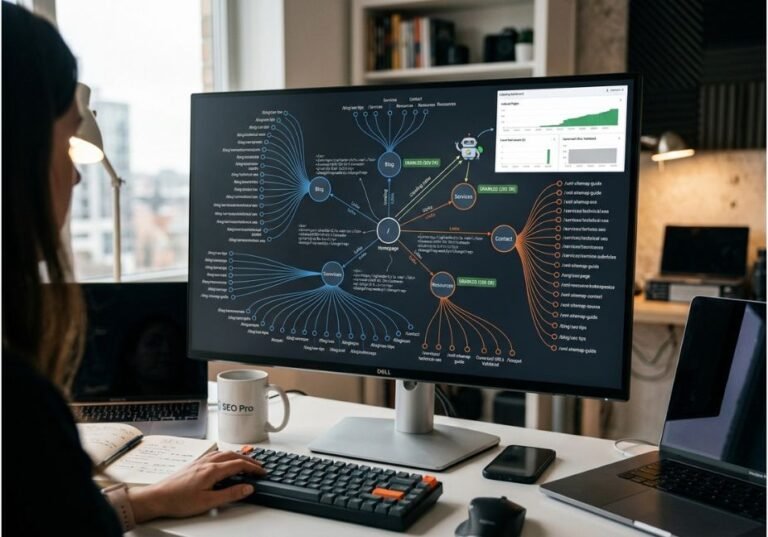
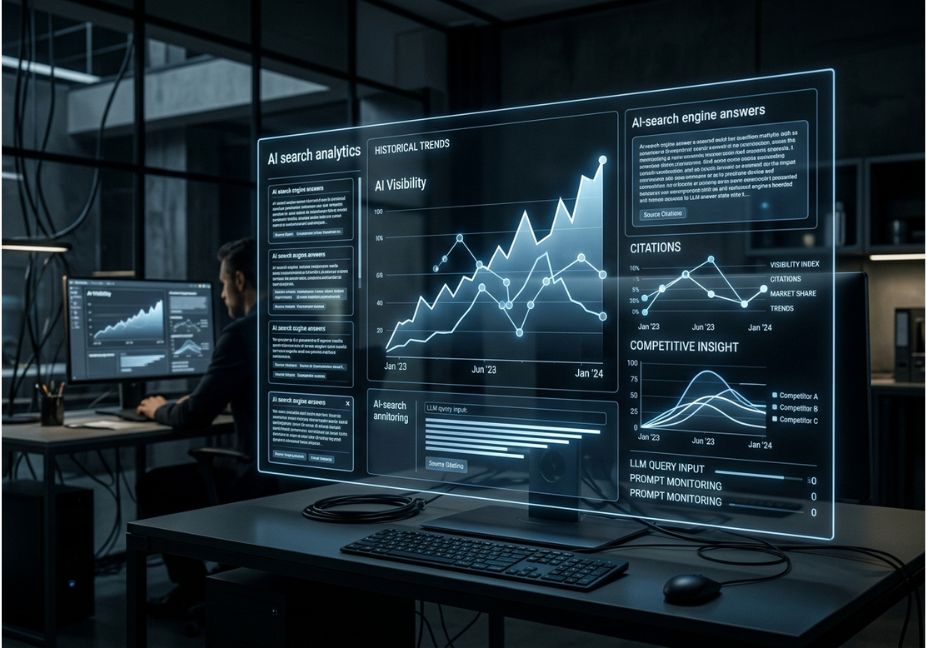
Most teams evaluating AI search optimization tools with historical data start by comparing dashboards and end up comparing marketing copy instead. Every vendor claims “deep historical tracking,” but almost none of them explain what that phrase actually means at the data layer: how often a prompt gets re-run, how a citation is extracted from a model’s response, or how a “mention” is distinguished from a hallucinated one.
That gap matters more than it used to. As generative engine optimization (GEO) the practice of getting content cited inside ChatGPT, Perplexity, and Google AI Overviews rather than just ranked in blue links becomes a real budget line, teams need historical data to prove whether their optimization work is moving the needle or whether a visibility swing is just model noise.
This guide skips the vendor-listicle format. We’ll cover what historical data means in this context, how the tracking pipeline actually works under the hood, which tools genuinely offer deep history versus a 30-day rolling window, and since this is a site for people who build with LLMs how to stand up a minimal tracker yourself.
What Is Historical Data in AI Search Optimization?
Historical data in AI search optimization is a stored, time-stamped record of how a brand, page, or entity appeared inside AI-generated answers including which model produced the answer, which sources it cited, and how that citation behavior changed over successive prompt runs.
This is distinct from classic SEO historical data (keyword rank over time, backlink growth, traffic trends), which comes from crawling ranked URLs. GEO historical data comes from repeatedly querying generative engines and parsing their output, which is closer to the evaluation methodology used in the GEO: Generative Engine Optimization paper (arxiv.org/abs/2311.09735), a black-box optimization framework built around impression metrics that let creators gauge how visible their content is inside generative engine responses. It’s worth reading directly if you want the underlying methodology rather than a vendor’s simplified dashboard version of it.
Did You Know? The original GEO research reported visibility lifts of up to 40% from specific content strategies with quotation addition and statistics addition producing the largest gains, while plain keyword stuffing barely moved the needle at all.
How Historical AI Visibility Tracking Actually Works
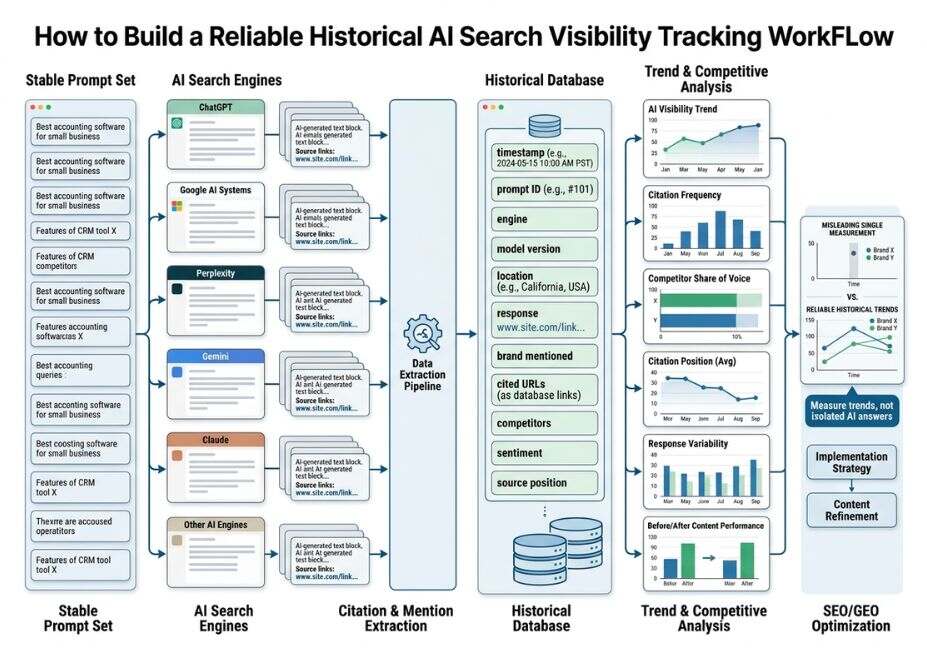
Every GEO/AEO tool with real historical data, regardless of vendor, is running some version of the same four-stage pipeline:
- Prompt sampling a fixed set of prompts (“best project management software,” “who makes the fastest EV charger”) gets stored and re-run against target models on a schedule.
- Response capture the raw model output is saved, not just a summary score. This is what separates tools with real history from ones that only store a daily “visible / not visible” flag.
- Citation and mention extraction parsing the response to find brand mentions, distinguish them from citations (a link or explicit source attribution), and match entities even when phrasing varies.
- Snapshotting and diffing storing each run so later analysis can diff week-over-week or month-over-month changes in share of voice.
Technical Note: Step 3 is the hard part. Naive string matching misses paraphrased mentions (“the Atlanta-based CRM” instead of the brand name), so serious tools use embedding similarity to catch near-matches — the same technique underlying retrieval in a standard RAG pipeline.
AI Search Optimization Tools With Real Historical Data, Compared
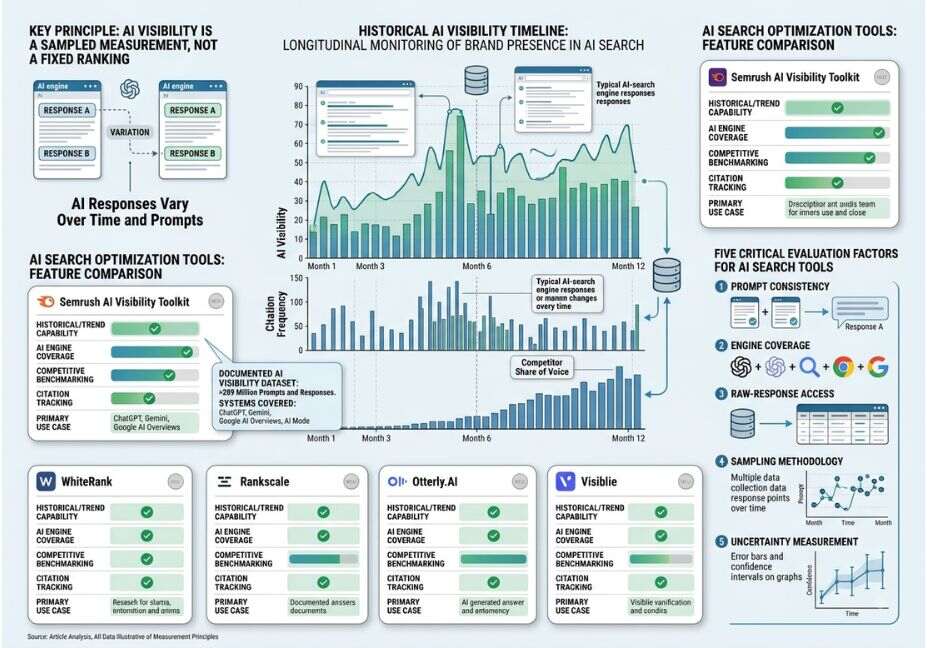
Not every tool that mentions “AI search” actually stores deep history. Some cap retention at 30 days on lower tiers; others go back years. Here’s how the categories break down.
| Tool | Historical depth | Engines tracked | Best for |
|---|---|---|---|
| Semrush (AI Visibility Toolkit) | Multi-year, inherited from its core SEO database | ChatGPT, Perplexity, AI Overviews | Teams that want AI tracking bolted onto existing SEO workflows |
| Ahrefs (Position History + AI Search Toolkit) | Multi-year for classic rank data; shorter for AI-specific tracking | ChatGPT, AI Overviews | Backlink-heavy strategies that also want AI visibility context |
| Conductor / BrightEdge | Years, enterprise-grade | Broad, enterprise SLA | Large orgs already paying enterprise SEO contract prices |
| Otterly AI | Weeks to months depending on tier | ChatGPT, Perplexity, Gemini | Small teams that just need simple prompt tracking |
| Peec AI | Months, with daily refresh | 10+ LLMs | Agencies needing broad multi-model coverage |
| A purpose-built self-hosted tracker (see below) | As long as you keep the storage | Whatever you configure | Engineering teams that want raw data ownership, not a dashboard |
Pro Tip: Before buying anything, ask the vendor two specific questions: “How many days of raw response history do you retain, not just scores?” and “Do you distinguish citations from mentions?” Most sales calls will dodge the first question that’s your signal.
Build vs. Buy: A Minimal Historical Visibility Tracker
If your team is already comfortable with LLM APIs, you don’t need a SaaS subscription to start collecting historical AI-visibility data you need a cron job, a prompt list, and somewhere to store the results.
Here’s a minimal pattern using OpenAI’s chat completions API (platform.openai.com/docs/api-reference/chat) to run a fixed prompt, extract mentions, and append a timestamped snapshot:
python
import json
import time
from datetime import datetime
from openai import OpenAI

client = OpenAI

PROMPTS =
    "What are the best AI search optimization tools?",
    "Which GEO platforms track historical citation data?",

BRAND_TERMS = ["YourBrand", "yourbrand.com"]

def run_snapshot:
    snapshot = {"timestamp": datetime.utcnow.isoformat(), "results":
    for prompt in PROMPTS:
        response = client.chat.completions.create(
            model="gpt-4.1",
            messages=[{"role": "user", "content": prompt}],

        text = response.choices[0].message.content
        mentioned = any(term.lower in text.lower() for term in BRAND_TERMS)
        snapshot["results"].append
            "prompt": prompt,
            "mentioned": mentioned,
            "raw_response": text,

    return snapshot

if __name__ == "__main__":
    data = run_snapshot
    with open(f"snapshots/{int(time.time())}.json", "w") as f:
        json.dump(data, f, indent=2)
Run this on a daily schedule and append each snapshot to storage even a flat JSON file works to start. Once you have a few weeks of runs, plot mentioned rate over time per prompt and you already have a basic share-of-voice trend line that no vendor dashboard is required for.
For a production version, swap the naive substring match for embedding-based similarity so paraphrased mentions get caught, and consider LangChain’s document loaders (python.langchain.com) if you want to pull in competitor citations and index them alongside your own for comparison.
Technical Disclaimer: Model outputs are non-deterministic. Run each prompt 3–5 times per snapshot and average the mention rate a single run is not a reliable data point, and the GEO research above evaluated strategies across repeated trials for exactly this reason.
Common Mistakes Teams Make With Historical AI Search Data
- Treating a single snapshot as a trend. One “not mentioned” result could just be model variance, not a real visibility drop.
- Confusing mentions with citations. A model naming your brand in passing is not the same signal as it linking to your page as a source track them separately.
- Ignoring retention windows. A free-tier tool advertising “historical tracking” that only keeps 7–30 days of data can’t tell you anything about a quarter-over-quarter trend.
- Only tracking one engine. ChatGPT, Perplexity, and Google AI Overviews cite differently; a strategy that lifts visibility in one can be flat in another.
- Skipping the raw response. Storing only a visibility score (not the actual model output) means you can’t later audit why a citation appeared or disappeared.
What Developers Are Saying
Outside of vendor marketing, practitioner discussion tends to be more skeptical of “historical data” claims than the sales pages suggest. Browsing recent r/LocalLLaMA (reddit.com/r/LocalLLaMA) discussion threads on tracking model citations is worth doing if you want to see engineers comparing notes on self-hosted tracking setups versus paid GEO platforms, including the tradeoffs around API cost when running prompts across multiple models daily.
FAQ — People Also Ask
What is historical data in AI search optimization?
Historical data in AI search optimization is a stored, time-stamped record of how a brand or page appeared in AI-generated answers over time, including which sources were cited. It differs from classic SEO history, which tracks ranked URLs rather than generative model output.
How far back does AI search historical data go?
It depends entirely on the tool and tier. Free plans often cap retention at 7–30 days; enterprise SEO platforms with AI features inherit multi-year history from their existing databases. Purpose-built GEO trackers vary widely, so always confirm raw retention, not just dashboard summaries.
What’s the difference between SEO historical data and GEO historical data?
SEO historical data comes from crawling and ranking web pages over time. GEO historical data comes from repeatedly querying generative engines and parsing their responses for citations and mentions a fundamentally different collection method with different noise sources.
Can I build my own AI search visibility tracker?
Yes. A minimal version only requires a fixed prompt list, a scheduled API call to a model like GPT-4.1, and storage for timestamped snapshots, as shown in the code example above. Production versions add embedding-based mention matching and multi-model coverage.
Which tool has deeper historical data, Semrush or Ahrefs?
Both inherit multi-year historical depth from their core SEO databases, which gives their newer AI visibility features more long-term context than most GEO-only startups. Neither has AI-specific tracking as mature as their classic rank-tracking data.
How often should AI search visibility be tracked?
Daily sampling is standard for teams treating this as a real KPI, since AI Overviews and chatbot answers can shift within 48 hours of a content update. Weekly sampling is common for smaller teams, but it will miss short-lived citation changes.
Conclusion
The tools that genuinely matter here separate into two camps: SEO platforms like Semrush and Ahrefs that bolted AI visibility onto multi-year historical databases, and purpose-built GEO tools that trade that depth for broader model coverage and faster refresh cycles. Neither camp has fully solved historical AI-visibility tracking yet which is exactly why understanding the underlying pipeline (prompt sampling, citation extraction, snapshotting) matters more than picking a vendor name off a listicle. If your team already works with LLM APIs, building a minimal tracker is a weekend project, not a procurement cycle.
Bookmark this guide and explore more hands-on AI agent tutorials at agentiveaiagents.com.