
Friction is at the centre of the traditional insurance model. Quote forms, hold queues, adjusters, and call back systems ensure that whatever speed a claim can be processed is reduced to a matter of hours or days instead of weeks. However, with the advent of Lemonade in 2026, everything changed. While legacy insurers were still operating AI pilots, Lemonade was able to automate 55% of its claims and virtually none of them had to be processed by a human. This statistic comes from Lemonade’s Annual Report the numbers reflect real-world performance across a matched peer group of insurance companies.
This was made possible through utilizing a sophisticated multi-agent conversational AI structure that includes three agents with explicitly defined responsibilities in the value chain: Maya, Jim AI, and Cooper. Identifying how each agent operates, and where they are most vulnerable in conducting their aspect of workflow will provide invaluable insight. The headline number provides context for the work being done. Therefore, the methodology of designing an agentic workflow is the source of value creation.
What Is Conversational AI in Insurance?
Conversational AI in insurance refers to NLP-powered systems that replace static forms, IVR phone trees, and human agents for core tasks. Specifically, these systems handle quoting, policy binding, FNOL intake, and claims adjudication.
Unlike rule-based chatbots, modern conversational AI agents use intent classification, slot filling, and dialogue state tracking. As a result, they handle open-ended user input and execute multi-step workflows automatically. The critical difference, moreover, is that these agents don’t just collect data they act on it. They query underwriting rules, trigger fraud scoring models, and issue binding decisions within a single conversation. This is exactly the foundation Lemonade built their entire operating model upon.
Lemonade’s Three-Layer AI Architecture Explained
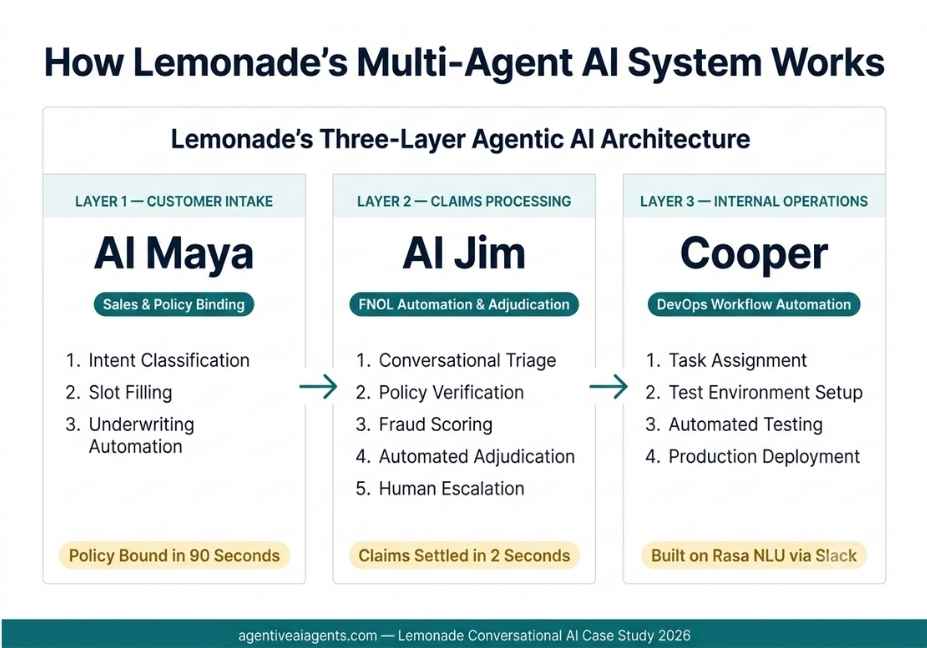
Lemonade’s AI stack is not one system. Instead, it is three purpose-built agents running in parallel across three separate domains. Together, they form one of the most complete agentic AI architectures deployed in financial services today.
Layer 1 : AI Maya: Conversational Intake and Policy Binding
Maya is Lemonade’s customer-facing sales agent. Her primary job is replacing the traditional insurance application entirely. According to the generative AI case study from Devoteam, Maya handles quote intake through adaptive NLP dialogue not a static form. She recommends coverage options, explains policy terms in plain language, and processes payment within a single conversational session.
So how does Maya actually work under the hood? Her pipeline breaks into three distinct functions:
First, intent classification determines what the user wants a new quote, a policy change, or a coverage question. Second, slot filling extracts structured data from natural language input. This includes address, dwelling type, and required coverage amount. Third, underwriting automation runs risk-scoring models against the collected slots before generating a binding quote.
The practical result is remarkable. A customer can get a fully bound insurance policy in under 90 seconds. Maya does not assist a human agent. She replaces the entire intake workflow from first message to signed policy.
Architect’s Note: Maya’s slot-filling pipeline is effectively the underwriting engine. Every conversational turn is also a data collection event that feeds directly into risk models. This is precisely why CEO Daniel Schreiber has stated publicly: “If you haven’t architected your company so that AI has access to deep information, it will be hard to glean the type of deep insights we’ve built our business upon.
Layer 2 : AI Jim: FNOL Automation and Claims Adjudication
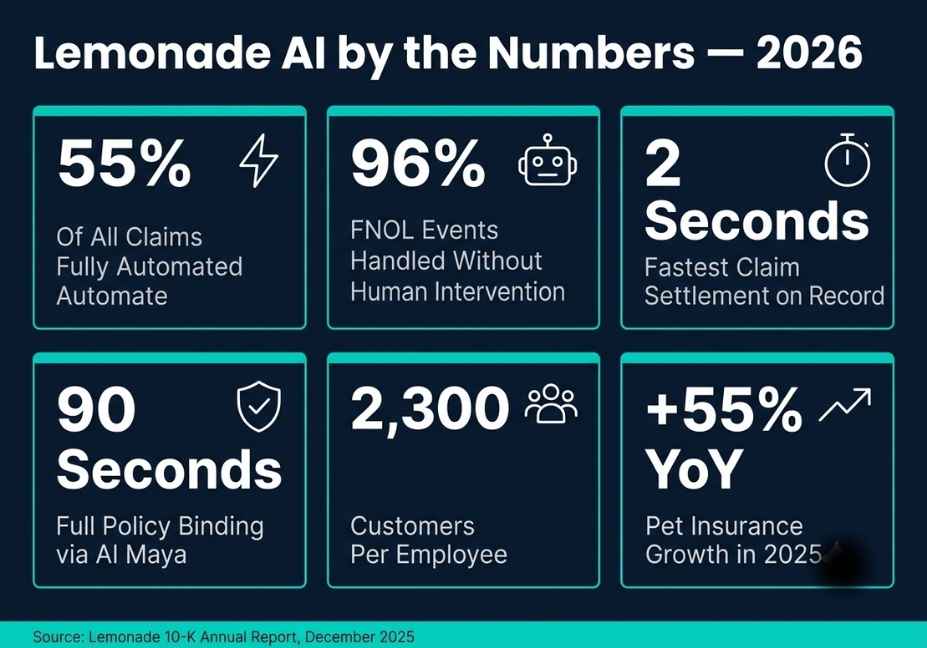
AI Jim handles Lemonade’s full claims lifecycle. According to Lemonade’s 2026 annual report, 96% of First Notice of Loss events are now handled by AI Jim without any human involvement. Furthermore, 55% of all claims are fully automated from submission to payout.
Jim’s pipeline follows a clear five-step agentic workflow loop:
Step 1 : Conversational triage: Jim asks targeted clarifying questions and captures claim details through NLP dialogue.
Step 2 : Policy verification: Jim runs an automated lookup against the customer’s active coverage terms.
Step 3 : Fraud and severity scoring: ML models analyze claim patterns, submission metadata, and behavioral signals. Notably, Lemonade has mentioned analyzing video submissions for non-verbal fraud cues a data input unavailable to traditional phone-based insurers.
Step 4 : Automated adjudication: For low-complexity, low-value claims that pass all fraud checks, Jim issues payment immediately.
Step 5 : Human escalation: Complex, high-value, or flagged claims route automatically to a licensed human adjuster.
This hybrid design is the key reason Jim’s automation rate keeps climbing. In 2021, roughly 30% of claims were automated. By year-end 2026, that figure reached 55%. Because the ML models sharpen as claims volume grows, the system improves continuously without manual retraining cycles.
Did You Know? Lemonade has paid out over $1 million in claims within seconds via AI Jim a figure cited across multiple public earnings disclosures. The fastest verified settlement on record stands at just 2 seconds.
Layer 3 Cooper: The Internal Agentic Workflow Bot
Most coverage of Lemonade focuses on Maya and Jim. However, Cooper the third agent is arguably the most technically instructive for AI engineers building agentic systems.
Cooper was built on Rasa’s open-source NLU framework. It serves as Lemonade’s internal automation brain, interfacing with the engineering team entirely through Slack. Specifically, Cooper handles DevOps workflows end to end: assigning tasks, preparing test environments, running automated test suites, deploying updates to production, and managing sprint planning.
Structurally, Cooper represents a pure agentic workflow pattern. It is a conversational interface layered over a set of backend tools, where the agent understands intent, selects the correct action, and executes it autonomously. This is precisely what modern LangChain developers call a tool-use loop. Importantly, Lemonade deployed Cooper in production in 2019 — years before that terminology entered mainstream AI discourse.
Pro Tip: If you are building internal DevOps agents , Cooper is the reference architecture. Treat every internal workflow as a tool the agent can invoke based on natural language intent not a hardcoded command list. The conversational interface is simply the routing and intent-resolution layer.
Key Metrics What Lemonade’s Conversational AI Actually Delivers
The numbers below come directly from public filings and earnings disclosures. Therefore, they represent production reality not vendor claims.
| Metric | Value | Source |
|---|---|---|
| Claims fully automated (2026) | 55% | Lemonade 10-K, December 2026 |
| FNOL handled without human intervention | 96% | Lemonade 10-K, December 2026 |
| Fastest claim settlement | 2 seconds | Lemonade public statements |
| Policy purchase time via Maya | Under 90 seconds | Q4 2026 Shareholder Letter |
| Customers per employee | ~2,300 | Lemonade 10-K, December 2026 |
| Gross loss ratio (Q2 2026) | 70% (–12 points YoY) | Agentic AI analysis of Lemonade’s Q2 2026 metrics |
| Pet insurance IFP growth (2026) | +55% year-over-year | Lemonade shareholder reporting |
The 2,300 customers per employee figure deserves special attention. Traditional insurers typically operate at ratios an order of magnitude lower. Conversational AI specifically the FNOL automation and policy binding pipelines is the leverage mechanism that makes that efficiency ratio achievable. Without it, Lemonade would need thousands more staff to reach the same output.
Failure Modes and Real Limitations (What Competitors Skip)
Understanding where Lemonade’s AI stack breaks down is just as important as understanding where it succeeds. In fact, this is the section that most competitor articles skip entirely.
Complex claims break the automation loop. AI Jim excels on straightforward, low-value claims with clean structured data. However, a water damage dispute with contested square footage, a stolen laptop with an unclear valuation, or a multi-party car accident these require contextual human judgment that current NLP and ML models cannot reliably replace. Consequently, Lemonade maintains an explicit human escalation path. It is not a fallback. It is a core design requirement.
Regulatory compliance constrains NLP architecture choices. Insurance is one of the most regulated industries globally. Every jurisdiction Lemonade operates in across the US, Europe, and the UK requires auditable, explainable claims decisions. As a result, the fraud-scoring models must be interpretable. Gradient boosted trees with explainable feature importance are the practical choice here, not black-box deep networks.
Adversarial or emotionally loaded inputs stress intent classifiers. Users who describe claims in non-standard, evasive, or highly emotional language push intent classification into low-confidence zones. Therefore, a well-designed dialogue management system must gracefully request clarification or escalate without degrading the user experience whenever confidence falls below an acceptable threshold.
Technical Note: The failure mode most teams underestimate is confident mis-classification. This occurs when the agent assigns a high-confidence intent label to an ambiguous input, proceeds autonomously, and produces a wrong outcome. Calibrated confidence thresholds with mandatory human review below a defined cutoff are non-negotiable in regulated environments like insurance.
Why Lemonade’s Architecture Is Hard to Copy
The engineering community has been analyzing Lemonade’s model intensively. The consensus is consistent: the real competitive moat is not the models themselves. Instead, it is the data flywheel.
Every Maya conversation enriches underwriting models. Every AI Jim claim resolution improves fraud detection accuracy. Every Cooper workflow execution tightens the DevOps feedback loop. Because of this compounding dynamic, Lemonade’s AI improves automatically as the business grows without manual intervention.
CEO Daniel Schreiber has articulated this directly across multiple earnings calls. Lemonade was “built for AI since day one.” This means the data architecture was designed from the start to feed AI models continuously. Legacy insurers, on the other hand, are retrofitting AI onto siloed, decades-old data systems. That structural disadvantage cannot be solved by purchasing better models or hiring more AI engineers. The data foundation has to be there from the beginning.
Additionally, Lemonade’s founding philosophy built on behavioral economics and co-founded by Daniel Schreiber and Shai Wininger shaped product decisions that reinforced AI-native data collection at every customer touchpoint. As a result, the company generates richer, more structured training data per customer than most traditional carriers generate per policy cohort.
FAQ People Also Ask
Lemonade uses an AI agent called AI Jim to handle the full claims workflow. Jim runs a five-step pipeline: conversational intake via NLP dialogue, policy verification, fraud and severity scoring via ML models, automated payout for clean claims, and human escalation for complex cases. As of year-end 2026, AI Jim handles 96% of all First Notice of Loss events. Additionally, 55% of all claims are fully settled in seconds without any human involvement.
AI Maya is Lemonade’s customer-facing conversational AI agent. She handles the full insurance onboarding workflow from quote to bound policy. Specifically, Maya uses NLP intent classification and slot filling to collect application data through adaptive dialogue. She then runs underwriting models against that data and generates a personalized quote. Customers can get a fully bound insurance policy in under 90 seconds. Furthermore, Maya works 24/7 without human agents involved at any point.
A standard insurance chatbot routes users to FAQs or human agents. Lemonade’s agents Maya, AI Jim, and Cooper are autonomous decision-making systems. They execute underwriting, claims adjudication, and DevOps workflows directly. In other words, they do not assist humans. Instead, they replace the workflow layer entirely. Human escalation is reserved only for edge cases that genuinely require judgment beyond the model’s capability.
AI Jim’s fraud detection layer uses ML models trained on claim submission patterns, policy history, and behavioral signals captured during the conversational interaction. Notably, Lemonade has discussed analyzing video claim submissions for non-verbal cues a data input that traditional phone-and-form insurers cannot access. Claims that score above a defined fraud-risk threshold are automatically routed to human review rather than auto-adjudicated.
Cooper runs on Rasa’s open-source NLU framework. It connects to Lemonade’s engineering team through Slack and acts as a conversational interface over DevOps tools. Specifically, Cooper runs test suites, deploys code to production, manages sprint tasks, and routes work to the right teams. Structurally, it is a production-grade tool-use agent loop deployed years before that pattern had a widely recognized name in the AI community.
The underlying models can be replicated. However, the data flywheel is far harder to copy. Lemonade’s advantage compounds over time because every customer interaction quote, policy change, or claim feeds back into improving AI model accuracy. Legacy insurers retrofitting AI onto siloed, decades-old data systems face a structural disadvantage. Therefore, purchasing modern tooling alone cannot close the gap. The data architecture has to be designed for AI from the very beginning.
Conclusion
Lemonade’s conversational AI stack is one of the most complete multi-agent agentic workflow deployments in financial services today. Three agents Maya handling intake and policy binding, AI Jim managing claims end to end, and Cooper automating internal DevOps each implement the same core pattern. Specifically, NLP dialogue management serves as the interface. Purpose-built ML models serve as the execution layer. Human escalation functions as the safety net for genuine edge cases.
The headline numbers are real. However, the architectural lesson matters more. A data flywheel that compounds every interaction into improved model performance is what makes this system defensible over time. Moreover, the Lemonade case study proves that conversational AI in insurance is not about replacing chatbots with better chatbots. It is about redesigning the entire operating model around autonomous agents from day one.
For AI engineers and insurtech architects building similar systems, the lesson is clear. Start with the data architecture. Build the flywheel first. Then deploy the agents.
Explore more production AI agent architectures and real-world agentic workflow case studies at agentiveaiagents.com.