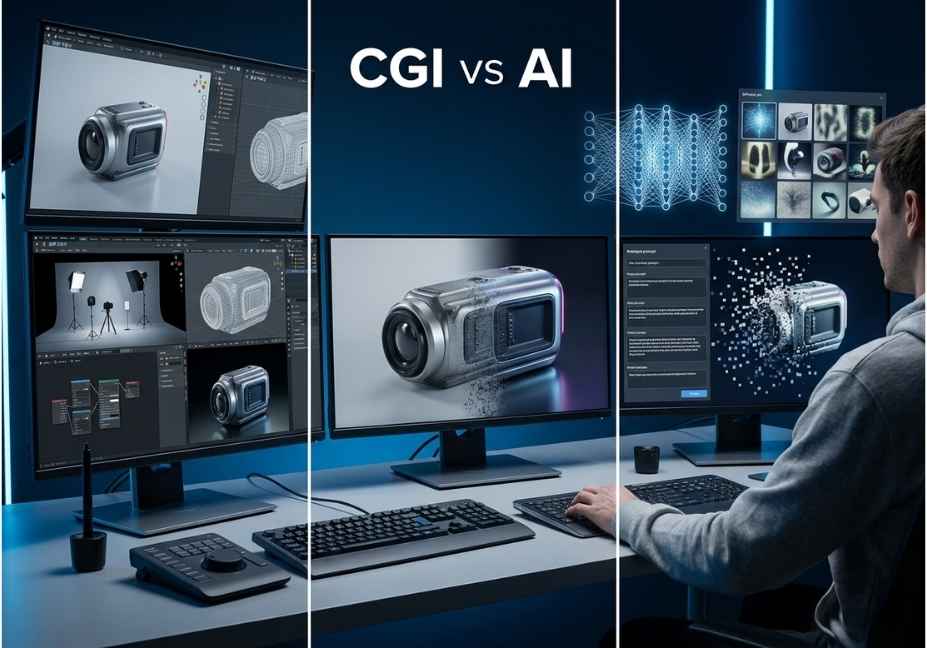
Eventually every creative team finds themselves in this situation – with a deadline approaching and a client requesting visuals, someone asks “do we use CGI or AI”. The answer depends completely on the end-goal of what you want from the output. The two mediums are actually not competing against each other, they’re solving different issues. Choosing incorrectly can ultimately lead to wasted resources in time and money and quite often can end a project entirely.
This guide details how both pipeline processes work, the issues that lie with both pipelines, and why the smartest studios in 2026 are leveraging both. Regardless of whether you are working in film, advertising, then creating architecture, product visualization; the decision framework discussed will directly correlate to your workflow.
What Exactly Is CGI? A Clear Definition
CGI stands for computer-generated imagery. It is a deterministic, artist-controlled visual production pipeline used to create photorealistic images, animations, and visual effects. Because the output is built step by step from a 3D model, every element in a CGI image is inspectable, adjustable, and repeatable.
In other words: if a shadow looks wrong, you move the light. If a surface reads as plastic instead of steel, you edit the shader. Nothing happens without a deliberate artistic decision behind it.
CGI has been the backbone of Hollywood visual effects since Jurassic Park demonstrated its commercial potential in 1993. Today it powers product commercials, architectural visualization, video game assets, digital twins, and the majority of high-budget film VFX.
What Exactly Is AI Image Generation? A Clear Definition
AI image generation is a prompt-based, data-driven method of creating images using machine learning models most commonly diffusion models or generative adversarial networks. Tools like Stable Diffusion, Midjourney, and DALL-E 3 accept a text prompt and produce a novel image in seconds by sampling from a statistical distribution learned from billions of training images.
Critically, there is no 3D scene behind an AI-generated image. There is no geometry, no shader, no light rig. The model predicts what pixels should look like given your prompt, based on patterns in its training data. The output is visually plausible. It is not physically verified.
That distinction physical accuracy versus perceptual plausibility is the root cause of almost every failure teams encounter when they apply the wrong tool.
How Does CGI Work? The Full Production Pipeline Explained
Understanding the CGI pipeline helps you know exactly where it delivers value and where it becomes expensive. The process moves through six stages, and each one builds on the last.
It begins with 3D modeling, where artists construct digital geometry using tools like Blender, Maya, or Houdini. From there, the model moves into UV mapping and texturing, where realistic surface materials are applied wood grain, metal reflections, fabric weave. A lighting setup follows, simulating natural or studio illumination using physically-based render engines. Then comes camera placement and animation. Finally, a render engine like Cycles, V-Ray, or Arnold processes the scene into a finished image. Compositing and color grading complete the chain.
Every stage produces an inspectable file. Therefore, errors can be caught, fixed, and re-rendered without rebuilding from scratch. That is CGI’s defining advantage in professional production: the pipeline is auditable end to end.
For example, a car brand producing 60 product renders across six colorways can build the 3D asset once and re-render it under different lighting conditions indefinitely. The geometry stays identical. The brand consistency is guaranteed.c
How Does AI Image Generation Actually Work?
AI image generation works through a process called diffusion. The model starts with random noise and progressively removes that noise over dozens or hundreds of steps, guided by a language embedding of your text prompt. At each step, a neural network typically a UNet architecture predicts what the image should look like as it moves closer to your description.
Consequently, the output is the model’s best statistical prediction of an image matching your words, not a rendered scene. There is no underlying geometry. There is no light source positioned in 3D space. The image looks real because the training data contained real images. It is not real because a physical process was simulated.
This distinction matters enormously for production decisions. Because the output is probabilistic rather than deterministic, re-running the same prompt produces a different image. Seed-locking helps reduce variation, but it does not eliminate it. Furthermore, the model has no concept of brand guidelines, engineering tolerances, or visual continuity across a sequence of frames.
CGI vs AI: Direct Comparison Across 7 Production Factors
Understanding the difference comes down to seven practical factors that affect every creative project.
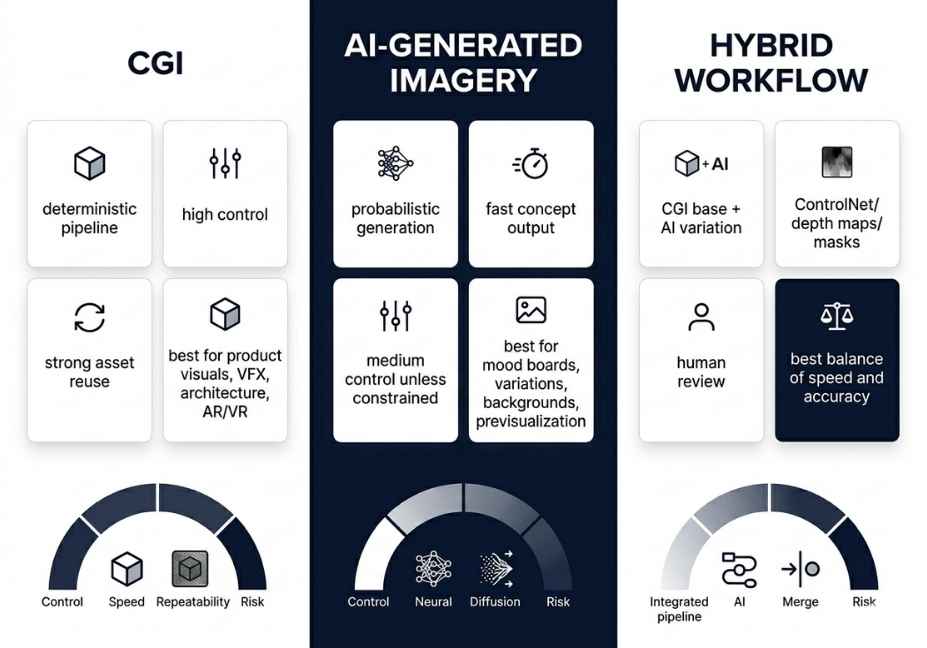
Input type. CGI starts from a 3D model and a scene setup. AI starts from a text prompt and optionally a reference image. As a result, CGI requires specialist modeling skills upfront, while AI requires prompt engineering skills to produce usable outputs.
Output control. CGI output is deterministic the same inputs produce the same output every time. AI output is probabilistic the same prompt produces a different image each time. Therefore, CGI is the only viable option when exact repeatability is required.
Speed. AI generates an image in seconds to minutes. CGI render times range from hours to days depending on scene complexity and available render farm compute. However, once CGI assets are built, future renders from the same scene become faster because the geometry and materials are already in place.
Geometric accuracy. CGI produces exact geometry that matches technical drawings or engineering specifications. AI produces approximate geometry that is perceptually convincing but not dimensionally reliable. For regulatory, architectural, or engineering deliverables, CGI is the only option.
Multi-shot consistency. CGI maintains perfect consistency across multiple shots because the same 3D asset is reused. AI cannot guarantee consistency even with identical prompts, geometry and surface details shift between generations. This is the most common failure mode teams discover too late.
Cost structure. CGI costs are transparent: artist time, render farm compute, and software licenses. AI costs are less visible: prompt iteration time, quality control curation, and the remediation of consistency errors. For final hero assets, CGI frequently delivers better cost-per-usable-frame than AI.
Failure mode. CGI fails through render errors and lighting artifacts problems that are visible and correctable in the pipeline. AI fails through hallucinated geometry, inconsistent branding, and the absence of any technical ground truth to correct from. These failures are often discovered at the delivery stage, not during production.
Can AI Replace CGI? Here Is the Honest Answer
No AI cannot replace CGI for precision production work, and the practitioners building these workflows are clear about why. However, AI is genuinely replacing CGI for a specific category of work: rapid ideation, style exploration, and visual concepting where geometric accuracy is not the goal.
Moreover, AI tools are being embedded inside CGI pipelines as accelerators. For instance, NVIDIA’s OptiX AI Denoiser uses deep learning to remove noise from partially-rendered frames, reducing render compute time by 70 to 80 percent per sequence without changing the underlying geometry or artistic decisions. According to a 2026 analysis by Vitrina, de-aging and digital double work that cost over ten million dollars five years ago is now accessible to mid-budget productions through AI-enhanced CGI pipelines.
Therefore, the accurate framing is this: AI is replacing the slowest, most expensive phases surrounding CGI production while CGI remains the standard for the final deliverable itself.
CGI vs AI for Film and VFX: Real Use Cases
Digital doubles and de-aging. Traditional CGI de-aging required hundreds of artist hours and cost tens of millions of dollars. Today, AI-enhanced CGI pipelines produce convincing results at a fraction of the cost. The underlying process is still CGI AI accelerates the texture mapping and compositing phases.
Product visualization for advertising. CGI dominates here because brand consistency across dozens of renders is non-negotiable. AI is used in the concepting phase to explore background environments and lighting moods before the CGI production run begins.
Architectural visualization. CGI is the standard for final renders that will be used in planning applications, investor presentations, or regulatory submissions. AI is increasingly used to generate early-stage mood boards and atmosphere references. Because floor plans contain confidential client data, cloud-based AI generation introduces NDA risk making locally-run open-weight models or on-premises CGI the only safe options.
Social content at scale. AI image generation is genuinely superior for brands producing 30 or more unique social visuals per week. At that volume, CGI render costs and timelines make the pipeline impractical. AI delivers sufficient visual quality for mobile-first social formats where photorealism is not scrutinized at the pixel level.
CGI vs AI for Marketing and Advertising: Which Should You Choose?
If you are a marketer trying to decide which approach fits your campaign, the answer comes down to three questions.
First, will this visual be scrutinized closely in print, on a large screen, or by a legal team? If yes, use CGI. Second, do you need the same product to look identical across 20 or more images? If yes, use CGI. Third, are you exploring creative directions before committing to production? If yes, use AI.
Because of this, most professional agencies now operate a hybrid model. AI handles concepting and rapid iteration. CGI handles final delivery. The two work together rather than competing.
The Hybrid Pipeline: How Top Studios Use Both Together
The most efficient visual production teams in 2026 run a three-phase hybrid pipeline that uses each technology where it performs best.
In the ideation phase, a diffusion model generates 15 to 20 style references from text prompts. This allows a creative team to identify the strongest visual directions in hours rather than weeks. Because this phase is exploratory, approximate AI outputs are entirely appropriate.
In the production phase, the selected directions move into a CGI pipeline. Artists build 3D models and set up scenes using physically-based rendering. During the render pass, AI denoising tools like NVIDIA’s OptiX Denoiser reduce compute time by four to eight times. Consequently, a VFX sequence that previously required 200,000 compute hours can be completed in 30,000 to 50,000 hours a material reduction in render farm costs.
In the post-production phase, AI tools automate rotoscoping, background removal, and upscaling of lower-resolution passes. Meanwhile, human compositors handle brand-critical quality control and final color grading. The result is a pipeline that is faster and cheaper than pure CGI, more consistent and accurate than pure AI, and therefore better than either approach used alone.
Common Mistakes Teams Make When Choosing CGI or AI
Using AI for a final hero asset. This is the most expensive mistake in visual production. Teams that route final product shots through a diffusion model because early concept outputs looked convincing discover in quality control that geometry, proportions, and brand colors have drifted. Fixing those errors in post costs more time than a CGI render would have required from the start.
Using CGI for ideation. Commissioning a full 3D model to explore whether a product looks better against a white background or a lifestyle environment is a budget error. AI answers that question in minutes. CGI should begin after the creative direction is confirmed, not before.
Ignoring NDA risk in cloud-based AI workflows. Sending confidential product designs to a cloud-based AI generation service means that design is processed on external servers. For any project under a non-disclosure agreement, locally-run open-weight models or a standard CGI pipeline are the only safe choices.
Assuming AI consistency is solved. It is not. Seed-locking helps, but it does not guarantee that a product will appear geometrically identical across 50 shots the way a CGI asset does. Teams that build campaigns on this assumption discover the gap during final delivery not during production.

FAQ People Also Ask
What is the difference between CGI and AI?
CGI builds images through 3D modeling and physics-based rendering a deterministic process where every element is manually constructed and controlled. AI generates images by predicting pixels from patterns in training data. CGI gives you exact geometry and guaranteed consistency. AI gives you speed and approximate aesthetics. They are fundamentally different pipelines, not competing versions of the same tool.
Can AI replace CGI artists?
Not for precision production work. AI tools are replacing specific repetitive tasks rotoscoping, background removal, and texture generation but they cannot replace the structured 3D modeling and rendering expertise that CGI artists provide. In practice, AI is making CGI artists more productive by handling automation, while artists focus on the craft decisions that require human judgment.
Which is more expensive CGI or AI?
CGI has higher upfront costs: artist time, render farm compute, and software licenses. AI has lower direct costs but higher hidden costs including quality control time, prompt iteration, and consistency remediation. For a campaign requiring dozens of final-quality renders with identical geometry, CGI is almost always the better investment because it eliminates the hidden costs of AI curation.
Is AI-generated imagery good enough for professional use?
It depends on the context. For social media concepting, mood boarding, and ideation, AI-generated imagery is excellent. For final product shots, architectural submissions, regulatory documents, or any deliverable where geometric accuracy and brand consistency will be audited, CGI remains the professional standard. Many studios use AI outputs as reference material that feeds into a CGI pipeline, rather than as final deliverables.
How are CGI and AI used together in film production?
In modern VFX pipelines, AI is used to accelerate CGI not replace it. AI denoising tools reduce render compute times by 70 to 80 percent. AI automates rotoscoping and background removal in post-production. AI generates texture references and style explorations in pre-production. The final VFX shot is still constructed in a CGI pipeline because only CGI can guarantee the geometric accuracy and multi-shot consistency that theatrical release requires.
Conclusion
CGI and AI are not competitors. They are tools that belong to different phases of a visual production workflow. CGI wins when precision, consistency, and technical accuracy are the requirement. AI wins when speed, volume, and creative exploration are the requirement. Therefore, the question is not which technology is better it is which phase of your pipeline you are in.
The teams producing the most cost-efficient, highest-quality visual content in 2026 have stopped treating this as a choice. Instead, they use AI to move faster in the phases where approximation is acceptable. They use CGI to anchor the phases where exactness is required. Getting that boundary right is the engineering discipline that separates efficient production from expensive rework.
For more in-depth breakdowns of AI-augmented production pipelines and agentic visual workflows, explore agentiveaiagents.com.