
Most “AI tools for product managers” roundups read the same way: a logo, a one-line pitch, a pricing tier. But they skip the part that actually determines whether a tool saves you an afternoon or quietly wastes it the agent loop underneath the interface. In other words, a tool that drafts a PRD isn’t magic. It’s a planner, a retrieval step, and a tool-use loop wearing a nice UI.
That distinction matters because the failure modes are predictable once you understand the mechanism. A model with no retrieval-augmented generation layer will happily invent a customer quote it never saw. Similarly, an agent with no memory will forget the constraint you gave it three prompts ago. So, this guide walks through how these systems actually work, where PMs are using them well in 2026, and where teams keep getting burned.
Quick answer: The best AI tools for product managers in 2026 aren’t chatbots they’re agents that plan, retrieve grounded data, and call tools autonomously. Look for a visible retrieval step, a documented tool-use loop (often via MCP), and a human checkpoint before output reaches stakeholders.
Pro Tip: Before adopting any AI PM tool, ask one question “what does this tool do when it doesn’t know the answer?” Tools that silently guess are the ones that generate confident, wrong PRDs.
What Is an AI Agent for a Product Manager?
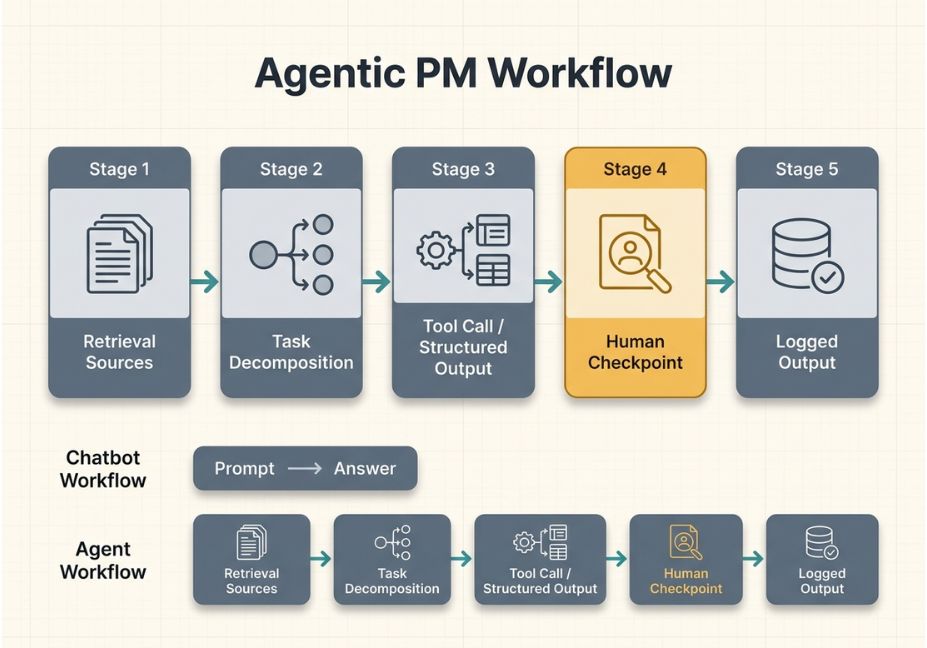
An AI agent for a PM isn’t a chatbot that answers one prompt at a time. Instead, it’s a system that observes context, plans a sequence of steps, and calls tools pulling a Linear ticket, summarizing a transcript, drafting a doc to complete a multi-step workflow with minimal hand-holding. As a result, the output is a finished artifact (a PRD, a synthesized theme report), not just a paragraph of text.
For PMs asking which AI tools for product managers actually replace manual busywork rather than adding another dashboard to check, the honest answer is: only the ones built as agents, not chat wrappers.
The building block behind most of these systems is well documented on the general Wikipedia entry on retrieval-augmented generation (https://en.wikipedia.org/wiki/Retrieval-augmented_generation), which every serious PM tool now leans on to keep outputs grounded in real customer data instead of the model’s training memory.
How Does an Agentic PM Workflow Actually Work?
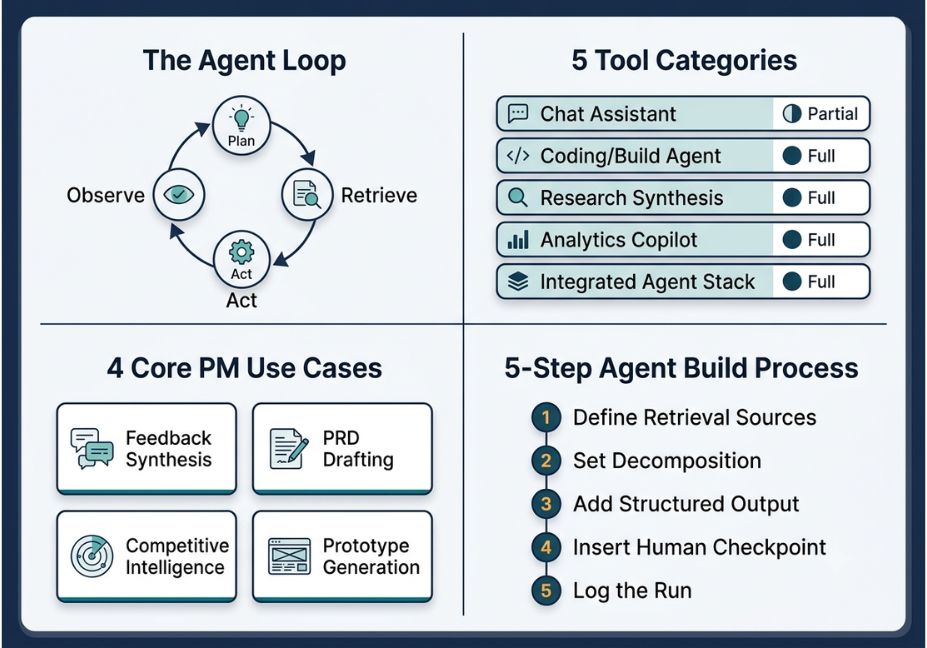
Under the hood, most PM agents run a loop: plan → retrieve → act → observe → repeat. First, the planning step decomposes a broad ask (“synthesize this quarter’s feedback”) into smaller calls. Next, the retrieval step pulls grounding data support tickets, interview transcripts instead of letting the model free-associate. Finally, the action step is a tool call: querying a database, drafting a section, or updating a ticket.
This interleaving of reasoning and action is formally described in the ReAct pattern for interleaving reasoning and action (https://arxiv.org/abs/2210.03629). The research showed that models perform measurably better when forced to alternate between “thinking out loud” and taking a concrete action, rather than reasoning in one long, unverified block.
Meanwhile, tool calls themselves are typically implemented through structured function definitions. This is the same approach outlined in OpenAI’s function calling documentation (https://platform.openai.com/docs/guides/function-calling), where the model is given a fixed schema (tool name, parameters) and picks which to invoke based on the current step.
Architect’s Note: The riskiest part of this loop isn’t the model it’s the retrieval step. If your feedback synthesis agent is pulling from a stale support-ticket export, every downstream PRD inherits that staleness. Check data freshness before you check prompt quality.
AI Tools for Product Managers Real-World Use Cases
PMs are running agentic workflows across four recurring jobs-to-be-done:
- Feedback synthesis: clustering themes across interviews, tickets, and reviews instead of reading every line manually
- PRD and spec drafting: generating a structured first draft from tickets, transcripts, or a rough brief
- Competitive intelligence: monitoring competitor changelogs and pricing pages on a schedule
- Prototype generation: turning a PRD directly into a clickable interface for early usability testing, closing the loop faster than a written spec ever could
These use cases map closely onto the classic Jobs-to-Be-Done and OKR-driven roadmap frameworks PMs already use the agent doesn’t replace the framework, it just automates the grunt work feeding into it. So, whether you run dual-track discovery or a straightforward quarterly roadmap cadence, the same agent loop applies underneath.
For teams specifically searching for AI tools for product managers without a data science background, this is the layer that matters most: an agent that clusters and ranks feedback in plain English, with no SQL or scripting required.
Did You Know? Teams that pair AI-drafted PRDs with real interview transcripts as grounding data catch a meaningfully higher share of invented requirements before engineering ever sees the doc. In short, the gap is almost entirely about what the agent was allowed to read, not which model it runs on.
Best Tools and Frameworks for Agentic PM Workflows
Not every “AI PM tool” is built the same way. Some are single-prompt chat wrappers. Others, however, run genuine multi-step agent loops with real tool access. The distinction is the entire ballgame.
Comparison of tool types:
- Chat assistant (ChatGPT, Claude chat): Partial agentic no persistent tool loop. Best for drafting, brainstorming, quick rewrites.
- Coding/build agent (Claude Code, Cursor): Fully agentic multi-step, file + tool access. Best for PRD-to-prototype, cron-based monitoring.
- Research synthesis (Dovetail, NotebookLM): Partial agentic retrieval-heavy, limited action. Best for interview and ticket theme clustering.
- Analytics copilot (Amplitude AI, Mixpanel): Partial agentic query generation, not action. Best for natural-language metric queries.
- Integrated agent stack (MCP-connected tools like Linear, Jira, Notion): Fully agentic full loop with real tool calls. Best for cross-tool workflows, autonomous triage.
The connective tissue that makes the last row possible is Anthropic’s Model Context Protocol (https://modelcontextprotocol.io/) an open standard that lets an agent discover and call tools such as a ticket tracker, a knowledge base, or a calendar, without a custom integration for each one. As a result, a 2026-era PM agent can move from “read the Linear backlog” to “draft a PRD” to “post it to Notion” in a single autonomous run, instead of three separate copy-paste steps.
Technical Disclaimer: MCP server implementations and tool schemas change frequently. Verify against the official protocol documentation before wiring any agent into a production PM workflow.
Step-by-Step: How to Build a Feedback-Synthesis Agent
- Define the retrieval sources. Point the agent at your actual support tickets, interview transcripts, and review exports not a generic prompt with no grounding data.
- Set the decomposition step. Have the agent break “summarize this quarter’s feedback” into sub-tasks: pull data, cluster by theme, rank by frequency, draft summary.
- Add a tool call for structured output. Use a function-calling schema so the agent returns clustered themes as structured data, not a wall of prose you have to re-parse.
- Insert a human checkpoint. Before the summary reaches stakeholders, a PM reviews flagged themes against the raw source this is where invented patterns get caught.
- Log the run. Keep a record of which sources were retrieved for which output, so a wrong conclusion is traceable back to its data.
Code snippet (simplified tool-use loop for a feedback synthesis agent):
def run_agent(query, tools, max_steps=5):
    context = retrieve(query)  # pull tickets, transcripts, reviews
    for step in range(max_steps):
        plan = model.plan(query, context)
        if plan.action == "final_answer":
            return plan.output
        result = tools[plan.action](plan.params)
        context.append(result)
    return "max steps reached — escalate to human review"
Common Mistakes and How to Avoid Them
- Treating AI-drafted PRDs as evidence. A fluent PRD section is not a validated customer need it’s structure and tone. The “why now” has to come from real discovery data, not the model’s fluent prose.
- Skipping the retrieval step entirely. Prompting a general chatbot without feeding it real tickets or transcripts guarantees a plausible-sounding but ungrounded draft.
- Buying one tool to do five jobs. An all-in-one “AI for product” platform that handles research, writing, and analytics at a C+ level usually loses to one focused tool per stage.
- No human checkpoint before stakeholder distribution. Every agent output that reaches a stakeholder should pass through a PM’s eyes first, specifically checking for invented specifics.
These aren’t hypothetical concerns. In fact, a thread on r/LocalLLaMA about agent reliability in production (https://www.reddit.com/r/LocalLLaMA/) surfaces the same pattern engineers keep running into: agents fail quietly, not loudly. Usually, the failure traces back to bad or missing context rather than a bad model.
What Developers Are Saying
Engineering-adjacent PMs increasingly describe their AI stack the way they’d describe a junior engineer’s toolchain version-pinned, logged, and reviewed rather than a magic black box. The recurring theme across practitioner discussions is that autonomy without a review checkpoint is the actual risk, not the model’s raw capability.
FAQ People Also Ask
What is an AI agent for a product manager?
An AI agent for a PM observes context, plans multi-step actions, and calls tools like pulling tickets or drafting docs to finish a workflow on its own, instead of just answering one prompt.
Can AI write a PRD without human input?
AI can draft a structurally complete PRD from tickets or transcripts. However, the customer problem and the “why now” should come from real discovery data, and a PM should review the draft first.
Do AI PM tools replace human judgment?
No. AI handles repetitive synthesis and drafting work. But prioritization, tradeoff calls, and stakeholder alignment still depend on human judgment.
How do AI agents connect to PM tools like Jira or Linear?
Most agents connect through structured tool-calling schemas or an open protocol like MCP. This lets the agent discover actions like reading a ticket or posting a comment without a custom integration for each tool.
Is it safe to feed customer data into AI tools?
It depends on the tool’s data policy. Avoid pasting confidential customer data into public, non-enterprise AI tools until you’ve checked the vendor’s retention and training policy.
What’s the best AI tool for product managers right now?
There isn’t one universal answer it depends on the job. For PRD drafting and multi-step automation, Claude Code and MCP-connected agent stacks lead. For research synthesis, Dovetail and NotebookLM are strong picks.
Conclusion
The most useful AI tools for product managers in 2026 aren’t the ones with the flashiest demo. Instead, they’re the ones with a grounded retrieval step, a transparent tool-use loop, and a clear human checkpoint before output reaches stakeholders. So, understand the agent loop underneath a tool, and you’ll quickly spot which platforms are doing real multi-step work versus which are just a chat window with a new coat of paint.
Ultimately, this same agent-loop lens applies whether you’re evaluating a feedback synthesis tool, a roadmap copilot, or a prototyping agent the underlying orchestration layer, not the marketing page, tells you what you’re really buying.
Bookmark this guide and explore more hands-on agentic AI tutorials at agentiveaiagents.com.