

A five-location retail brand recently learned this lesson the hard way. Their AI review-reply agent had been set to “auto-publish,” and within weeks it produced a burst of near-identical, AI-flavored responses across every location. As a result, Google’s fake-engagement detection flagged the pattern, and their profiles picked up a public warning banner overnight.
That’s the real risk behind AI tools for Google Business Profile optimization in 2025. The tools work. However, most guides never explain the loop these tools actually run, or where Google draws the line on autonomy.
This isn’t a vendor roundup. Instead, it’s a breakdown of what these tools are AI agents running a repeatable tool-use loop of audit, draft, and publish and where a human checkpoint has to stay in that loop, both for quality and for policy compliance.
What Is AI-Driven Google Business Profile Optimization?
AI-driven GBP optimization means using a language model or a purpose-built agent to handle the repetitive parts of managing a listing. That includes writing the business description, suggesting categories, drafting Google Posts, and generating first-pass replies to reviews.
It doesn’t replace the underlying local-ranking factors. Relevance, distance, and prominence still decide who shows up in the Local Pack and on the Knowledge Panel.
What has changed is the mechanism. These tools now behave less like a text generator and more like a system of AI agents that continuously optimize local presence keeping listings accurate, responding to reviews, publishing content, and surfacing insights across every location. This is exactly the tool-use loop that defines an intelligent agent (Wikipedia: Intelligent agent).
How Does an AI Agent Optimize a Google Business Profile?
Under the hood, most of these tools run some version of a perceive → plan → act → verify loop. This is a close cousin of the ReAct pattern of reasoning and acting in a loop (Yao et al., 2023, arXiv:2210.03629), a pattern first formalized in natural language processing research.
- Perceive the agent pulls current profile data: categories, hours, photos, review text, and sentiment.
- Plan using intent classification and entity extraction, it identifies gaps, such as missing attributes, stale posts, or unanswered reviews.
- Act it drafts a description, a post, or a review reply, grounded in the profile’s existing brand voice.
- Verify the draft either auto-publishes or waits for human approval, depending on how the tool is configured.
That fourth step is where tools genuinely diverge. Some platforms Semrush’s dedicated GBP agent, for example, or Birdeye’s BirdAI route review replies and post drafts through an approval queue by default. Others, on the other hand, increasingly support one-click, low-oversight automation. That’s precisely the setting that got the retail brand in the introduction flagged.
Technical Note: Framework and product capabilities here move fast. The automation levels described in this article reflect tool behavior as of mid-2026. Always check the vendor’s current documentation before assuming a feature works the way it did last quarter.
Which AI Tools Are Best for Google Business Profile Optimization in 2025?
Rather than a flat top-10 list, the tools worth knowing about split cleanly into three jobs. Below is a breakdown of each, including free and budget options.
1. General-purpose LLMs (ChatGPT, Claude) best free option
These are best for one-off content generation: descriptions, a month of Google Posts drafted in one sitting, review-reply templates by star rating, and a Q&A seed list. A good prompt is most of the result here. Vague briefs, in contrast, produce the same generic description every competitor in the category also generated. There’s no native GBP connection, so you copy the output in yourself.
Long-tail use case: “how to optimize Google Business Profile with ChatGPT” feed it your services, service area, and three competitor descriptions, then ask it to write a 750-character description using your specific category keywords.
2. All-in-one local SEO platforms best for multi-location brands
Semrush’s GBP AI Agent and Birdeye’s BirdAI sit here, alongside Yext and Synup. These connect directly to the profile, run continuous audits, and increasingly close the loop from draft to publish, with configurable human review.
Birdeye Reviews AI, for instance, automates review generation, crafts on-brand responses based on sentiment, and surfaces insights that help improve ratings and strengthen local SEO performance at scale. Similarly, Semrush includes a dedicated GBP AI Agent for automated review replies, integrated within a broader SEO suite.
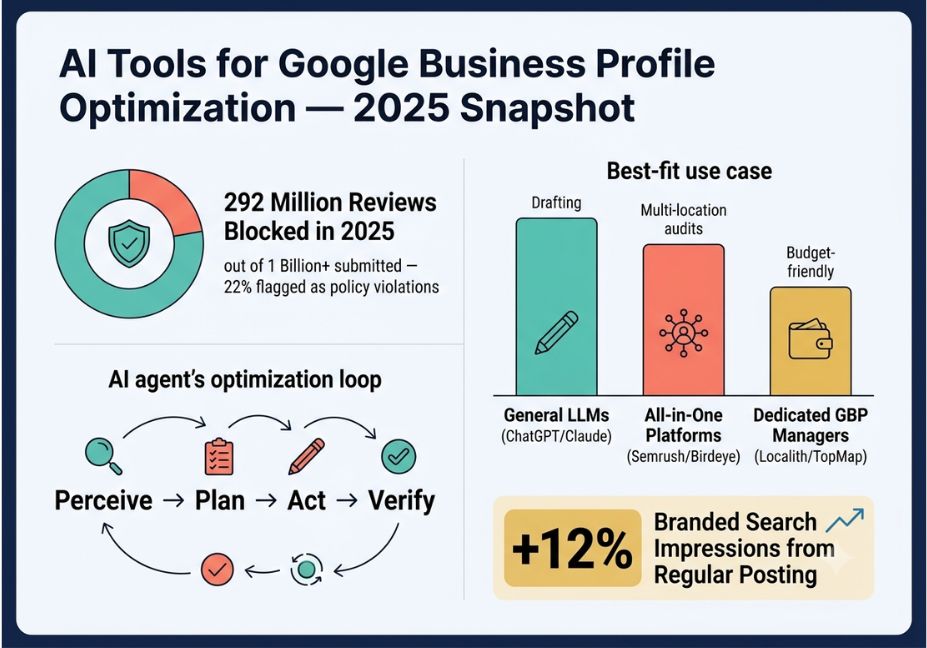
3. Dedicated, budget-friendly GBP managers best for single locations
Tools like Localith and TopMap are narrower and cheaper, built specifically for GBP rather than full local SEO. Localith, for example, offers AI-powered posting capabilities alongside its review management features. Consequently, it’s a reasonable entry point for a single-location business that doesn’t need a full SEO suite.
| Tool category | Example tools | Best for | Human-in-the-loop by default? |
|---|---|---|---|
| General LLM | ChatGPT, Claude | Drafting copy, one-off content | Always (manual copy-paste) |
| All-in-one platform | Semrush, Birdeye | Multi-location, continuous audit + publish | Configurable check settings |
| Dedicated GBP manager | Localith, TopMap | Single-location, budget-conscious | Configurable check settings |
Did You Know? Google blocked or removed more than 292 million policy-violating reviews in 2025, out of over 1 billion submitted roughly 22% of all review activity. Detection today is largely automated pattern-matching, not manual complaints.
What Are Real-World Use Cases for AI in Google Business Profile Management?
- Multi-location retail: bulk-auditing 50+ profiles for missing categories and inconsistent hours (NAP consistency) in one pass, instead of manually checking each listing.
- Service businesses (law, HVAC, dental): generating a weekly Google Post tied to a real offer or seasonal service, which keeps the freshness signal alive without a dedicated marketer.
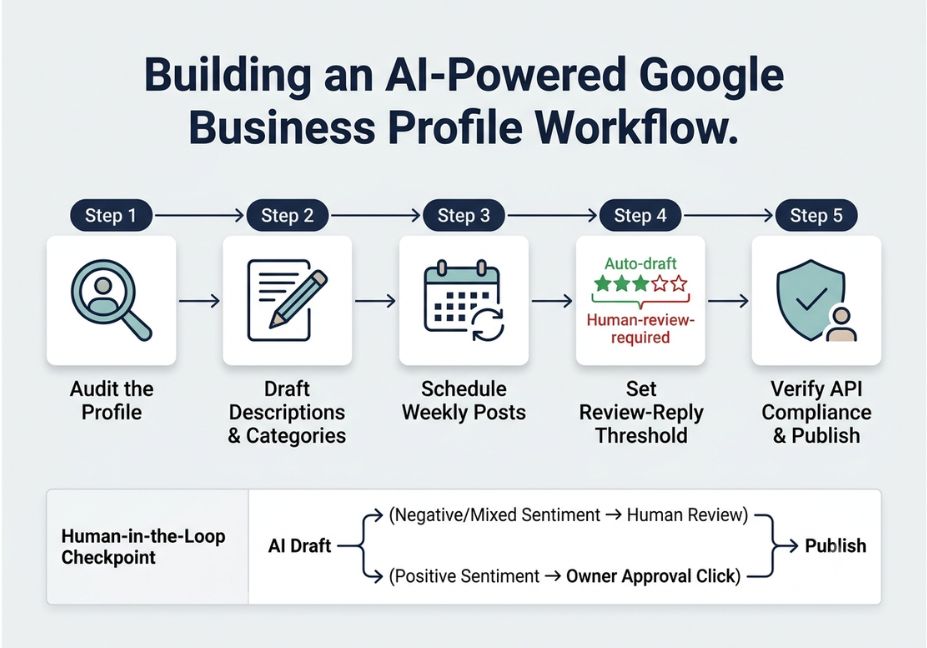
- High-review-volume brands: triaging incoming reviews by sentiment, so a human only has to hand-write replies to the negative and mixed ones, while routine five-star replies get a fast, on-brand draft.
How Do You Build an AI Workflow for Google Business Profile Optimization?
- Audit first. Run the profile through an AI-assisted audit either native GBP suggestions or a platform like Semrush to find missing fields before generating anything new.
- Draft the foundation. Use an LLM to write category-aligned service descriptions and a first-pass Q&A list. Narrow, specific categories consistently outperform broad ones for ranking power.
- Schedule the recurring work. Draft four weeks of Google Posts in one session, so the profile stays active without daily effort.
- Set the review-reply threshold. Auto-draft replies for every review, but require manual approval on anything below four stars.
- Check the API terms before automating publishing. If you’re connecting any tool programmatically, Google’s Business Profile API policies (developers.google.com/my-business/content/policies) explicitly prohibit automating review replies, Q&As, or listing edits without the account owner’s specific, express consent. This applies to your own scripts just as much as to third-party tools.
# Simplified example: sentiment-gated review reply drafting
def handle_review(review):
    sentiment = classify_sentiment(review.text)   # LLM call
    draft = generate_reply(review.text, brand_voice)
    if sentiment in ("negative", "mixed") or review.rating <= 3:
        queue_for_human_review(draft)              # human-in-the-loop
    else:
        publish_with_owner_approval(draft)          # still requires a click
What Mistakes Should You Avoid When Using AI on Your Google Business Profile?
- Letting the agent publish reviews or fabricate details. Google’s updated 2026 content policy permits AI-assisted drafting of posts, descriptions, and replies. However, it prohibits AI-generated reviews, AI Q&A answers posed as a real customer, and any content that invents services or awards. Enforcement is automated, and it bulk-removes clustered, similar-sounding text across profiles.
- Treating the tool as a growth strategy instead of a time-saver. AI tools speed up the writing-heavy and repetitive parts of GBP management, but they don’t answer the phone call, message, or quote request the profile actually generates. Because of this, a polished, AI-optimized listing that drives ten enquiries a week is worth nothing if half go unanswered.
- Skipping ground-truth checks. AI can’t verify your Saturday hours are correct or that you genuinely serve a given suburb. If you get that wrong, even the best-written description won’t save you.
- Ignoring Google’s own generative AI content guidance (developers.google.com/search/docs/fundamentals/using-gen-ai-content). This guidance draws a clear line between AI-assisted, quality-reviewed content and scaled, low-effort content generated to manipulate rankings. The latter falls under the spam policy, regardless of which tool produced it.
What Are AI-Powered Search Engines (Gemini, SGE) Changing About GBP?
Google’s Search Generative Experience (SGE) and Gemini now pull directly from your profile, posts, and reviews to answer conversational queries in Google Maps’ “Ask Maps” feature. In short, your profile is increasingly parsed by a language model rather than read by a human. That means structured, specific, grounded information not marketing copy is what gets surfaced. This is the same shift search practitioners describe as Generative Engine Optimization (GEO): optimizing not just for ranking, but for being cited as the “source material” an AI answer draws from.
What Are Practitioners Saying About AI and Google Business Profile Tools?
Local SEO practitioners on r/LocalSEO and in industry Slack groups have converged on a similar rule of thumb this year: use AI to compress the writing time, never the review time. The consistent complaint isn’t that AI-drafted content performs worse. Instead, it’s that bulk auto-publish settings, when left on, produce the kind of repetitive phrasing across locations that trips Google’s spam-detection systems.
FAQ People Also Ask
What are the best AI tools for Google Business Profile optimization in 2025?
There’s no single best tool. It depends on scale. General LLMs like ChatGPT work well for one-off content on a single profile. All-in-one platforms like Semrush and Birdeye suit multi-location brands needing continuous audits and review automation. Dedicated managers like Localith fit single-location budgets.
Can AI write Google reviews for my business?
No. Google’s content policy explicitly prohibits AI-generated reviews and any AI Q&A content posed as a real customer. Using AI to draft your replies to reviews is allowed. Using AI to generate the reviews themselves is a policy violation that can trigger profile suspension.
Does posting more often actually improve local ranking?
Regular posting is a freshness signal, not a direct ranking factor on its own. That said, GBP listings with regular posts generate roughly 12% more branded search impressions, and posts now feed directly into Google’s AI-generated Maps summaries.
Is it safe to fully automate review replies with AI?
Treat it as risky by default. Some rollouts of Google’s own AI reply suggestions still require manual approval before publishing. However, reports on bulk auto-reply behavior are inconsistent, so the safer workflow gates every reply especially negative ones through a human click before it goes live.
Is there a free AI tool for Google Business Profile optimization?
Yes. ChatGPT and Claude are both free to use for drafting descriptions, posts, and review replies, though you’ll need to copy the output into your profile manually since they don’t connect directly to GBP.
Conclusion
The AI tools worth using for Google Business Profile optimization in 2025 aren’t the ones that automate the most. Instead, they’re the ones that make the audit-draft-review loop fast without removing the human checkpoint at publish time. Pick a general LLM for one-off content, an all-in-one platform if you’re managing several locations, and keep a person approving anything that goes out under your business’s name. Bookmark this guide, and check back as Google’s AI content policy keeps evolving.