
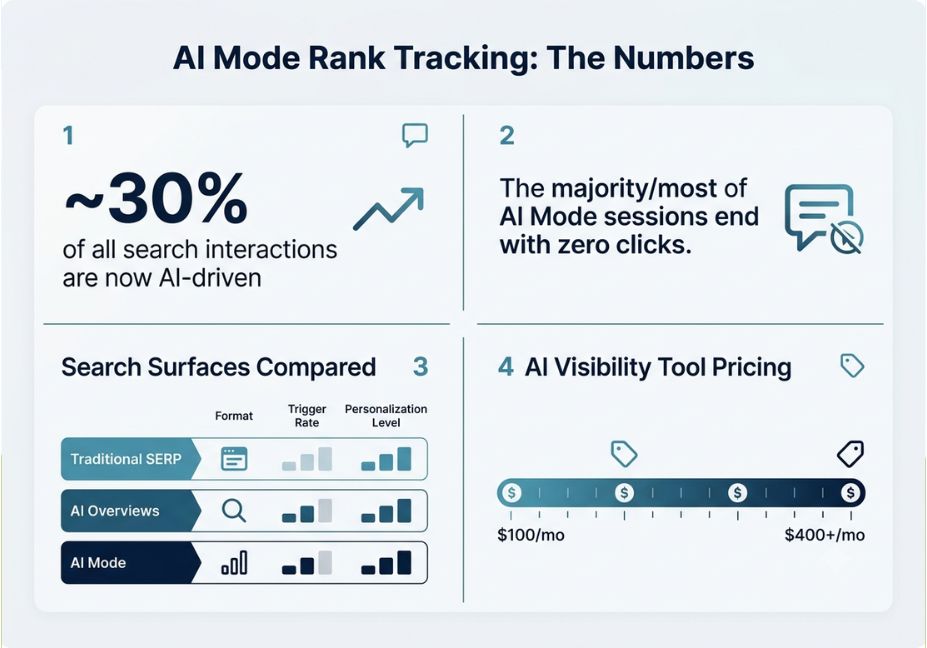
Most teams still check rankings the way they did in 2015 a keyword, a position number, a green-or-red arrow. That model breaks the moment a query triggers Google AI Mode, because there is no fixed position ten to check. The page synthesizes a conversational answer from dozens of sources, and your brand either gets cited inside that synthesis or it doesn’t. Recent estimates put AI-driven search interactions at roughly 30% of total search volume, with the large majority of AI Mode sessions ending without a single click to any website. If your content isn’t the one Gemini pulls into its answer, you’re invisible to that searcher regardless of where you’d rank in the old ten blue links.
That’s the gap AI mode search rank tracking tools exist to close. This guide breaks down how they actually work under the hood, what separates a reliable tool from a marketing dashboard, and how to build a lightweight validation check yourself before you commit budget to one.
QUICK ANSWER (snippet/voice/AI-engine box): AI mode search rank tracking tools are software that automate queries against Google AI Mode, capture the generated response, and detect whether your brand or URL is cited recording inclusion, citation order, and competitor share of voice instead of a numeric SERP position. Popular options include SE Ranking, Rankability, Rankscale, and Semrush’s AI Visibility Toolkit.
WHAT IS AI MODE RANK TRACKING?
AI Mode rank tracking is the practice of monitoring whether, where, and how often a brand or URL gets cited inside Google’s AI Mode responses. It covers a fully conversational search surface that’s distinct from the shorter AI Overviews panel, so the two need separate measurement. Unlike classic rank tracking, which records a numeric SERP position, AI Mode tracking instead records inclusion (did you appear at all), citation order, and share of voice against named competitors. For that reason, teams researching how to track AI Mode rankings usually need a different tool than the one they already use for classic keyword tracking.
Notably, Google’s own documentation on AI Overviews and AI Mode eligibility (developers.google.com/search/docs/appearance/ai-features) confirms that a page must already be indexed and eligible to appear in standard search results before it can be surfaced or cited in either feature there’s no separate technical gate, no hidden AI-specific sitemap, and no special schema requirement just for AI Mode inclusion.
HOW DO AI MODE RANK TRACKERS WORK?
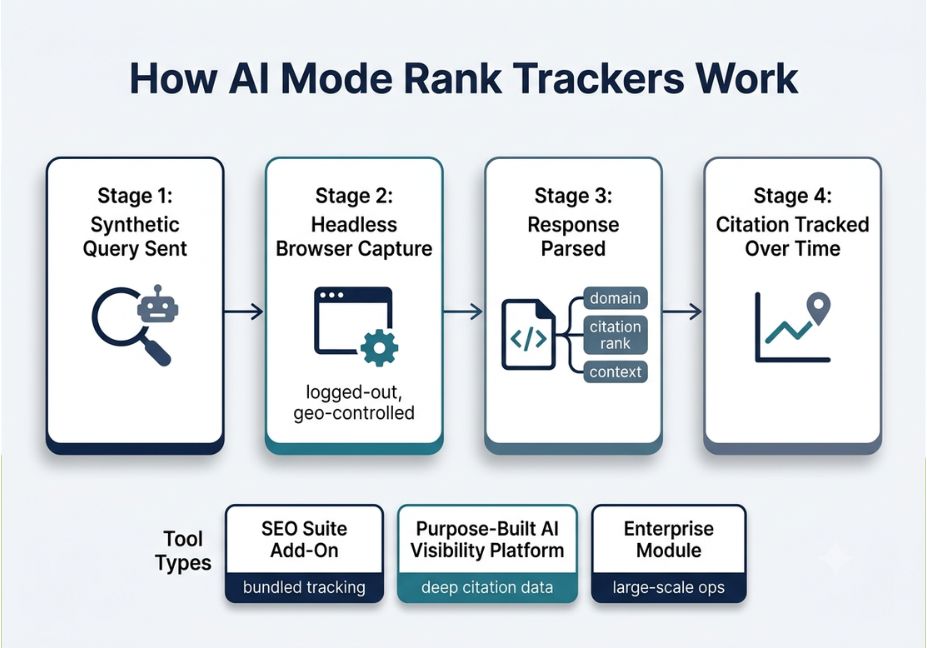
Under the hood, nearly every AI Mode tracker follows the same basic pattern: send a synthetic query into AI Mode through an automated, logged-out browser session, capture the full rendered response, then parse it for brand mentions, cited domains, and citation position.
A few architectural details separate a trustworthy tool from a noisy one:
- Headless browser execution. Because AI Mode responses are rendered client-side and vary by session, tools need an open-source browser automation framework like Playwright (github.com/microsoft/playwright) or an equivalent, run in headless mode, to trigger and capture a real response rather than relying on a static API.
- Geo and device controls. Query results shift by country, language, and device. A credible tool exposes geo-targeting settings and runs logged-out to strip out account-level personalization.
- Citation parsing. The captured HTML gets parsed into structured fields domain, URL, citation rank, and surrounding context so results are comparable across days rather than being a raw screenshot.
- Scheduling and volatility thresholds. Because responses can change response-to-response even for an identical query, single-snapshot tracking is misleading. Better tools average across repeated pulls and flag movement past a defined volatility threshold rather than every fluctuation.
Pro tip: If a vendor can’t show you their browser automation settings specifically whether queries run logged-out and how geo-location is set treat every ranking number they report with suspicion. Logged-in, single-location data is not a ranking; it’s one personalized snapshot.
Technical disclaimer: AI Mode’s rendering behavior and citation format change frequently as Google iterates on the feature. Screenshots and selectors referenced by any tracking vendor should be validated against a live query before you trust a historical trend line.
Why AI Mode Behaves Like a Retrieval Pipeline
If this pattern feels familiar, that’s because it is. AI Mode’s citation behavior mirrors retrieval-augmented generation architecture (en.wikipedia.org/wiki/Retrieval-augmented_generation) the model retrieves candidate documents first, then generates an answer grounded in what it retrieved, rather than generating purely from memorized weights. Consequently, the same failure modes that show up in RAG systems built with LangChain or LlamaIndex also show up in AI Mode: stale retrieval, low-relevance source selection, and occasional citation of a source that doesn’t fully support the generated claim. The foundational retrieval-augmented generation paper (arxiv.org/abs/2005.11401) by Lewis et al. (2020) is worth reading if you want the underlying mechanics it explains why grounding an answer in retrieved documents reduces hallucination but doesn’t eliminate it, which is exactly the citation instability AI Mode trackers are built to monitor.
AI MODE VS. AI OVERVIEWS: WHY TRACKING BOTH MATTERS
AI Overviews are the shorter, generated summaries that sometimes appear above traditional results for a subset of queries. AI Mode is a separate, full-screen conversational interface closer to Gemini than to a SERP snippet that appears across a much broader set of queries and supports multi-turn follow-ups. Because the two surfaces pull from different source-selection logic, a brand can be well-cited in one and absent from the other, so tracking only one gives an incomplete picture of AI visibility.
Comparison:
- Traditional SERP Format: 10 ranked links. Trigger rate: nearly all queries. Personalization: low.
- AI Overviews Format: short generated summary above results. Trigger rate: subset of queries. Personalization: moderate.
- AI Mode Format: full conversational, multi-turn answer. Trigger rate: broad, expanding. Personalization: high.
AI MODE RANK TRACKING USE CASES
For teams asking how to monitor brand mentions in Google AI Mode, these are the four use cases that come up most often:
- Brand visibility audits. Confirm whether your domain is cited at all for the queries that matter most to your funnel, even when you don’t hold a top-ten organic position.
- Competitor share-of-voice tracking. Measure how often a named competitor gets cited versus you across the same query set, over time.
- Content gap detection. Identify which of your existing pages get pulled into AI Mode responses most often, then reverse-engineer what made them citable.
- Post-publish validation. After shipping new content, confirm whether it starts appearing in AI Mode citations within a defined tracking window.
Because AI Mode also surfaces data from Google’s Knowledge Graph and, for local and shopping queries, Google Search Console-indexed product feeds, these audits often surface gaps that classic keyword tracking never would have flagged.
BEST AI MODE RANK TRACKING TOOLS AND FRAMEWORKS COMPARED
The category has moved fast; most entrants now bundle AI Mode alongside AI Overviews, ChatGPT, and Perplexity tracking rather than isolating Google’s feature. So, before you shortlist an AI Mode citation tracking software vendor, it helps to know the three broad patterns in the market:
- All-in-one SEO suites (e.g., SE Ranking, Semrush’s AI Visibility Toolkit) add AI Mode tracking as a module on top of an existing rank-tracking product, which is convenient if you’re already in that ecosystem but often shallower on AI-specific metrics.
- Purpose-built AI visibility platforms (e.g., Rankability, Rankscale, Profound) are built around citation and mention tracking from the ground up and tend to offer deeper competitor share-of-voice breakdowns.
- Enterprise add-on modules (e.g., BrightEdge’s AI Catalyst) fold AI Mode monitoring into a broader enterprise SEO platform, aimed at teams that already run large-scale content operations.
Comparison:
- SEO suite add-on : It is best for teams wanting one login for classic + AI tracking. Trade-off: less depth on citation-level detail.
- Purpose-built AI visibility platform : It is best for teams that need granular share-of-voice data. Trade-off: separate tool/login from your SEO stack.
- Enterprise module : It is best for large sites with existing platform contracts. Trade-off: higher cost, enterprise sales cycle.
Did you know? Independent evaluations of the category have found that AI Mode sessions end without a single outbound click in the overwhelming majority of cases — meaning citation, not click-through, is now the primary measurable outcome for a large share of AI-driven search traffic.
HOW DO YOU VALIDATE AN AI MODE TRACKER BEFORE YOU BUY?
In short, don’t take a vendor’s dashboard at face value run this check yourself first.
- Pick 5 queries your brand should realistically be cited for.
- Run each query manually in AI Mode, logged out, from your primary market, and note whether your domain appears.
- Ask the vendor to run the same 5 queries through their tool and compare results.
- Repeat from a second country to confirm geo-localization actually changes the citations returned identical output across markets is a red flag.
- Check citation parsing accuracy, not just inclusion does the tool correctly attribute the domain and position, or just flag a keyword match?
For teams comfortable writing their own lightweight checks, a minimal Python skeleton using Playwright looks like this:
from playwright.sync_api import sync_playwright

def check_ai_mode_citation(query: str, target_domain: str):
    with sync_playwright() as p:
        browser = p.chromium.launch(headless=True)
        context = browser.new_context(locale="en-US")  # set geo/locale explicitly
        page = context.new_page()
        page.goto(f"https://www.google.com/search?q={query}&udm=50")  # AI Mode param
        page.wait_for_selector("[data-attrid='AIMode']", timeout=15000)
        content = page.content()
        cited = target_domain in content
        browser.close()
        return {"query": query, "cited": cited}

result = check_ai_mode_citation("best project management software", "yoursite.com")
print(result)
This won’t replace a production-grade tracker Google’s markup shifts constantly and this needs error handling, retries, and proxy rotation to run reliably at scale but it’s enough to sanity-check a vendor’s claims against ground truth.
COMMON MISTAKES AND HOW TO AVOID THEM
- Comparing logged-in results to logged-out benchmarks. Because personalization skews citation order, always compare like for like.
- Treating a single snapshot as a trend. AI Mode responses vary run to run even for identical queries, so track averages across repeated pulls instead of one-off checks.
- Ignoring citation order. Being mentioned fourth in a synthesized answer is a very different outcome from being the first source cited, which is why this metric shouldn’t collapse into a simple “included or not” flag.
- Optimizing for AI Mode instead of fundamentals. Google’s own guidance is explicit that there are no special technical requirements to appear in AI Mode beyond standard crawlability, indexing, and content quality. Therefore, chasing AI-specific “hacks” instead of fundamentals remains a common and avoidable mistake.
FAQ PEOPLE ALSO ASK
What is the difference between AI Mode and AI Overviews rank tracking?
AI Overviews tracking monitors a short generated summary that appears above some traditional search results, while AI Mode tracking monitors a full, multi-turn conversational answer on a separate interface. They pull citations differently, so a complete AI visibility strategy tracks both.
Can you track your brand’s ranking in Google AI Mode?
Yes. Purpose-built tools run automated queries against AI Mode and parse the response for your domain, tracking whether you’re cited, in what position, and how often even when the citation doesn’t link directly to your site.
How do AI Mode rank trackers avoid personalized results?
Reliable tools run queries in logged-out, incognito-style sessions with explicit geo-location controls, which strips out account-based personalization and produces comparable results across time and markets.
Do traditional SEO rank trackers work for AI Mode?
No. Traditional trackers are built to record numeric positions in a static ten-link SERP. AI Mode returns a synthesized, dynamic answer with no fixed position list, so it requires purpose-built citation-parsing tools instead.
How much do AI Mode tracking tools cost?
Pricing varies widely by category SEO suite add-ons are often bundled into existing plans, while purpose-built AI visibility platforms commonly run from roughly $100 to $400+ per month depending on query volume and competitor tracking depth.
Is Google AI Mode replacing traditional search results?
Not entirely AI Mode currently sits alongside traditional search as a separate, optional interface, but its query coverage has been expanding, which is why tracking AI-specific visibility alongside classic rankings has become necessary rather than optional.
CONCLUSION
AI Mode rank tracking isn’t a cosmetic add-on to your existing SEO stack it measures a genuinely different outcome: citation inside a synthesized answer instead of a position on a link list. The tools that do this well share a common architecture logged-out headless browser automation, explicit geo-controls, and structured citation parsing and the ones that skip any of these three will hand you numbers you can’t trust. Before you commit to a vendor, run the five-query validation check yourself. Bookmark this guide and keep testing your AI Mode visibility as Google’s rollout continues to expand.
10 Responses