
AI Medical Mapping Tool: Why Experts Are Switching
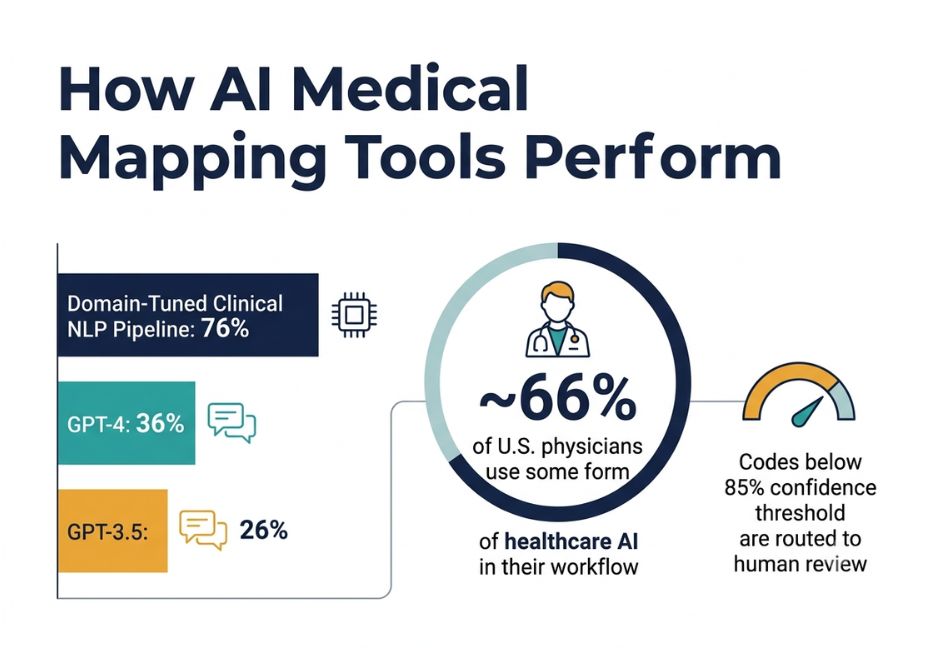
Most clinical coding pipelines don’t fail because the language model is weak. Instead, they fail because nobody designed a proper tool-use loop between extraction, terminology lookup, and human review. Physicians in the U.S. now spend a large share of their day on documentation instead of patient care. As a result, a growing share of that work gets routed through automation. In fact, recent AMA survey data puts physician adoption of some form of healthcare AI at roughly two-thirds of practitioners.
An AI medical mapping tool sits at the center of that shift. It converts free-text clinical notes into standardized ICD-10-CM and CPT codes. These are the same code sets regulated by CMS for U.S. billing and maintained internationally by the World Health Organization (WHO). Done well, the tool behaves less like a static lookup table and more like an agent. It chains together extraction, retrieval, and validation steps. Below, you’ll find how that pipeline actually works, where it breaks, and how to build one.
What Is an AI Medical Mapping Tool?
Featured snippet answer: An AI medical mapping tool is software that uses natural language processing to translate clinical notes into standardized medical codes. This includes ICD-10-CM, CPT, and SNOMED CT. Instead of a coder manually cross-referencing code books, the system extracts clinical entities. Then it resolves each one against a terminology database.
This matters because ICD-10 has a multi-axial structure (see: https://en.wikipedia.org/wiki/ICD-10), which makes rule-based matching brittle. For example, the same clinical concept can map to different codes. That depends on severity, laterality, and encounter context — exactly the kind of disambiguation modern entity-resolution models are built to handle. Consequently, organizations like AHIMA and AAPC, which certify human coders, increasingly train their members alongside AI-assisted workflows rather than in competition with them.
How Does an AI Medical Mapping Tool Work?
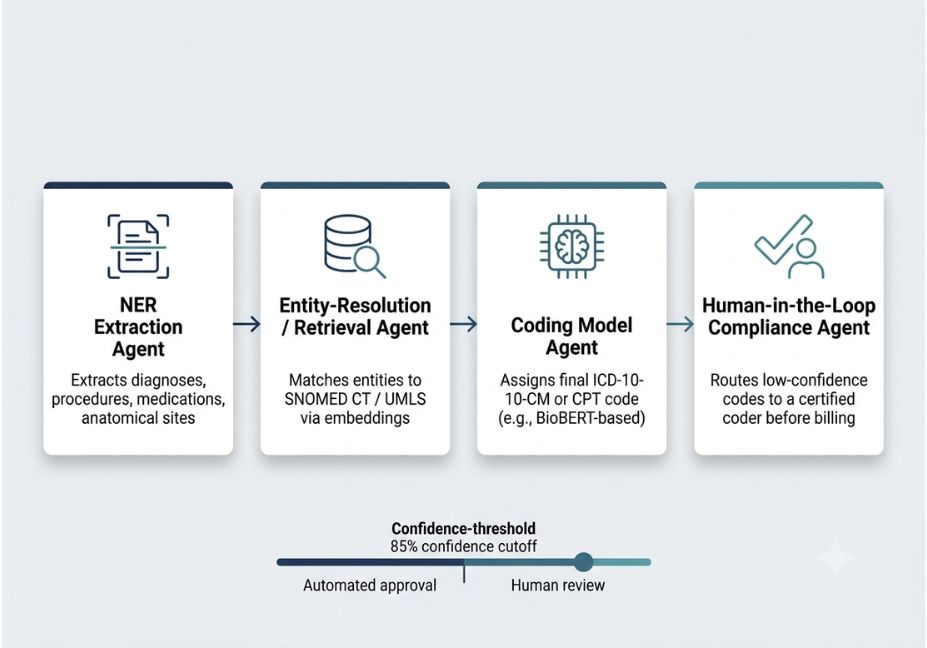
The architecture behind most production systems has four stages. Notably, it maps cleanly onto an agentic tool-use loop rather than a single model call.
- NER extraction agent pulls clinical entities out of raw text. These include diagnosis, procedure, medication, and anatomical site.
- Entity-resolution / retrieval agent matches each entity against a terminology server (UMLS, SNOMED CT) using embeddings. Often, this step uses retrieval-augmented generation. That way, it pulls in the exact coding guideline passage instead of relying on the model’s memory.
- Coding model agent assigns the final code. It’s frequently built on a domain-adapted model like BioBERT (https://huggingface.co/dmis-lab/biobert-v1.1).
- Compliance / human-in-the-loop agent flags low-confidence codes. It routes them to a certified coder before anything reaches billing. This step increasingly plugs into HL7 FHIR-based EHR systems, so flagged codes route directly into a coder’s existing worklist.
Did You Know? In a head-to-head evaluation, a domain-tuned clinical NLP pipeline hit roughly 76% success on ICD-10-CM assignment. By comparison, general-purpose GPT-3.5 and GPT-4 scored around 26% and 36%. In other words, raw LLM fluency doesn’t translate into coding accuracy without domain grounding.
That gap is the whole argument for retrieval and domain fine-tuning over a bare LLM prompt. See how entity resolution pipelines compare general-purpose LLMs against domain-tuned NLP: https://www.johnsnowlabs.com/comparing-spark-nlp-for-healthcare-and-chatgpt-in-extracting-icd10-cm-codes-from-clinical-notes/
AI Medical Mapping Tool Use Cases
- Outpatient billing acceleration auto-suggesting CPT codes as a physician finishes a note. This cuts time-to-claim.
- Retrospective chart audits batch re-coding thousands of historical encounters. This catches under-billed or misclassified claims.
- Payer-side claim validation insurers run the same models in reverse. This flags mismatched diagnosis-procedure pairs before approval.
- Clinical research cohort building maps free-text notes to standardized codes. This lets researchers query structured datasets instead of raw text.
Architect’s Note: Treat the coding model as a suggestion engine, not an autonomous decision-maker. Every production deployment we’ve seen retains a certified coder as final approver. After all, the ROI comes from speed, not from removing the human.
Best AI Tools for ICD-10 and CPT Code Mapping
| Tool | Best For | Coding Systems | Human Review Built In |
|---|---|---|---|
| SNOMED Navigator | Fast clinical-term-to-code lookup | SNOMED CT | No |
| ICDcodes.ai | AI-native ICD-10 workflows | ICD-10-CM | Yes |
| IBM Watson Health tools | Enterprise search + coding tips | CPT, ICD-10-CM, HCPCS | Partial |
| John Snow Labs Spark NLP for Healthcare | High-accuracy entity resolution at scale | ICD-10, SNOMED, RxNorm | Yes |
| 3M 360 Encompass | Hospital-grade revenue cycle coding | ICD-10-PCS, DRG/MS-DRG | Yes |
Pro Tip: If you’re prototyping rather than deploying at hospital scale, start with a smaller entity-resolution model plus a retrieval layer over your payer’s current rule set. Full fine-tuning on proprietary EHR data is rarely necessary just to validate the workflow.
Step-by-Step: How to Build an AI Medical Mapping Pipeline
- Extract entities with a clinical NER model.
- Retrieve candidate codes from a terminology index using embedding similarity.
- Rank and resolve with a domain-tuned classifier.
- Route low-confidence results to a human coder.
python
def map_clinical_note(note_text):
    entities = ner_agent.extract(note_text)          # step 1
    candidates = []
    for entity in entities:
        matches = terminology_index.retrieve(entity)  # step 2, RAG-style lookup
        best = coding_model.resolve(entity, matches)   # step 3
        candidates.append(best)

    for code in candidates:
        if code.confidence < 0.85:
            queue_for_human_review(code)               # step 4
    return candidates
Technical Disclaimer: Framework versions evolve rapidly. This example is written as of mid-2026 for illustrative purposes; check the official docs of whatever NER, retrieval, and terminology-server components you use for current APIs.
Common Mistakes and How to Avoid Them
- Treating code assignment as fully autonomous. Skipping human review on low-confidence outputs is the fastest way to trigger claim denials.
- Using a general-purpose LLM with no retrieval grounding. As the benchmark above shows, ungrounded models miscode far more often.
- Ignoring ICD-10’s multi-axial structure. A flat keyword-match approach can’t capture laterality or severity.
- Not versioning the terminology database. Payer rule sets update regularly, so a stale index silently degrades accuracy.
- Skipping ONC and HIPAA compliance review. The Office of the National Coordinator for Health IT (ONC) sets interoperability standards. Tools that ignore these requirements risk failing certification audits.
What Developers Are Saying
Developers on forums like r/MachineLearning (https://www.reddit.com/r/MachineLearning/) frequently note something interesting: clinical NLP is one of the few domains where small, fine-tuned models still beat large general-purpose LLMs on accuracy. Largely, this is because the label space of thousands of codes rewards retrieval and classification. It doesn’t reward open-ended generation.
FAQ People Also Ask
What is an AI medical mapping tool?
It’s a software system that uses NLP to convert unstructured clinical text into standardized medical codes like ICD-10-CM or CPT, reducing manual lookup time for coders and billers.
How does an AI medical mapping tool work?
It extracts clinical entities from a note, retrieves matching terminology, applies a coding model to resolve the final code, and routes low-confidence results to a human coder for review.
How accurate are AI medical coding tools?
Domain-tuned clinical NLP pipelines have reported accuracy in the mid-70% to high-90% range, generally outperforming general-purpose LLMs used without retrieval grounding.
Can AI replace human medical coders?
Not in current production deployments. Most systems flag low-confidence codes for human review, positioning AI as an accelerator rather than a replacement for certified coders.
What is the difference between ICD-10 mapping and CPT mapping?
ICD-10 mapping assigns diagnosis codes describing what condition a patient has, while CPT mapping assigns procedure codes describing what service a provider performed.
Are AI medical coding tools HIPAA compliant?
Compliance depends on the vendor’s infrastructure and contracts, not the AI model itself. Look for HIPAA-compliant hosting and a signed Business Associate Agreement (BAA) before deploying any tool on real patient data.
Conclusion
An AI medical mapping tool is only as good as its architecture. Raw LLM fluency doesn’t beat a domain-tuned, retrieval-grounded pipeline with human review built in. The winning pattern is simple: NER extraction, retrieval against a terminology server, a domain classifier, and a compliance checkpoint. That’s the same agentic tool-use loop that shows up across other production AI-agent systems. So, if you’re building or evaluating one, start small. Get a certified coder in the loop early, then scale automation once confidence scores hold up. Bookmark this guide and explore more hands-on AI agent tutorials at agentiveaiagents.com.