

AI Mode SEO Checking Tool That Beats Old SEO Hacks
An AI mode SEO checking tool tracks whether Google’s AI Mode cites your content in its generated answers. Unlike a rank tracker, it doesn’t measure position. It measures whether a passage from your page got pulled into a synthesized, multi-turn response. This is the fastest way to answer a question more developers are now asking: how do I check if my page is cited by Google AI Mode?
Most teams find out they’ve lost visibility the hard way. Organic clicks fall. Rankings haven’t moved. So what changed?
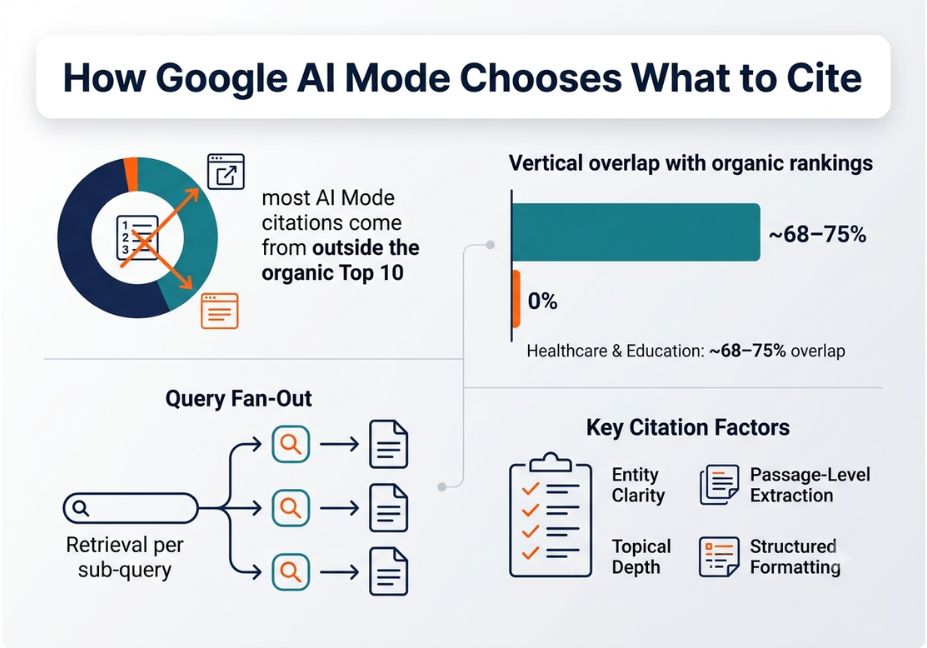
According to Moz, most AI Mode citations come from outside the traditional organic top 10. As a result, a page can rank #1 and still be invisible inside the answer itself. This is exactly why purpose-built AI Mode checking tools now sit alongside retrieval-augmented generation (RAG) evaluation and agent monitoring as standard tooling.
This guide covers how these tools work, how to evaluate one, and how to build your own using the same tool-use patterns you’d use for any retrieval agent. For background on the underlying architecture, see our guide to building agentic RAG workflows.
What Is an AI Mode SEO Checking Tool?
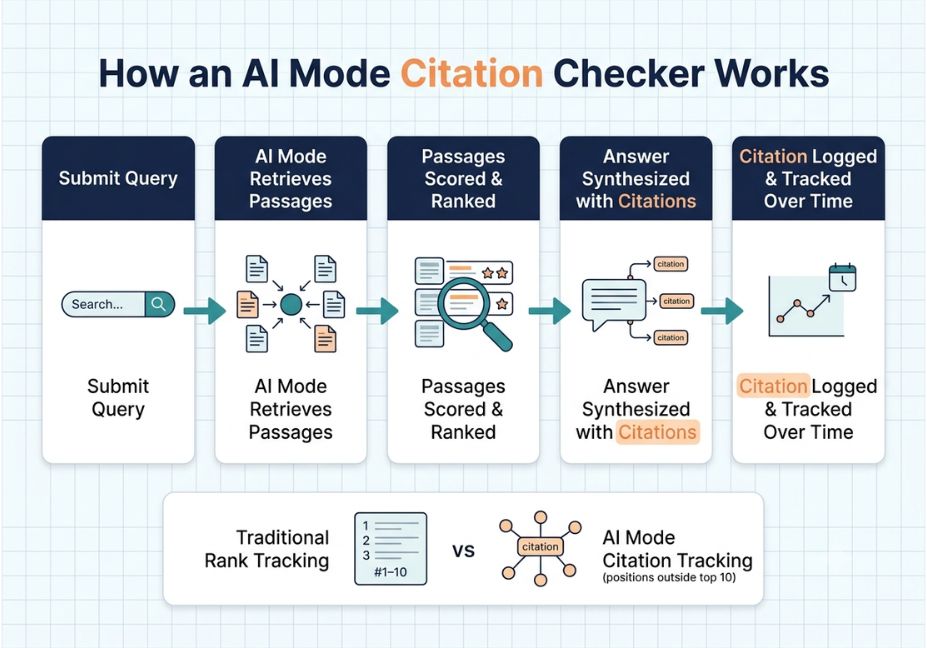
An AI mode SEO checking tool submits a query to Google’s AI Mode interface and captures the synthesized response. Then it extracts which source URLs and passages were used to support each claim. In short: it reveals citation frequency and passage-level extraction, not rank position. Under the hood, this mirrors a retrieval-augmented generation pipeline — retrieve candidate passages, ground an answer in them, and expose the citations for verification.
Voice search answer: “An AI mode SEO checking tool is a tool that checks which of your web pages Google’s AI Mode cites in its answers.”
How Does Google AI Mode Actually Decide What to Cite?
AI Mode doesn’t evaluate a page as one unit. Instead, it retrieves and scores individual passages, then assembles an answer from the best-scoring fragments across several sources. This process is closer to the ReAct-style reasoning loop used in agentic systems than to classic keyword ranking. The system reasons about what it still needs, issues another retrieval call, and repeats — much like Google’s broader shift toward entity-based understanding through its Knowledge Graph and language models like BERT and MUM.
Two mechanics matter most here:
- Query fan-out: the original query splits into several sub-queries, and each one retrieves its own set of candidate pages. Consequently, a single article rarely satisfies every sub-query on its own.
- Passage-level scoring: citation-worthiness is judged paragraph by paragraph, not page by page. Therefore, one self-contained paragraph that fully answers a sub-question can outperform a longer, more scattered article.
Did You Know? Research on AI Mode citation behavior found that healthcare and education content showed roughly 68–75% overlap with top-10 organic rankings. However, e-commerce showed almost no correlation at all — proof that vertical matters as much as content quality.
AI Mode SEO Checking Tool Use Cases 4 Real-World Examples
- Content gap detection. Run a checker against your own priority keywords to see which competitor passages get cited when yours don’t.
- GEO (Generative Engine Optimization) reporting. Track citation share across AI Mode, AI Overviews, and other LLM answer engines as a distinct KPI, separate from rank position.
- Regression alerts. Flag when a previously cited page drops out of AI Mode responses after a content or schema change.
- Competitive citation mapping. Identify which domains consistently supply the cited passage for a topic cluster this reveals where entity authority is concentrated.
Pro Tip: Match location and device parameters to your real audience when you run checks. Otherwise, you’ll miss the locale-based shifts that affect which pages AI Mode cites the same way local organic results shift by region.
What’s the Best Free Tool to Check Google AI Mode Citations?
| Tool | Primary Focus | Best For | Limitation |
|---|---|---|---|
| SEOmator AI Mode Analyzer | Single-query AI Mode response breakdown | Fast, ad-hoc citation checks | Manual, one query at a time |
| Semrush SEO Checker / Site Audit | Site-wide technical + on-page audit | Full-site technical debt | AI visibility is secondary, not the core metric |
| Seobility SEO Checker | Metadata + backlink analysis with AI-readiness flags | Small sites, quick diagnostics | Daily query caps on free tier |
| SEO Site Checkup | Multi-engine AI visibility monitoring (ChatGPT, Gemini, Perplexity, AI Overviews) | Agencies managing many domains | Paid tiers needed at scale |
| DIY agent (below) | Custom citation tracking at query-set scale | Teams wanting raw data and control | Needs engineering time to maintain |
How Do I Build My Own AI Mode Citation Checker?
You don’t need an enterprise platform to get directional data. In fact, a minimal checker is just a retrieval agent with a scraping step and a scoring function:
python
import requests
from bs4 import BeautifulSoup

def check_ai_mode_citations(query, target_domain):
    """
    Minimal AI Mode citation checker.
    Replace `fetch_ai_mode_response` with your chosen
    rendering/automation approach for Google's AI Mode surface.
    """
    response_html = fetch_ai_mode_response(query)
    soup = BeautifulSoup(response_html, "html.parser")

    citations = [a["href"] for a in soup.select("a[data-citation]")]
    cited = [url for url in citations if target_domain in url]

    return
        "query": query,
        "total_citations": len(citations),
        "domain_cited": bool(cited),
        "cited_urls": cited,


result = check_ai_mode_citations(
    "what is an ai mode seo checking tool",
    "agentiveaiagents.com"

print(result)
This mirrors an agent’s tool-calling loop: fetch, parse, extract, score, and repeat across a query set. Next, wrap this function in a scheduler with a daily diff-check, and you have a basic regression monitor the same pattern used in RAG evaluation pipelines.
Technical Note: Google changes AI Mode’s markup and rendering behavior often. So treat any scraping approach as brittle by design, and budget maintenance time accordingly. This is exactly why commercial checkers exist.
Common Mistakes to Avoid When Tracking AI Mode Visibility
- Assuming rank position predicts citation. Most AI Mode citations don’t come from the top 10. So treat citation tracking as its own metric, not a byproduct of rank.
- Writing pages instead of passages. If no single paragraph fully answers a sub-query, AI Mode has nothing self-contained to extract. Check Google’s own guidance on how generative results are grounded before assuming your formatting qualifies.
- Ignoring entity clarity. An ambiguous author or brand identity makes it harder for the system to attribute a claim with confidence. This lowers citation odds even when the content is accurate.
- Treating one check as a trend. Citation sets shift between runs. Therefore, track over a rolling window, not a single snapshot.
What Are Developers Saying About AI Mode Tracking?
On Reddit’s r/SEO and r/LocalLLaMA, a theme keeps coming up: practitioners increasingly build lightweight internal scrapers instead of trusting one vendor’s citation count. Why? Because AI Mode’s rendering and citation markup shift often enough that no single tool’s numbers should be treated as ground truth.
Technical Disclaimer
Google AI Mode’s interface, citation markup, and query fan-out behavior change frequently, and Google hasn’t published full documentation on them. So treat the code above as illustrative of the retrieval-agent pattern, not a production-ready scraper. Always check any automation approach against Google’s current terms of service.
FAQ People Also Ask
What is an AI Mode SEO checking tool?
It’s a tool that submits queries to Google AI Mode and reports which pages and passages got cited in the synthesized response separate from traditional rank tracking.
How is Google AI Mode different from AI Overviews?
AI Overviews show a static answer block above organic results. AI Mode, however, is a conversational, multi-turn interface that turns follow-up questions into new sub-queries and retrieves fresh sources for each one.
Does ranking #1 in Google guarantee an AI Mode citation?
No. Most AI Mode citations come from outside the organic top 10, so rank position alone is a weak predictor of AI Mode visibility.
Can I build my own AI Mode tracking tool?
Yes. A basic version is simply a retrieval agent: fetch the AI Mode response, parse the cited URLs, and score domain matches against a query set on a schedule.
What factors influence whether a page gets cited in AI Mode?
Entity clarity, passage-level self-containment, topical depth, and structured formatting matter more here than keyword density or raw rank position.
How do I check if my website is cited in Google AI Mode?
Run your target queries through an AI Mode checking tool, then compare the cited URLs against your own domain. For ongoing tracking, repeat this on a schedule rather than checking once.
Conclusion
An AI mode SEO checking tool answers a different question than a rank tracker: not “where do I show up,” but “did my content get pulled into the answer itself.” Prioritize passage-level clarity, track citations on a rolling basis, and don’t assume top rankings guarantee AI Mode visibility. Bookmark this guide, and explore more hands-on AI agent tutorials at agentiveaiagents.com.