

Bad students often fail their exams not because they didn’t learn material once upon a time; they fail because they didn’t retrieve their knowledge again. ChatGPT can do a fantastic job explaining a concept when asked, but a single explanation will not help a student to establish long-term memory. A randomized study conducted in 2026 about educational outcomes in Neonatology education revealed that the students who made use of digital flashcards in the course of their study scored 16.24 points out of 20 in the subsequent test, versus 11.89 points earned by those who followed a traditional approach to studying the same material.
The distinction between failure of conventional education and success of AI tools which outperform ChatGPT does not necessarily mean that the latter models are smarter but rather rely on a different mechanism in their work: capturing ideas, memory retrieval, memorization of ideas, and tests on their knowledge.
The article aims to explain the inner workings of these tools and point out the areas where ChatGPT is still better and provide recommendations for creating a study stack instead of relying on a chatbot only.
What Are AI Study Tools?
AI study tools are applications that apply retrieval practice and a spaced repetition algorithm to content a student already owns lecture recordings, PDFs, or class notes instead of answering open-ended questions from general training data.
Structurally, most combine two components: a retrieval-augmented question-answering layer grounded in the student’s own documents, and a scheduler that resurfaces material right before it’s likely to be forgotten. The underlying scheduling logic traces back to the rehearsal schedules first proposed by Pimsleur, later formalized into the spaced repetition scheduling algorithm (en.wikipedia.org/wiki/Spaced_repetition) that remains the basis of most modern implementations.
That’s a fundamentally different architecture from a chatbot that starts fresh in every session.
How Do AI Study Tools Work?
The mechanism has four stages, and each one maps to a different technical component:
- Capture : audio transcription or document ingestion (lecture recorders, PDF importers)
- Retrieval : a RAG-based Q&A layer that answers questions grounded in the student’s own material, reducing hallucination risk versus an ungrounded chatbot
- Scheduling : a spaced repetition algorithm that tracks per-item difficulty and resurfaces weak cards at increasing intervals
- Self-testing : auto-generated quizzes that force active recall instead of passive re-reading
Technical Note: Research on how active recall and spaced repetition strategies (arxiv.org/abs/2508.09494) help both humans and models learn facts at scale shows these methods consistently outperform passive repetition for durable retention this is the same principle these tools automate for students.
Here’s a simplified version of the interval logic these schedulers run on:
def next_interval(prev_interval, ease_factor, quality):
    # quality: 0-5 self-rated recall score
    if quality < 3:
        return 1  # reset — review again tomorrow
    if prev_interval == 0:
        return 1
    elif prev_interval == 1:
        return 6
    else:
        return round(prev_interval * ease_factor)
Did You Know?
A 2026 randomized controlled trial in undergraduate paediatrics found post-test scores of 16.24/20 for the spaced-repetition group versus 11.89/20 for the control group, with over 90% of intervention-group students reporting improved retention and confidence.
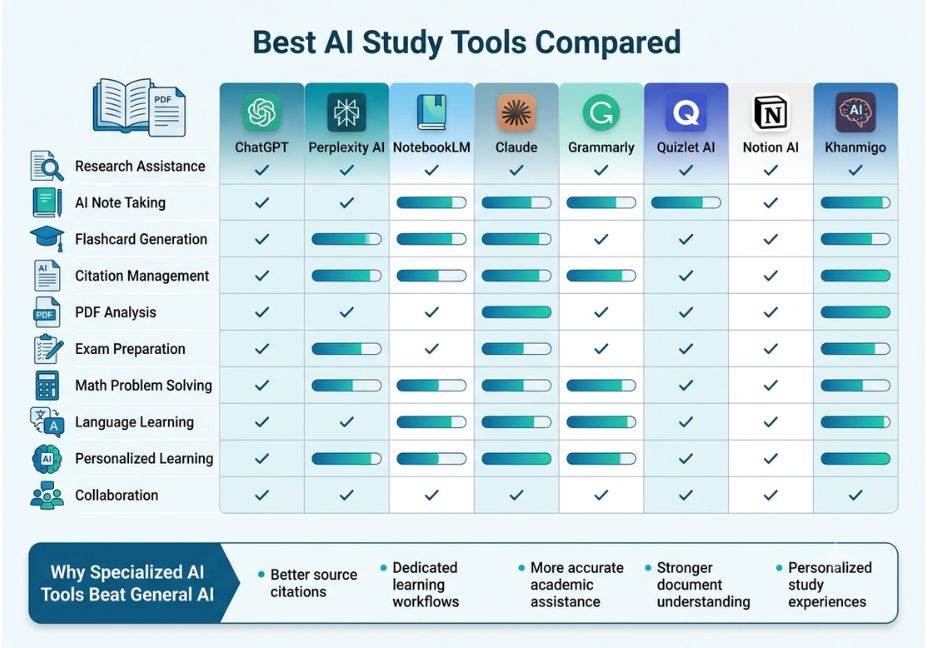
AI Study Tools Use Cases 5 Real-World Examples
- Med school pharmacology: Anki-style spaced repetition for thousands of drug facts before boards
- Research papers: citation-backed retrieval tools (Perplexity, Consensus) for literature reviews
- Lecture-heavy courses: transcription tools that turn a 2-hour lecture into a timestamped summary
- Concept-heavy subjects (economics, physics): Socratic-method AI tutoring that questions rather than answers
- Vocabulary and law cases: flashcard-first tools optimized purely for term memorization
Pro Tip: Match the tool to the task, not the other way around. Findings from a randomized trial on spaced-repetition flashcards (ncbi.nlm.nih.gov/pmc/articles/PMC12343689) in undergraduate medical education back this up directly the biggest retention gains came from scheduled review, not from any single “smarter” explanation tool.
Best AI Study Tools and Frameworks Compared
Anki Best for: long-term recall (med/law) Core mechanism: SM-2 spaced repetition, no built-in AI card generation without add-ons Free tier : Yes (desktop)
Quizlet (Q-Chat) Best for: flashcards & quizzes Core mechanism: spaced repetition + adaptive drilling Free tier : Yes
Khanmigo Best for: concept tutoring Core mechanism: Socratic-method guided questioning Free tier : Limited
NotebookLM Best for: research from your own PDFs Core mechanism: RAG-based Q&A grounded in uploaded sources Free tier : Yes
Perplexity AI Best for: cited research Core mechanism: real-time web retrieval with source citations : Free tier : Yes
Otter.ai Best for: lecture capture Core mechanism: audio transcription + summarization Free tier : Limited
This is where an open-source spaced repetition scheduler (github.com/ankitects/anki) like Anki’s is worth studying directly its difficulty-tracking logic still underlies most flashcard tools on the market today, whether or not the vendor markets it as “AI.”
Step-by-Step: How to Build Your Own AI Study Stack
- Pick a capture tool for anything you can’t re-read easily a lecture recorder if you attend live classes
- Add a retrieval-grounded Q&A tool (NotebookLM or similar) so questions are answered from your own notes, not generic training data
- Layer in a spaced-repetition scheduler for anything requiring long-term memorization pharmacology, vocabulary, case law
- Keep ChatGPT or Claude on hand for open-ended explanation when a concept genuinely isn’t clicking
- Self-test 48 hours before an exam, not the night before the interval matters more than the total review time
Architect’s Note: No single tool covers this entire loop well. Most effective students run two or three complementary tools rather than forcing one generalist chatbot to do everything.
Common Mistakes and How to Avoid Them
- Treating ChatGPT as a memorization tool it has no persistent scheduling layer, so nothing resurfaces automatically
- Accepting AI-generated flashcards without reviewing them auto-generated cards still need a human quality check
- Skipping the self-test step reading a summary is not the same as active recall, even with a great summary
- Ignoring citation accuracy always verify sources an AI tool provides, especially for research papers
What Developers and Students Are Saying
Discussion threads on r/MachineLearning and similar communities reflect a consistent pattern: practitioners increasingly treat single chatbots as one component of a workflow rather than a complete solution, mirroring how production AI agent systems combine retrieval, memory, and tool-use rather than relying on one monolithic model call.
FAQ People Also Ask
What is the best AI tool to study with besides ChatGPT?
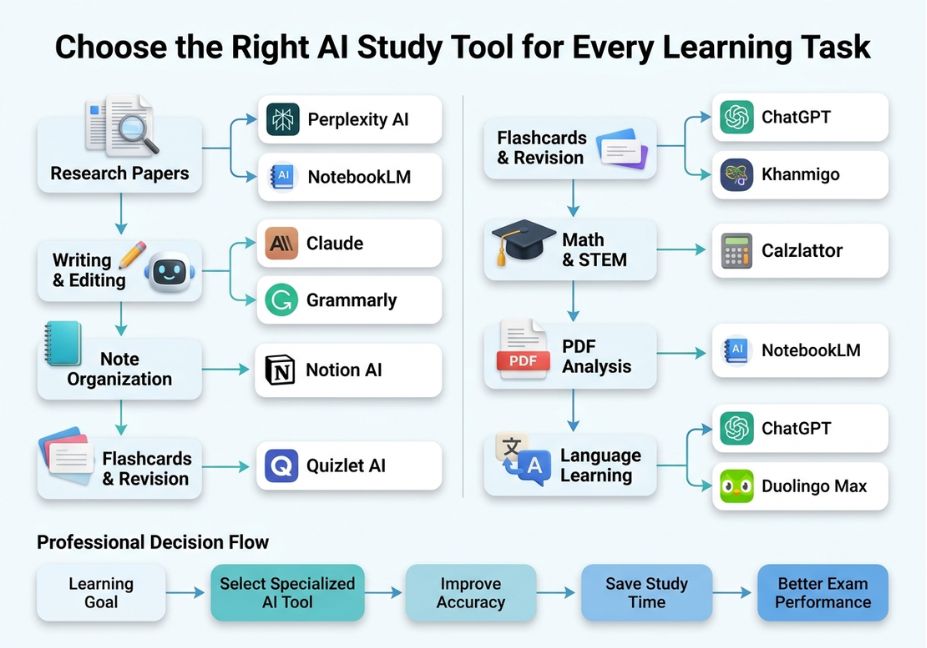
There isn’t one universal winner. NotebookLM is strongest for research grounded in your own PDFs, Anki and Quizlet lead for spaced-repetition flashcards, and Khanmigo is best for Socratic-method concept tutoring.
Why is ChatGPT not the best tool for studying?
ChatGPT excels at on-demand explanation but has no persistent scheduling layer. It doesn’t track what you got wrong last week or resurface it automatically, which is the core mechanism behind effective long-term retention.
Can AI flashcard tools replace Anki?
Not entirely. Anki’s open-source SM-2 scheduler is still considered the gold standard for long-term recall, though newer AI tools add automatic card generation that Anki lacks natively.
Are AI study tools accurate for exam prep?
Accuracy varies by tool. Retrieval-grounded tools that cite your own uploaded material tend to be more reliable than open-ended chatbots, which can occasionally produce confidently wrong answers.
Is Perplexity better than ChatGPT for research papers?
For citation-heavy academic work, yes Perplexity returns sources alongside answers, making claims easier to verify than a standard ChatGPT response without browsing enabled.
Conclusion
ChatGPT remains genuinely useful for brainstorming, essay structure, and one-off explanations. But studying is a retrieval and scheduling problem, not a conversation problem which is exactly the gap that dedicated AI study tools that are better than ChatGPT are built to close.
The most effective approach isn’t picking one winner; it’s combining a retrieval-grounded research tool, a spaced-repetition scheduler, and ChatGPT (or Claude) for the explanations that still need a generalist. Bookmark this guide and explore more hands-on AI agent tutorials at agentiveaiagents.com.
Technical Disclaimer: Tool features and pricing change frequently. Details in this article reflect publicly available information as of July 2026 always check each vendor’s current documentation before choosing a tool.